

Thanks to Dcarch, Danab, Lou and...
...all the rest of you who have posted over the years about seasoning cast iron pans.
For the first ever I have NON-STICK cast iron. I'm thrilled. They are not as beautiful yet as some that have been posted with finishes that look like polished glass, but they are glossy and NON-STICK. I now pretty much understand the concept of creating a polymerized layer by baking on the seasoning oil just below the smoke point of that oil after baking on several layers just above the smoke point.
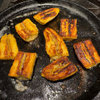
I posted on WFD a couple of days ago that I was trying to season two old cast iron skillets. They have now passed the test twice, last night for perfectly seared short ribs that just slid around the pan and tonight for rare tuna, seared plain for a very short while and then when my courage was high, brushed with a light layer of Gojuchang sauce, which has sugar and other sticky stuff, and very briefly seared again with no sticking. They were delicious, seared but not burned and totally rare inside.
Dcarch, your suggestion to add a thin film of oil to the hot pan and to also brush oil on the meat/fish worked perfectly. It didn't smoke as I had feared and cleanup was a breeze.
I like to cook in cast iron, but have mostly limited the use of my non enameled pans to roasts in the oven.
I really thought the concept of a non stick iron pan was a long perpetuated myth. As soon as we have a couple of cooler days I'm going to season a cast iron wok that I have never used and a fajita grill that always sticks.
The CF is a wondeful place!
Lee









Here is my favorite thread on that subject. I seasoned all of mine so long ago that I had forgotten how I had done it, and they have been my favorite pans for ages. I do have a very old Magnalite frying pan that I use just as much, but those have not been made for a long time. I think Caphalon makes something similar, however, but the anodized aluminum conducts heat very differently from the cast iron, and so the pans are not interchangeable.
How nice that you have a cast iron wok! I have not found one myself, although the one I have works well enough.
Lars
Lars,
Your favorite thread/article refers to some of my postings on the Chemistry of seasoning a cast iron or high carbon steel pan. The author of that linked blog article was in touch with me after she wrote her article and found out that Paul Wheaton obtained his Chemistry of seasoning and maintenance procedures from me. Below is the link to some of my writings that formed the very basis to that particular blog article re cast iron seasoning. Paul Weaton is the guy who started that particular thread.
Lee, so glad to hear you now have a non-sick cast iron pan!!
Dan
Semper Fi-cus
Here is a link that might be useful: High Temperature Seasoning of Cast Iron
Lee, it is very nice and responsible of you to give feedback to encourage more future contributions and to show appreciations.
I have to say I don't deserve your gratefulness.
I have not added to or advanced the knowledge of the science of cast iron seasoning. I mostly just applied the knowledge by reading contributions from others, especially from Dan.
Thank you Dan, not a clever Googler, but a true expert.
dcarch
Lee, aren't well seasoned cast iron pans wonderful to cook with?
My all time favorite pan is a 10 inch cast iron no-name skillet that was a gift to me in 1974, and now, with nearly 40 years of use, it's pretty much nonstick. I'm still working on that old Griswold that I got at the yard sale, but it's coming along.
Although I'm one of those people who don't care about the chemistry, I just want to know what works, not why, it's sure convenient to have all the information available. I'm constantly picking up new "tips" on how to do things faster, better or more simply and so I'm greatly appreciative to everyone who contributes, whether or not I use their method or prefer something else.
This IS a great place!
Annie
I recently posted how I had good success using the method linked by Jim in the thread that Lars linked above. (LOL did I say that right?) Dan, I understand that a lot of the knowledge stemmed from you. The one thing the author did, which I've not seen from you, is put it into a clear step-by-step.
I'd love to see you do the same. Based on Lee's original post above, it sounds like your method is slightly different than what the author has.
So how about it? If you leave out 99% of the chemistry for us laymen, surely it wouldn't take you as long to throw together as your great response to the BBQ thread yesterday! The benefit for you: Everyone (at least around here) will use your article as the bible and then you won't have to jump and take credit whenever someone references Paul or Sheryl's work!
We do all learn a lot here on the CF. At Easter I was helping to cook in my DIL's mom's kitchen. She had a beautiful glossy cast iron small frying pan on her pot rack. I commented on how great it looked and asked what she did to it and her reply was "oh I just use it a lot, it's great for eggs." She would share anything she knows with anyone who asks but seasoning her pan was just intuitive for her and she couldn't tell me more. Then I spent hours researching here and all over the net. There are some amazing and curious theories out there, such as pour some oil in the cast iron pan, heat it at 125 degrees in the oven for half an hour, wipe the excess out and put back in the oven at 225 degrees for half an hour - done! That didn't make sense to me. You just have to read and read and read and then decide what makes sense to you, and what is practical and convenient for you to do.
I know I tend to overthink things as any of you who have read my jam or breadmaking questions know. I want to know why something didn't work as well as why doing it differently should work. So I have indeed read the above linked threads several times and many more. I'm still not sure about how long is the minimum or the optimum time in the oven at the above and below the smoke point temps; I went with an hour for the first step and an hour and a half on the second step. Another piece of invaluable to me information, although I now can't say exactly where it came from, was that the finish could look spotted at first and that is what led me to repeat the first step three times, after the third heating period there were no more spots. If I hadn't read that, I would have wondered what I was doing wrong.
Lars, I bought the cast iron wok on Amazon years ago for about $15.00. At the time I had a not great coil electric stove and I thought the heat retention properties of cast iron would help (and I thought it looked nice). I never used it because I soon realized what a PITA it would be to clean. Now I feel comfortable seasoning it along with a two burner sized fajita grill that I use a lot and swear at lot when I clean it. And with my induction cooktop, the heat issues are just knowing what setting to use to not overheat the cast iron.
Dcarch, although you have not have posted on seasoning specifically, you immediately answered my question about how you quickly pan seared meat with no sticking. So you did add to my knowledge even though you may not necessarily use cast iron.
Dan, I gained the most information form you and your explanation made sense to me but in all the searching I did for your posts I never wound up with a clear idea of how long the pans need to be in the oven each time you repeat the heat in each step. Maybe I just missed that, but I would like to know if an hour to an hour and a half for each heating is overkill or just about right.
Annie, while I certainly don't understand all, or even most, of the chemistry, I do like to know why things work and I like to know that something has worked for someone whose opinion I can trust. In the end, we all make our own decisions, but when you or Ann T or Grainlady or Linda says sometime about baking bread - I know the information has worked for you. Then we get into the issues of how will it work at 5600' above sea level for me.
FOAS, I read so much, printed out some, saved some more on my computer and then made choices about how to proceed. And I had Crisco, which I have probably bought twice in 30 years, leftover from a specific recipe that I was asked to make for a family gathering recently. I'm not a fan of Crisco so this was a good way to use a little more of it. And I always have grapeseed oil.
Everything worked out, including cool weather to do this over last weekend.
Lee
Lee, I sure agree with you that Crisco works great for seasoning cast iron and I use it in exactly ONE recipe, my molasses cookie recipe which just doesn't come out right if you don't use some.
So, although my eyes glaze over and I start looking for reasons to escape when the technical explanations get longer than a couple of paragraphs, I've learned to skip over them and do "selected" eading. My alternative option would be to just not read them at all, which doesn't give me the information I prefer, which is what works, so I "speed read".
And that's what makes this such a great place. We have the people who measure everything to the grain, those who just throw stuff together, those who like the explanations of why and those who only want to know how, those who love cast iron, those who hate it and those who put sugar in the cornbread. (grin) Oh, and those who take beautiful pictures and those of us who just take pictures!
So I do appreciate dcarch and dan and everyone else who posts here, becuase even if I don't read the technical stuff, I can still glean the part about what works. And I know that they actually tried the technique and it worked, and that they didn't just do an internet search for a whole bunch of information, then copy and paste without ever trying it.
Annie
Dan, thanks for that link! I've tried to follow all of the links to your posts so that I can save some of the information for future use. I enjoy reading the technical aspects of cast iron, as they make it easier for me to remember how to do what. I have one pan that needs to be reseasoned (because I don't use it enough), and I was able to find the exact information I need to do that. You've been very generous with your knowledge!
Lars
I seasoned so many cast iron pots (some as large as 30 gallons) in my lifetime that much of what I do is second nature to me. I do vary the procedure and the seasoning oils depending upon the condition of the pot. Some of the advice I have given in some of my posts was very specific to the person who had a question about a specific cast iron pan that they had......this can can be very confusing.
For clarity of purpose I will write a step by step "universal" procedure for the seasoning and routine maintenance of cast iron. As suggested, I'll leave out the "whys" and focus just on the necessary steps. I've promised to do this before....but still haven't done it. My bad. I just hang out at the fig forums too much!!
FYI....I am a former Marine who loves to cook and am very passionate about my fig hobby......and that is the reason for my signature below. Semper "Fi"delis is a Marine's way of life. And "Ficus" is a fig tree. Merge the two and wala.......Semper Fi-cus!! And I am a retired chemist who DOES NOT leave chemistry out of any of my cooking activites......even with his BBQ!!
Dan
Semper Fi-cus
Thank you very much Dan, I would love a universal procedure and I fully appreciate how much time and effort goes into writing a tutorial like that. However, I hope you do add in at least some of the whys. There are all kinds of people here and many with math and physical science backgrounds who would like to know at least some of the "whys". I may not understand all of the theory but I always want to try, to look up explanations, to have some idea of why something will or will not work.
We all learn and do in different ways and we will take what we need from any post and leave what is not meaningful to us individually.
I'll be looking forward to your next post.
Lee
I am very interested in whys.
I think it's good to have an idea as to "why" things work, in case your litlle kids asks,"Mom/Dad, I understand you have to season a burger, but why do you have to season a frying pan?"
dcarch
Sure the science is interesting. It's also already out there in various threads. Yes, it would be great to have all the information bundled together in one spot (similar to Sheryl's blog), but I imagine that would take a lot of work. So I just asked for the one piece we seem to be missing.
Lee:
I have been seasoning my Pizza Pans and Cast Iron in the oven since 1962.
One thing I always do is to make sure the Skillet is hot before I put in any oil,
to cook a Steak or Burger.
When done I wash them with a cloth ( no scouring )and
lay on a thin film of oil.
Set it on the Range for about 10 minutes.
Now it is ready for the next Steak.
I may have repeated myself. Don-t get old !!!
Have a good one.
LOU
Thanks Lou, What material are your pizza pans made of? I know they've worked well for you in your restaurant?
Lee
Lee:
In the Pizzeria I had 100, they were Steel.
Now I do not have too many. The round are Steel and so are the Sicialian size.
Think I told you the story , about my wife and SIL,
cleaning all the Pizza Pans.
They got them all shiny and new looking. Thanks !!!
I had to season them all over again.
LOU
Dcarch, I'd give an explanation that a child could understand: "Because it makes the pan more slippery and food won't stick to it so much".
OK, never mind, I give up. Give technical and scientific explanations by the page. I'll go cook something and leave you all to discuss polymers or something. (grin)
Annie
I really appreciate Dan's detailed explanations, for two main reasons:
1) If you google "seasoning cast iron" you will get a wide variety of conflicting advice about how to do it.
2) In my previous life, I did chemical engineering....
One of my grandmother's left school after 4th grade. She wouldn't know a polymer from a saturated fat....but her cast iron was slick as....well you know.
She just said...."cook in it....fry stuff" when I asked what to do with my new cast iron fry pan...and she said never use soap on the pans.
At first a raw pan makes for some bad eggs and the pork chops are not a lot better....but after cooking a fair amount of bacon, eventually the pan develops a slick seasoned coating, and it just keeps getting better.
I understand about poly unsaturated oils polymerizing and forming that lovely slick coat on a cast iron pan....but what about people like my grandmother and great grand mothers who never cooked with anything but bacon fat and lard....with perhaps a little chicken fat for good measure. How did those old lovely seasoned pans get that way? I think the only vegetable fat my grandmother used at all was Spry....which as I remember was part lard....and later Crisco....but that was always suspect....as it wasn't lard!
How did that happen?
Linda C
Linda, while polymerization of unsaturates is the PRIMARY way seasoning is formed....there is another lesser known (on the Internet) mechanism. When SATURATED fats are heated to the smoking point they will undergo THERMAL cracking chemical reactions. These cracking reactions will then form or create unsaturated molecules that will in turn undergo those same polymerization reactions. These reactions, however, will tie up nearly pure carbon into the polymer matrix that is formed. The polymers thus formed are not the same as what is formed when using Grapeseed oil. Grapeseed oil has a VERY LOW carbon residue content. Because of the added "carbon" into the polymer matrix those polymers formed when using lard will not be PLANER in their orientation. "Planer" polymers (Grapeseed oil) are much stronger and slicker. You want polymers to be planer in their orientation.....and that is why I REALLY STRESS the point to ALWAYS use "LIGHT" layers of oil when you are seasoning your pan. You WILL NOT speed up the seasoning process by applying more oil in each seasoning cycle.
FYI.....there is also a benefit to seasoning cast iron with low smoke point "saturated" fats like lard (purchased lard is better) or Crisco. When the thermal cracking occurs this chemical reaction leaves behind what is known in organic chemistry as "carbon residue". The carbon residue content of petroleum oil and animal fats & oils is a CHEMICAL property of the oil and it varies with the chemical composition of the oil or fat. It is a very important chemical property and it is measured by a specific analytical test procedure. It is important in the overall classification of oils and gives certain information about the higher molecular weight molecules contained in the oil.
Adding carbon residue (i.e using lard or Crisco) is sometimes useful when seasoning a pan which was formed using modern day coarse sand molds......like the one's made by Lodge. Cast iron produced by Lodge is very "rough" because it was cast in a sand (not clay) mold and because it was not machined polished as the cast iron pans of old.
Sooo.....you sure can season a pan with both lard and/or Crisco.....or perhaps just wait for it to develop over time thru usage like your grandma did. But why wait???? Use grapeseed oil and you can get to initial non-stick a whole lot faster. Then you get to build upon that solid non stick base through continued use of the pan......that is if you maintain it properly.
There is a lot more detail that I can get into on this particular subject. I could write a chapter in a book on this topic. However, I'm afraid it would be too confusing for some. I've touched on carbon residue in the link I posted above and it was confusing to some people based on the emails that I received.
The procedure that I will eventually write will work just fine 90% of the time for most people.....that is, if people follow the procedure EXACTLY how I will write it. For instance... when I say clean your pan with Bar Keepers Friend....I mean it. When I say to use "purchased" lard...I mean to use the stuff you buy in a super market and not rendered bacon fat. When I say dry your pan on a burner before storage......I mean exactly what I've written......because there are very specific and sometimes technical reasons why I will put that particular step in the procedure. I've written many hundreds of very complex and technical procedures in my former career and I do not put extra steps in just for the fun of it. I'll post when I am satisfied with what I consider to be the best (simple) procedure for most cases.
Dan
Semper Fi-cus
Problem with good scientists is that they can't write, and problem with good writers is that they hate science.
You sir, Dan, are a great scientist with exceptional writing skills.
I took a 10-credit course in "Chemical Equilibrium and Qualitative Analysis", I am in full understanding of your emphasis on following EXACT procedure.
dcarch
Hi Dan:
I will second all that Dcarch said, except I do not have the 10 credit course.
But I have do a 10 credit course in experience, in many things.
Like the old saying " Jack of all trades, Master of none"
I have worked in many trades and became proficient in them
I appreciate all of your input.
Hope all the others will do the same.
LOU
Thanks guys.
Those who bake seem to understand the importance of correct sequence and following an EXACT procedure more so than those who are only cook!!! In cooking you can get by with a lot of changes and ad libbing in a recipe.....not so much so with baking. Those trained in the sciences know how important it is sometimes to follow procedures as written so that the results are predictable and can be duplicated over and over again.
Dan
Semper Fi-cus
DAN :
Thanks again.
Another reason I am glad you put in the Scientific explainations is ,
I put in the way I seasoned the Pans and Cast Iron,
about 3 years ago.
I explained the the carbonization.
It was not recieved too well, with comments like,
" the oil will turn Rancid "
So I just gave up on it.
LOU