



|
| to refinish the banister in the home I grew up in. I have refinished furniture before and done a good job. I researched the project before I got started, and the results have been so poor I'm on my second try.
object: The banister is almost 50 yrs old, made of oak, was professionally stained a walnut color (like the oak floors) about 25 years ago, that faded with use. goal: To have a nice walnut color, protect the wood, and achieve a soft hand feel to the banister. problem: The finish is sticky, and the color not as smooth as I'd like. method: For the second attempt, I removed the finish with denatured alcohol and 0000 steel wool, sanded with 220 grit paper, used a tack cloth to remove dust, then applied Minwax pre-stain wood conditioner, allowed it to dry for 1 hour, then Minwax Wood Finish in Dark Walnut (oil-based wood stain), wiped it 2X, let the banister dry overnight (16 hours), then applied Formby's Tung Oil Finish Low Gloss (store didn't have Waterlocks), wiped it off, then let dry 18 hours. The banister doesn't feel right in my hand. Formby's says to let the finish dry completely, buff with steel wool and re-apply to build sheen. Will that improve anything? questions: Is this ever going to look and feel right? What should I have done? What can I do now - must I begin again? The Minwax fumes are killing me - I don't think I can stain with that stuff again. This banister almost killed me once when I was a kid. I should have known to leave it alone. Thanks for your help. |
Follow-Up Postings:
|
| Prestain conditioner is designed for use on virgin(unstained) wood---was not necessary to use. It is always necessary to wipe the surface after the oil stain has dried, there are usually always extra particles that need to be removed. And a light hand sanding is usually necessary after stains have dried. Finishes are finicky. And finish manufacturers are very often less than truthful about their products until you get deep into the fine print. I've never used the product you used (Formbys) simply because I learned a long time ago there are much better finishes---they are just hohum normal stuff like varnish or lacquer. Or even shellac. And shelf life has a HUGE impact on the viability of most finishes. It sounds like the actual container of finish was way over the expiration date. If it is, do not use it again as it will just compound the problem. You should be able to get the finish off fairly easily with whatever is the base for the finish---alcohol/thinner/etc.---since it sounds like it is not drying. I'd use a wiping varnish---lacquer feels better to me, but the fumes require a filter half face(or more) respirator. Just get the product from a real paint store and not a hardware/home improvement store. |
|
- Posted by bobsmyuncle (My Page) on Thu, Oct 11, 12 at 18:00
| I see a few problems: While your stair treads look like oak, your banister does not. And it looks like some stain, sometime, has blotched. Unless the finish was shellac, denatured alcohol will not remove it. DNA might have some effect on lacquer of that vintage. But if the rails were done the same time as the stair treads / floor, it's probably a varnish. Banisters are also a good place to attract body oils from use. That can soften many finishes and putting new finish over soft finish -> soft finish. Body oils also build up that might affect later finishes unless scrupulously cleaned. And if this is your second attempt, what was your first?? Contrary to directions, it works best if left to dry overnight. But if you have not removed the old finish, it probably didn't do any good, as it was not getting into the raw wood. Normally, this is good. A common cause of "sticky" finish is to not wipe off enough of the stain (which happens to be called Wood Finish, another misleading label.) But again, this product is meant to be applied to raw wood, which you may not have and thus just ended up sitting on top of what was there and didn't cure properly. With the situation as described, it's hard to say. One coat of wiping varnish is quite minimal. It's equivalent to about 1/3 a coat of finish. Air movement and adequate temperature are needed for these finishes to cure properly, that they do by absorbing oxygen and polymerizing. I would give it a few more days then try some more Formby's. It may not work, but it's worth a try. Stain is meant for raw wood. That train has already left. If you didn't get off all the original finish, it didn't even stop at the depot. Worst case scenario: |
Here is a link that might be useful: Tung Oil Finish
|
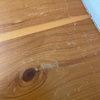
| Thank you both. Handy, it never occurred to me this stuff could be out of date. Bob - I was hoping you'd chime in. I've read a lot of your posts on tung oil - after the fact. I'm embarrassed to say my first attempt was a light sanding followed by stain followed by polyurethane. It was hugely blotchy, just awful. I thought the poly might even it out. I then sanded down to raw wood but not everywhere. I started worrying about taking off too much wood, and I did a horrible job on the round bits at the base, so I switched to a finer paper surface sanding and moved on to round 2 which, as you know, has also not gone well. The ugliest part is the part I did take down to raw wood shown in the images above. So the new plan is: wait and see, then do it right. Out of curiosity, what type of wood do you think I have? There are occasional dark bits, as at the base, that could drive a lesser woman to distraction... |
|
- Posted by sombreuil_mongrel (My Page) on Thu, Oct 11, 12 at 20:08
| Looks like hemlock. Finish problems because stain probably did not have time to cure. Always use fresh materials. Casey |
|
- Posted by bobsmyuncle (My Page) on Thu, Oct 11, 12 at 22:31
| Rats, I wrote a big response and it disappeared :-( |
|
- Posted by bobsmyuncle (My Page) on Fri, Oct 12, 12 at 16:31
| Rats, I wrote a big response and it disappeared :-( |
|
| I still prefer water based aniline dye and brushing lacquer (Deft 'clear wood finish). it takes a few coats to build, but unlike polyurethane and varnish the coats melt into each other. If you use the gloss you can reduce the sheen to any level you want. |
|
| casey - hemlock would explain a lot. Is there any way to know items are fresh? They don't seem to have expiration dates on them. bob - thanks for trying. brick - I looked up aniline dye and found a product called "Trans Tint Dyes" at the link below. Is this what you mean? What is the proper way to prepare the wood for this - strip, sand, stain? Do I need a wood conditioner to prevent blotchiness? Can you recommend a lacquer for me? Thanks |
Here is a link that might be useful: Dyes
Please Note: Only registered members are able to post messages to this forum. If you are a member, please log in. If you aren't yet a member, join now!
Return to the Woodworking Forum
Instructions
- You must be a registered member and logged in to post messages on our forums.
- Posting is a two-step process. Once you have composed your message, you will be taken to the preview page. You will then have a chance to review the contents and make changes.
- After posting your message, you may need to refresh the forum page in order to see it.
- It is illegal to post copyrighted material without the owner's consent.
- HTML codes are allowed in the message field only.
- No advertising is allowed in any of the forums.
- If you would like to practice posting or uploading photos, please visit our Test forum.
- If you need assistance, please Contact Us and we will be happy to help.