

|
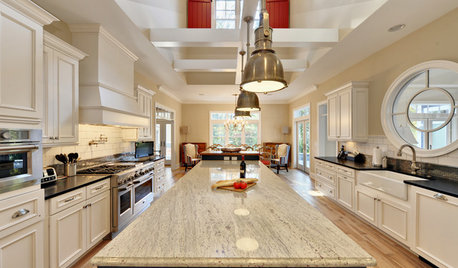
| I'm planning on using some of my countertop granite to have a table top made. The table will be about 60"x36", and abut the island. It will not be attached to the island, just sit next to it.
The supporting table will be cherry. I'm contemplating buying one of the table base kits from someone like tablelegs.com, but not sure whether they strong and stiff enough for a granite top. This is 2cm granite, with the edge laminated to make 4cm. For the cabinets, it is installed over 5/8" plywood, so that would be my default choice for the table. How much deflection can be allowed? I've been using the "Sagulator" to calculate sag of the table apron. The plywood will provide a small amount of additional stiffness, as will the granite itself, but I'm not including those. Any other good construction suggestions would be appreciated. Gary
|
Here is a link that might be useful: Sag calculator
Follow-Up Postings:
|
| "How much deflection can be allowed? " Basically zero. |
|
| "Basically zero" Depending on ones definition of "basically," nobody would have any granite counter tops if that were true. Certainly true for my definition of zero. Basically zero is the value of your comment. |
|
| That is why you do not see a lot of wood framed tables with granite tops. Even cabinets with sides all the way to the floor exhibit essentially zero deflection under load. Stone is a brittle material, and cannot survive significant movement in its support. You would likely require massive hardwood aprons (think both thick and tall) or metal under structure (think how a large fish tank is supported). Why do you think the overhangs for granite counter tops are so small? Metal rods cut into the underside or other metal supports are often required past about 12 inches (or less depending on the exact type of stone). The longest counter dimension with 3 cm granite that is not supported is a DW, 24 inches wide.
|
|
| Apron height helps a lot (doubling decreases deflection by 8x), but to be able to sit at the table, one needs to get one's legs under there, which limits apron height to about the typical 4" for a 29" leg. Doubling the width of the apron only decreases deflection by a factor of 2. A fifth leg near the center of this size of table would stiffen it considerably. Metal is surprisingly bendy, such that adding angle iron to the aprons would not have enough effect to bother. I may have to go to a glass top over wood instead of granite slab. |
|
| Now you know why you do not see a lot of stone slab tables. You have to pick the correct metal shape. You are incorrect about iron. When chosen and used appropriately is will significantly stiffen wood. A piece of angle wrapping around the inside to the bottom edge would also add significant strength, as would just a flat strip on the bottom of the apron for its length. A huge amount of flitch beam performance comes down to hole size in the metal matching screw shank diameter tightly, and enough screws and resulting bearing area to make the two material behave as a single unit and the wood does not crush under loading at the screws. The screws limit buckling of the metal away form the wood so it stays flat in place with very little deflection for the composite assembly. Angle are channel (open side down) are common since they have the vertical dimension required to get decent strength. Just like strapping the bottom of joists with 1/8 in steel strap (plenty of flex there) stiffens the joists greatly The method relies on the fact that the bottom of the joist MUST get longer as the joists sag allowing even a floppy piece of 1/8 thick x 1.5 in wide strap 12 feet long on the bottom of the joist to stiffen it very significantly (the same as putting a huge wooden lip on the bottom of the joist) |
|
| Any suggestions on how to closely size (barely interference) the screws and holes for the added metal plate/angle? If not readily done, is there some sort of tapering ring that would fit inside the hole, to provide a compression fit as the screw is tightened? |
|
| "Any suggestions on how to closely size (barely interference) the screws and holes for the added metal plate/angle? " Use number size drill bits that match the screw shank. Remember the hole is ALWAYS a few thousandths over the bit size. You might even need to try metric bits. The most accurate holes are reamed after drilling them as close as possible (but still undersized). |
|
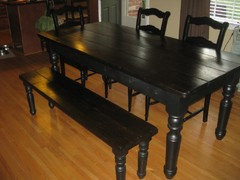
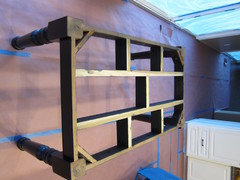
| I've decided to just go with wood to beef up the aprons on the long sides. This gets the deflection to under L/1300 with me standing on the center of one edge, which I don't intend to do and hope that nobody else does. I will also add a third rail longways, teed off the two shorter apron sides, 1-5/8" wide x 4" high. I'll also put some blocking in the short direction at a couple of locations. For beefing up the aprons -- is it best to just glue the extra board to the inside of the existing apron, or should I also screw it? I'm using the legs in the link. My table will be a foot shorter and and inch narrower than the one in the link. Cherry, stained almost black. |
Here is a link that might be useful: Table with Portsmouth legs from Osborne Wood
|
| "For beefing up the aprons -- is it best to just glue the extra board to the inside of the existing apron, or should I also screw it? " Make sure you use a glue that will not exhibit creep. ALL the polyvinyl acetate glues have creep. Elmer's, Titebond (in all it grades). You need a resorcinol glue or hide glue (even the liquid hide glue). |
|
| Thanks for the clue on glues -- I hadn't realized the creep issue. Makes for interesting reading. |
|
| The Osborne base also uses a screw to help draw it into the mortise/tenon joints -- pocket hole in apron, screw into the leg. The wood corner braces have screws into apron, and an anchor bolt from leg. They don't say to also glue the braces, but I'm considering doing that. Should I peg the mortise / tenon joints, or is the improvement not worth the risk of splitting a tenon? |
|
| I went with just adding two longwise rails (1.625"x4", 54" long), plus some cross bracing. Still to be added is 5/8" plywood, then the 3'x5' granite slab. Worst case is that I sit on the edge of the long side, but still should be less than L/1300 deflection. Standing in the middle will give less than L/2000. |
This post was edited by attofarad on Wed, Mar 27, 13 at 13:02
Please Note: Only registered members are able to post messages to this forum. If you are a member, please log in. If you aren't yet a member, join now!
Return to the Woodworking Forum
Instructions
- You must be a registered member and logged in to post messages on our forums.
- Posting is a two-step process. Once you have composed your message, you will be taken to the preview page. You will then have a chance to review the contents and make changes.
- After posting your message, you may need to refresh the forum page in order to see it.
- It is illegal to post copyrighted material without the owner's consent.
- HTML codes are allowed in the message field only.
- No advertising is allowed in any of the forums.
- If you would like to practice posting or uploading photos, please visit our Test forum.
- If you need assistance, please Contact Us and we will be happy to help.