


Return to the Woodworking Forum
| Post a Follow-Up
removing john boos 'varnique' finish
| | |
Posted by
mally (
My Page) on
Mon, Jul 31, 06 at 22:35
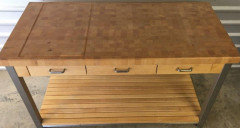
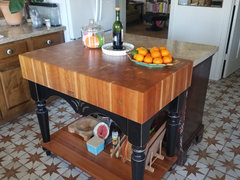
| I just purchased a John Boos butcher block work table, after being told that it has an oil finish, come to find out it has a "varnique" finish. (Boos is using a "varnique" finish for a lot of their butcher blocks.) I believe that this is similar to a wipe-on finish, combining oil and varnish, though in what proportions I don't know. I've been told that this finish can be sanded off fairly easily, and an oil finish applied. Does anyone have any information about this? |
Follow-Up Postings:
RE: removing john boos 'varnique' finish
| | |
| Many finishes sold as "oil finishes" are, in fact, oil/varnish mixes, so don't waste your time unless you're sure that what you want to apply is substantially different than what's already there. I'm not familiar with the finish that Boos uses and can't comment on how hard it is to remove, but the rumor of easy sandability sounds believable. |
RE: removing john boos 'varnique' finish
| | |
| As Jon mentioned many finishes are combination of oil and varnish. Behlen's "Salad Bowl" finish comes to mind as an example. Why do you want to remove the old finish? Mike |
RE: removing john boos 'varnique' finish
| | |
| I'm just beginning to understand something about finishes. Butcher blocks (boards and tops) generally have an oil finish: you renew it by rubbing in more oil (food safe oil, no varnish). these surfaces can be used for food preparation including cutting, which is what I want to do. The Varnique finish is a harder, shinier, finish, that you cannot cut on, as it would ruin both your knives and the top. Boos also says that you should not put glasses filled with water, etc, on the top as these will also ruin the finish. If you tried to put oil on this top now, it would just sit on the surface. Boos says these tops can be renewed with their "EZ-DO Wipe on polyurethane gel." no further description. I have the opportunity now to exchange the table for one that has an oil finish. The only reason I hesitate is that the one I have has some desirable features that I would not get on the oil-finished table. Also it's nice to have the legs, drawers and lower shelves finished with a harder finish than oil; only the top needs the oil finish. So, I could continue with the table I have, but I would put glasses and wet objects on it, pretty much using it as a food prep table, but not cut directly on it. At some point, I would probably want to sand the Varnique finish off the top. That's why I'm asking if it could be sanded off fairly easily. I'm also wondering how the varnique finish would look after I've used it a while like this, and before sanding. Any comments would be greatly appreciated. |
RE: removing john boos 'varnique' finish
| | |
| It sounds like you're dealing with a fairly typical synthetic wiping varnish, though I doubt that cutting on it will damage your knives. Pretty much any finish will be damaged by cutting on it. The finish you've got may not be certified as officially food-safe, but safety is very unlikely to be a serious problem with it. The bigger problem would probably be appearance, because regularly wiping on more coats of the stuff would rapidly build a thick, plasticy film in some places while tending to stay worn down and dull in others. Pure oil finishes are better for frequent recoating because they don't contain the resins that cause varnishes to build a film so rapidly. So yes, a pure oil finish would probably be a good choice. Yes, it's good to have the other finish on the rest of the piece for the sake of water resistance, and yes, it's likely to be fairly easy to remove the varnish you've got now with either sanding or a cabinet scraper. |
RE: removing john boos 'varnique' finish
| | |
Hi, if the underside is also finished, and if this top is less than, say, 8 inches thick, you would need to remove the finish on the bottom to make sure both sides are finished the same. Reason being that you want both sides to absorb/expel moisture at the same rate to avoid warping. Casey |
RE: removing john boos 'varnique' finish
| | |
| In theory, at least, Casey is right that having any given slab of wood finished the same on both sides is ideal. In practice there are many situations, this one included, where it won't make much difference. Factors that affect only the top side, like direct sunlight and exposure to water, pretty much eliminate your chances of having a perfectly balanced, tension-free structure anyhow. The world won't end. |
RE: removing john boos 'varnique' finish
| | |
| Just from a brief reading at Boos' website it seems to me that the "varnique" is more of a "decorative" rather than "functional" finish. In other words you need to use a cutting board just like you would with a traditional countertop. The best course of action may be to call Boos and ask for advice. I'd think the finish could be sanded off with relative ease, if that's the course of action you want to take. There's no hand applied finish that would damage a knife. Now some of the factory applied floor finishes (e.g. Pergo) are exceedingly hard but you can't touch them up at home. Mike |
RE: removing john boos 'varnique' finish
| | |
| thanks all. I've decided to keep the one I have, and take my chances with the finish. I'll let you know how it works out. |
RE: removing john boos 'varnique' finish
| | |
| Did you ever try to sand the Boos "varnique" finish? I am looking at buying one of their pieces, and I see where this could be a problem. It almost sounds like a piece of fine furniture in the kitchen. The surface would have to be more forgiving than that for my family! What did you end up doing? Rita |
RE: removing john boos 'varnique' finish
| | |
| here's how things stand almost two years later. I have used one end of the work table for cutting food and have treated pretty much the entire table as a counter top. The area where I cut shows numerous criss-cross knife marks, which are darker than the surrounding area. Other areas show dark scratches, cuts, blotches, etc. I have not yet tried thoroughly sanding the entire top. I did sand a small area and then applied butcher block oil. in this area there are still light and dark areas. the varnique finish apparently contains a stain which is lighter than the wood, and a more thorough sanding would be necessary to remove the finish. |
RE: removing john boos 'varnique' finish
| | |
| wouldn't it be wonderful if people just told you what they were using instead of making up hoo-haa names to apply a certain mystique to what is an ordinary and well-known process? If you are cutting on it, you do not want a film-forming finish as it will soon be cut through and start fracturing and letting liquid water through, accelerating peeling etc. Most "butcher block" finishes are either straight mineral oil, or mineral oil with about 10-12% paraffin wax in it. Faster and less likely to damage that starting off with a sander of some sort is to use a cabinet scraper to remove superficial damage. I did this for a lady a few years ago whose tenants cut into her pristine tops. I thought her eyes were going to pop out when she saw the bushel of shavings when she walked into the kitchen after about 15 minutes. Her husband called that evening and said they looked wonderful. |
Here is a link that might be useful: Oil Finishes
RE: removing john boos 'varnique' finish
| | |
| If it were up to me, I would probably just buy an oil finished butcher block counter top in the first place. You definitely don't want to be cutting on the varnique finish as it will scratch and may cause damage later on if water gets into it. |
Here is a link that might be useful: Butcher Block
Post a Follow-Up
Please Note: Only registered members are able to post messages to this forum. If you are a member, please log in.
If you aren't yet a member, join now!
Return to the Woodworking Forum
Instructions
- You must be a registered member and logged in to post messages on our forums.
- Posting is a two-step process. Once you have composed your message, you will be taken to the preview page. You will then have a chance to review the contents and make changes.
- After posting your message, you may need to refresh the forum page in order to see it.
- It is illegal to post copyrighted material without the owner's consent.
- HTML codes are allowed in the message field only.
- No advertising is allowed in any of the forums.
- If you would like to practice posting or uploading photos, please visit our Test forum.
- If you need assistance, please Contact Us and we will be happy to help.