




|
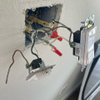
| I went to "help" my 70yr old neighbor by replacing a burnt out receptacle on her 21yr old electric cooktop. The rest of the burners work, just the one in question. She purchased the correct replacement, just needed me to install it.
She is appropriately freaked out because although I fixed everything, when I placed the top back onto the unit the incoming HOT terminal shorted against the base and mini-boom & sparks flew. The tab-terminals have 1/2" exposure and the top easily slides backward until exposed terminals hit the metal base. It's a very poor design but acceptable until yours truly forgot to flip breaker back off before re-attaching again. I assumed it tripped, but she said breaker was still in ON position. She survived, though her poor heart raced for a few minutes. The entire cooktop was functional after I was done, no visible problems. Just the scorch marks inside the unit, not visible unless unit is opened up. Anything I/she should be worried about? Other than me coming over a second time to fix something else.
Here's the problem: --> forgot to flip the breaker back OFF when I went to re-attach the top. As I set the top down, then the mini-boom & spark. The incoming HOT is exposed where it attaches to the cooktop (normal for this unit) with tab-terminals. But I set it down 1/2 inch too close to the support base. Shorted against grounded metal base and left a burn mark (not visible) on inner metal, but structurally it's fine. After letting her catch her breath, she shut off the breaker, I opened top to confirm problem, all looked OK and screwed top back down. Flipped breaker back. Everything appears to be working fine. I tested all burners individually & simultaneously on high. I removed/replaced all burner elements over a dozen times to show her it was safe. |
Follow-Up Postings:
|
- Posted by bus_driver (My Page) on Tue, Sep 20, 11 at 21:59
| Problem with terminology? You described a "surface unit". Some ranges do have receptacles for plugging in coffee makers and the like. She may never again be at ease with that range. Tell her to use it a few times and see how it works. And forget it. |
|
| I think I'm using the correct terminology. It's probably confusing because range/cooktop parts share the same term "receptacle". Here is a receptacle kit , another receptacle aka terminal block , here is a burner/element that "plugs into" the receptacle. Though your advice is probably correct, I was hoping maybe someone who has worked on these before would know if some interior components may now be "flaky" or worse yet susceptible to overload and/or fire. |
|
| Any equipment that plugs in is using a receptacle to make the connection. This is an appliance idiom, and NOT an electrical code idiom. Many older electric ranges had a 120 V convenience receptacle on them, without any additional overload protection provided. It was across a 30-40-50 amp fuse/breaker. They are no longer allowed (and should bot be repaired).
|
|
- Posted by bus_driver (My Page) on Wed, Sep 21, 11 at 21:30
| The electric ranges with a 120 volt receptacle did have an Edison base plug fuse somewhere in the range. Perhaps in the control console or under the oven accessible by pulling out the drawer. I saw the fuse in one this week. |
|
| I always thought they were banned because it was thought that the cord running over the stove was dangerous. |
|
| I don't mind filtering out non-relevant cross-talk, that's what makes threads interesting after all. But are *any* responses thus far relevant to the original question, since it was a range cooktop withOUT an electrical outlet (surface unit)? The original question was: would a one-time short from the unit's hot against the grounded metal catch tray be likely to cause any of the components to be less reliable and/or more dangerous? I can go take pictures and track down the wiring diagram if needed. |
|
| "The electric ranges with a 120 volt receptacle did have an Edison base plug fuse somewhere in the range. " Many had no additional protection. I scrapped out a 48 inch wide one a few years ago with no protection. |
|
| All of the wires in question are designed to handle a lot of power continuously though less than the maximum for the whole range. How long was the short active, less than a second? The breaker was not tripped so the heat was limited. If it were my range, I would not worry. I, however, might know less about it than you do. |
|
- Posted by weedmeister (My Page) on Thu, Sep 22, 11 at 14:57
| More dangerous? Probably not. Less reliable? Perhaps the control for that element might have been stressed a bit. Neither are anything that I would worry about. |
|
| >>> How long was the short active, less than a second? Yes, less than a second. A tiny bit longer & louder than other quick shorts I've seen on 110 lines. Probably an echo affect from that catch basin. It did however burn through the outer coating, now showing a shiny (silver?/aluminum?) metallic fleck like core. >>> If it were my range, I would not worry. OK thanks for your help. |
|
| When my cooktop element supply wires shorted it sounded like popcorn popping and the circuit breaker did not trip. It did not smell like popcorn ;-( |
|
- Posted by bus_driver (My Page) on Fri, Sep 23, 11 at 13:46
| "I scrapped out a 48 inch wide one a few years ago with no protection." Makes one wonder about UL Listings. |
|
| All of a sudden I am finding this much more interesting. In order for the UL to reject this design, there must be hazard, to person or property. If there is nothing like a fuse in the range, this outlet would only be protected by, what, a 30- or 40-amp fuse in a panel. If there is excessive current on the outlet, the outlet will heat up and melt or the wires will burn. Maybe the outlet and wires are rated for 30 or 40 amps. OTOH, maybe the level of concern is low because all of the flammable stuff is enclosed or installed in a metal chassis that will not burn. If the cable in the walls is stressed, it is protected to the level it needs to be by the panel equipment. The way I understand it, using a fuse or circuit breaker to protect the appliance or cord connected to an outlet is not the concern in the USA though it is elsewhere. You understand what I am thinking? I know that my mother acutely missed the outlet when her range was changed-out. The 1959 kitchen did not have enough circuits for her early 70s kitchen small appliances and she tended to use it for the electric griddle when making pancakes for a family of 6. |
|
| "If there is nothing like a fuse in the range, this outlet would only be protected by, what, a 30- or 40-amp fuse in a panel. " My guess would be that the high temperature insulation is more than capable of carrying enough current to trip a breaker or open the fuse. The fusing current of even #14 wire is very large (around 166 amps). |
Please Note: Only registered members are able to post messages to this forum. If you are a member, please log in. If you aren't yet a member, join now!
Return to the Electrical Wiring Forum
Instructions
- You must be a registered member and logged in to post messages on our forums.
- Posting is a two-step process. Once you have composed your message, you will be taken to the preview page. You will then have a chance to review the contents and make changes.
- After posting your message, you may need to refresh the forum page in order to see it.
- It is illegal to post copyrighted material without the owner's consent.
- HTML codes are allowed in the message field only.
- No advertising is allowed in any of the forums.
- If you would like to practice posting or uploading photos, please visit our Test forum.
- If you need assistance, please Contact Us and we will be happy to help.