
|
| I hope this is the right place to ask this question. I'm usually on the kitchen forum.
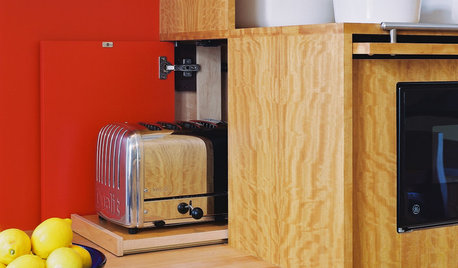
I recently purchased an old (1950's) toaster at a garage sale. I really like the look of it but recently, when touching it with wet hands I felt a "tingle". Does this mean it has a short? Can a new cord be put on or would it be something else that is worng? |
Follow-Up Postings:
|
- Posted by brianwarner (My Page) on Wed, Feb 4, 09 at 23:37
| Well if it was built in the 50s its got no ground on it so it could be a short indeed. Yes it can also be rewired and its a pretty easy task if you can get the thing open. U may be able to just open her up and see exactly what the problem is. Its stranded wire prob sauntered to the coils. It maybe as simple as a little sauntering and its as good as new. Some of the stranded wire possibly came lose and is hitting the side. This may sound dumb but are you sure it was a electric shock from the toaster or maybe a static shock? |
|
| Good luck "sauntering" (which means 'idly strolling') those wires on there. They're probably not soldered either, as solder tends to melt with high heat, and toasters are heating appliances. My toaster contains the special high-temperature wire (stranded wire with some sort of heavy-duty braid around it) CRIMPED onto the ends of the heating element. Disassemble the unit and follow ALL of the wires, looking for any wire that is touching the case. This includes the heating element itself, as it may very well short to the case at a point in the middle. You may find a wire, most likely one of the power cord wires, directly attached to the case in a way that looks as if it was intentionally done. If this is the case... then you need to, at the very minimum (and this isn't a great solution either), replace the power cord with a POLARIZED (one prong larger than the other) cord and ensure that the larger prong is the side attached to the case. If this turns out to be the issue, do respond in here so that we can give you a better solution (note for any other regular who responds to such a post if I go AWOL: disconnect case wire, replace with grounded cord...) |
|
| You should not use a grounded cord with a toaster. If a piece of toast gets stuck and you try to pry it out with a knife and touch the element, and you're not grounded, nothing will happen. If you're slightly grounded, you'll get a small shock as the resistance will be too high. But if the case were grounded, and you were holding it, you'd be the perfect path to ground. |
|
- Posted by ronnatalie (My Page) on Thu, Feb 5, 09 at 9:00
| What does the knife coming in contact with the toaster element have to do with the cord? My DUALIT toaster, perhaps the most expensive conventional toaster on the market, has the case grounded (and a grounded cord). Actually your more likely to smoke your knife and trip the breaker if the case were grounded. However, if you've got case leakage, grounding it will not solve the problem. Thank god for GFCI's in the kitchen |
|
| >Thank god for GFCI's in the kitchen Yes. But if the OP is getting a "tingle," there's a high probability that this kitchen doesn't have them. Not that this should replace a proper kitchen GFCI receptacle (not to mention ensuring that the toaster itself is correctly and safely wired), but... Most if not all hair dryers have, for some time now, been equipped with cords that have integral GFCI protection at the plug. If the OP has or can find a disused hair dryer with one, would there be any objection to replacing the old toaster cord with one of these? |
|
| iris16, since you mention a minor sensation, that you only feel when hands are wet, my first guess is this: a tingling, being slight not sharp & hard, is probably from the "neutral" wire sending a little bit of current into the case. Not the other wire, which carries the power (voltage, line). Look at where the two wires come out of the cord and into the toaster. Isolate the neutral wire a bit more, and see if the tingling stops. The neutral wire will be the one that doesn't get spread out as a heating element. Neutral has white sheathing, power has black, by today's standards and pro'lly back then too. -- If this is correct, then the first answer posted was not too far off: it's neither static nor a shock of real 110VoltAC power. HTH |
|
| I suspect the insulation in the original cord is breaking down. It was probably cloth-covered? You can get replacement cord the same, or you ought to be able to, just rewire it exactly as it was done before, if it has a ground, it should again. If you don't see any obvious loose wires, look also for dead mice etc, you'd be surprised. You can also buy gfci plugs, or things that go into the receptacle that you then plug into. That would be another approach. |
|
| DEAD MICE! I hope not. I did clean it out really well when I first purchased it. Thanks for all the information everyone. I am way out of my element here so I'll have to ask DH to have a look at the information given. I am sure it wasn't a static shock. It just wasn't that kind of quick thing, more of.....well a "tingle". The toaster does have a cloth cord. I don't see any area of wear. It does not have a ground plug or a polarized plug. Thanks for all the information. I'll get back to you about what we do. |
|
- Posted by countryboymo (My Page) on Thu, Feb 5, 09 at 19:37
| Say Ghost five times as fast as you can... Now... what do you put in a toaster? I would say take it apart and look everything over and if you do not find anything check for voltage from the case of the toaster to the ground on the outlet after you start some bread. |
|
| I'm not sure I'd want to touch any toaster or appliance new or old with damp hands. Electricity taught me who was the boss in college when I plugged a sewing machine into a floor outlet that had somehow become a bit damp. It's a sensation, sound, and smell you never forget. :-) |
|
- Posted by ronnatalie (My Page) on Sat, Feb 16, 13 at 8:43
| Is there some reason you felt it necessary to dredge up an four year old post to make that comment? |
|
| "Well if it was built in the 50s its got no ground on it." Toasters with exposed live heating elements have classically (and still) often have no ground for a metal case. It would INCREASE the danger to have a solid ground present. Some new toasters use insulated hating rods (the patent expired long ago) that have a heating element inside a ceramic filled metal tube (same as eclectic stoves, they used to be referred to as 'Caloric heating rods'). These have no exposed hot elements and often also lack a ground. The joints to the heating wire are always crimped since solder (and even much brazing) would not survive the heat level present (red hot). The old appliance can be restored, but it should be restored exactly, and if it has 2-prong plug, maintain a 2-prong plug. The correct temperature insulation should also be used for the cord. There are a number of places that sell cut lengths of correct cloth covered (for appearance) high temperature insulated cord to match these old appliances (sometime even matching the old colored checkering present in the decorative cloth braid). If it is old enough, you may even find asbestos insulated conductors both in the cord and the internal wiring so be careful.
|
Please Note: Only registered members are able to post messages to this forum. If you are a member, please log in. If you aren't yet a member, join now!
Return to the Electrical Wiring Forum
Instructions
- You must be a registered member and logged in to post messages on our forums.
- Posting is a two-step process. Once you have composed your message, you will be taken to the preview page. You will then have a chance to review the contents and make changes.
- After posting your message, you may need to refresh the forum page in order to see it.
- It is illegal to post copyrighted material without the owner's consent.
- HTML codes are allowed in the message field only.
- No advertising is allowed in any of the forums.
- If you would like to practice posting or uploading photos, please visit our Test forum.
- If you need assistance, please Contact Us and we will be happy to help.