


|
| Hello!! Mike from Alaska here.
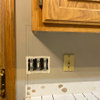
Picture for this question:
I am installing 120V hardwired undercabinet lights and two proper dedicated 20A small appliance circuits in my kitchen. I have a log home. I am furring out the log kitchen wall with 2x2's in order to drywall it. As a result I have extremely low clearance for junction boxes. I picked small metal handy boxes for the receptacles, as they fit back right to the log surface, and stick out to the perfect drywall finish height, so they are about the best I can do in the space. I'd did not think I would have room to splice NM cable along within each box on to the next, so I decided only to run cable into each box and then right to the receptacle -- not out again. So I put two 4x4 junction boxes on the log wall under the sink cab location, and i ran several NM cables out from each 4x4 box to the various receptacles and undercabinet light locations. When i am done the NM will be secured along the profile of the wall surface, generally in the crotches of the logs as you can see. Is this OK? Mike |
Follow-Up Postings:
|
|
- Posted by ronnatalie (My Page) on Mon, Feb 27, 12 at 8:21
| Yes, running the NM along the logs like that will be fine even in exposed areas. The biggest issue is to check the box fills when using shallow boxes like that. |
|
| Hi Ron thanks for your response. Those top boxes are illegal with a single device in them? Is there any way to make legal use for them at all!? I used this attached link when I picked those top boxes. Maybe I should go with a low profile 4x4 with a raised single device mud ring for each of those? |
Here is a link that might be useful: wire fill
|
| The shallowest boxes you can get are 4x4 boxes 1.25 inches deep. You then put a plaster ring on them, but that extends into the drywall. A regular switch-plate still covers the opening, and you have a lot more volume for wire allowances. The box fill is 2 #12 wires, 1 #12 allowance for all the grounds (you need to pigtail to the box to ground it) and 2 allowances of #12 for the device. The total box fill is thus five 12 wires. It looks like you are going to have a hard time grounding the boxes since it does not appear there is nay space on the back for the grounding screw to go though. It looks like you used external cable clamps, so no fill allowance there. |
|
| Hi brickeyee I actually went back to the giant Orange store and picked up the shallow 4x4 boxes with the mud rings. I figure I will probably have to take these mud rings back and then get even deeper ones to accomodate drywall and a tile backsplash. For the handyboxes, my plan was to put two GFCI breakers in the panel and not try to squeeze those beasts into in the little boxes. But now that I have mud-rings on big boxes, I should just use the GFCI receptacles huh? No trips to the breaker box downstairs. |
|
| Mud rings are all the same depth. Use the standard mud ring with an extension to get withing 1/4 inch of the tile surface. |
|
| Why not notch the logs to use full depth boxes, and feed all the receptacles from a GFCI in the 4x4 under the sink? |
|
| Hey brickeyee.. I guess "mud ring" refers to the 1/2" deep model only then? I am referring to the several depths of cover shown on page 3 of this RACO PDF in the link. Home Depot sells em all. parts There is surely one which would be within 1/4" of my final tile surface. SaltCedar - I just needed a NOW approach because my drywaller was standing there waiting for me. (And as things happened... he left.) |
Here is a link that might be useful: RACO covers
|
| If that is an outside wall, I think I would have used 2 X 4s to frame out, so I could get more insulation in there, thus eliminating the problem with the boxes. |
|
| You can also just cut into the log face to get box clearance. It is not like it is going to show behind the drywall. |
|
| Thanks for the responses. We didn't have room for 2x4 because the installed cabinetry would push into a nearby door frame. Even with the 2x2 the trim around the door will be notched. I'll admit having considered notching into the logs but the timeframe of the brother-in-law furring work and drywall install didn't mesh with it. (And as it turns out... its still undrywalled so I had plenty of time.) In the end I like these big boxes with mud rings, it will be relaxing to wire. Thanks again! |
|
| You can still notch the logs at this point for the boxes as needed. "In the end I like these big boxes with mud rings, it will be relaxing to wire. " You are trading extra wiring room for more drywall work. Not a bad trade if you are paying since electricians earn a lot more than drywall mechanics. Sort of a wash if you are good at finishing drywall. |
|
| I am still very curious though.... are the original handy boxes illegal? |
|
- Posted by ronnatalie (My Page) on Wed, Feb 29, 12 at 12:33
| Yes, they are. Those look like the typical 13 cu inch hand boxes, you over fill them with just a single #12 cable coming in and a standard receptacle (even with external clamps). |
|
| " you over fill them with just a single #12 cable coming in and a standard receptacle" no you wouldn't. If you had only one 12/2 romex and a device that would equal 11.25 cu in. 2 for the conductors + 1 for the ground + 2 for the the device = 5 x 2.25 = 11.25 < 13 |
|
| In the end, I want to keep these sturdy metal handy boxes. I am not pigtailing on in anything, each box is the end of the line, I can easily ground them, and I tested one and can comfortably put a receptacle in them. They are RACO model 662 seen in attached PDF. They are 13 cu inch capacity. Are they illegal or not? Ron Natalie says "Yes, they are." (illegal) Others say no. thanks! |
Here is a link that might be useful: RACO BOXES
|
| If the boxes are 13 in^3 you would be OK, though it wil be tough to pa k a GFCI receptacle into one. The fill looks like this (#12 allowances) 1 hot + 1 neutral + 1 grounds + 2 device = 5 allowances * 2.25 in^3 per allowance = 11.25 in^3. It would be legal, but is going to be a PITA. You need a pigtail to ground each box (and clearance for the grounding screw through the back of the box). The clearance is note a code issue, just driving the screw through the threaded hole in the back of the box. A ground clip would sole the screw issue, but you stil need a pigtail for three #12 wires (ground in + box pigtail + device pigtail). It will be VERY tight in there, GFCI devices are large (and under code require only the same two wiring allowances as a regular duplex receptacle or simple snap switch). |
|
| I tried one yesterday and it wires up no problem. There is a slightly raised surface for a ground screw. I am planning on putting normal recepts in these, with GFCI breakers... no legal probs there right? Just my wife mad when it trips and I have to go downstairs to reset it? |
|
| Just for your information, you can get mud rings(4x4 plastering covers, one device, or two) flat or up to 1-1/4" raised. |
|
| I bet if I tile this wall, I'll legally need to extend these handy boxes? I am not sure that exists for these little boxes. I like to do stuff to code. |
|
| Single gang extensions should be fine. In smaller dimensions they use the device screws to hold them in place. If you trip the GFCIs your wife will come to hate the walk. Of course it also means there is an electrical problem in the device you are using many times. |
|
- Posted by ronnatalie (My Page) on Sat, Mar 3, 12 at 2:52
| Yeah, math error on my part, I got 13.25 I did something wrong...it's only 11.25 |
|
| In the end.... I bit the bullet. I carved out a little bit of log behind each box, put 4x4 metal boxes in and used mud rings big enough to stick completely out of the drywall and almost through the (upcoming) tile covering. |
|
| "I carved out a little bit of log behind each box, put 4x4 metal boxes in and used mud rings big enough to stick completely out of the drywall and almost through the (upcoming) tile covering." Better in the long run. The box fill rules only require two wring allowances for the device. It is OK for a simple snap switch or a duplex receptacle, but a dimmer or GFCI receptacle can be a tight (though legal) fit. You will find wiring in the 4x4 boxes much easier. |
|
| Whats the rule for when a box extension is required? Is it not required at all if you put a non-combustible material on (like tile/mortar), or is it a "must come within X" of ANY surface" type rule? |
|
| The front face of a box may be recessed no more than 1/4 inch of a finished non-flammable surface (plaster or drywall), and flush with a flammable finished surface (like wood). Ceramic tile is not flammable, so the box can be recessed no more than 1/4 inch. |
|
| Thanks everyone for all the great help i am really happy with the final choices. |
Please Note: Only registered members are able to post messages to this forum. If you are a member, please log in. If you aren't yet a member, join now!
Return to the Electrical Wiring Forum
Instructions
- You must be a registered member and logged in to post messages on our forums.
- Posting is a two-step process. Once you have composed your message, you will be taken to the preview page. You will then have a chance to review the contents and make changes.
- After posting your message, you may need to refresh the forum page in order to see it.
- It is illegal to post copyrighted material without the owner's consent.
- HTML codes are allowed in the message field only.
- No advertising is allowed in any of the forums.
- If you would like to practice posting or uploading photos, please visit our Test forum.
- If you need assistance, please Contact Us and we will be happy to help.