



|
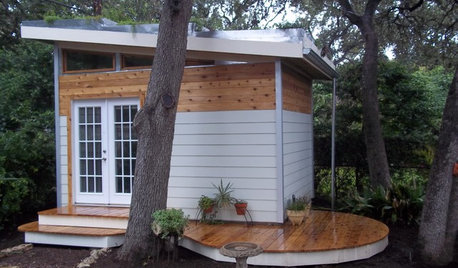
| I built a 14x14ft storage shed with a loft and small work bench in my back yard and want to run power out to it. My plan is to have two lights and two electrical outlets in it.
My house is about 50 ft from the shed with my main circuit panel in the basement. I am planning on drilling a whole through the 2x6 above my foundation and running the wire from the panel directly outside. Once outside I have a two foot drop to the ground. My questions are, how far do I have to bury the wire and do I have to run the wire through two feet of conduit (or however you spell that) into the ground? My other idea was to install another electrical outlet on the back of my house and wire an extension cord with two male ends. Wire my shed with a female end on the wire and use an extension cord to power it up when I need to. I would prefer to just flip a switch, however a couple of electricians I have talked to recommended I use the extension cord method. I plan to run it on its own breaker so that I can flip it off at night in case the shed got broke into, the crooks atleast would not have light. Any feed back or ideas would be greatly appreciated. |
Follow-Up Postings:
|
- Posted by ronnatalie (My Page) on Wed, Jan 9, 08 at 17:15
| The wire must be approved for direct burial and protected from physical damage. DO NOT MAKE A KLUDGE MALE-TO-MALE EXTENSION CORD. Extremely unsafe!!! No real electrician would recommend that. You've got to be kidding. An option would be to put a MALE plug on the shed and plug it into a regular extension cord. Even that is somewhat problematic. The breaker is important for safety MORE than putting crooks in the dark. |
|
| " how far do I have to bury the wire and do I have to run the wire through two feet of conduit (or however you spell that) into the ground?" Don't even think about the male-male extension cord. |
|
| No I am not kidding. I have asked 3 electricians that I have run into on different job sites. Maybe they misunderstood what I was telling them about making the extesnion cord anyway........... now I know not to do that. The wire is UF 12/2 and is grey in color and is approved for direct burial. So how far underground? 3 feet? Thanks for clearing up what a breaker is for also, I have learned something today. |
|
| If you want to go direct burial you'll still need an LB at both the house and shed and use 3/4" PVC. The PVC needs to extend down almost to the base of the trench. Don't bend the cable 90 degrees from the bottom of the PVC but make a gentle loop and then go horizontal. Depth for direct burial is usually 24". Check your local code requirement. |
|
| Thank you bigbird. |
|
| In my opinion the plastic conduit is the best solution. With that most places have no minimum burial depth, makes it much easier to install. I would go with the 3/4" or larger but add a second, someday you may want to add a TV, intercom, etc. The plastic conduit is cheap and can be bent if you heat it with a hot air gun (~ 15" section for a 90 bend). takes a few minutes to get it nice and soft. The color of it should not change, if it does you got it to hot. |
|
| "In my opinion the plastic conduit is the best solution. With that most places have no minimum burial depth, makes it much easier to install." You are posting wrong information.....again! |
|
- Posted by ronnatalie (My Page) on Thu, Feb 7, 08 at 19:19
| Gil, Most places go by the NEC. You better read Art. 300.5. There is most definitely burial depth limitations. Just heating up a conduit with a heat gun until it is nice and soft is not a legal way of making a bend (nor is it particularly effective). |
|
| You are correct, I miss typed the answer, it should have said most places have "a" not "no", thanks. You got my curiosity up and for grins I checked the state code with the NEC, they are different. NEC 24", State 12". The heat gun works for me but you have to be careful. It takes about 10 minutes to make the bend with the proper radius etc. I bent 1/2, 3/4 and 1" plastic conduit this way. I believe Greenly (green box) makes several heating devices to heat the plastic conduit so it can be bent, that is what the contractors were using next door. I made the assumption he would rather spend the time making the bend rather then purchasing a tool. You can also buy manufactured bends. |
|
- Posted by petey_racer (My Page) on Sun, Feb 10, 08 at 22:19
| Gil, the burial depth (NEC T300.5) for PVC is 18", NOT 24". |
|
| The best thing is to ask the inspector. We have three different depths suggested, all meeting a code of some type somewhere. The NEC is a dynamic document and does change over time, every three years. The current issue is 2008. That probably has not been adopted in many communities, and or they also have there own code. Since the code is a minimum specification and the conduit was buried 24" it met all the codes referenced here. I never got in trouble by asking the inspector. It is fairly hard for him/her not to pass what he/she said to do. |
|
| All I want to know IS: what size wire to run from my main panel to a shop 175 feet from there from a 50 amp. breaker. NOBODY addresses this. This is the MOST critical element in wiring. I can dig a trench---I have proper conduit-----I can pull wire-----I can hook it up. Just stop telling me to make sure of the proper size. GIVE ME THE FRIGGIN' SIZE. Stop dancing around. RGB |
|
| >GIVE ME THE FRIGGIN' SIZE. Stop dancing around. Just curious... do you normally get results with people using this approach? |
|
| "GIVE ME THE FRIGGIN' SIZE. Stop dancing around. RGB" No problem! 500 MCM Copper wire paralleled for the 2 hots with a single 500 MCM Copper wire for the neutral. Also dont forget a 2/0 Copper wire for the Ground. Hope that helps!!!! |
|
| "All I want to know IS: what size wire to run from my main panel to a shop 175 feet from there from a 50 amp. breaker. NOBODY addresses this. This is the MOST critical element in wiring. I can dig a trench---I have proper conduit-----I can pull wire-----I can hook it up. Just stop telling me to make sure of the proper size. GIVE ME THE FRIGGIN' SIZE. Stop dancing around. RGB" You're not even the OP. Doorguy06 is. Start a new post, be a little more civil, and you might get a civil answer. |
|
| Is this place in California-on a fault line? The shed has moved and additional 125 feet from the house! It started out at 50 feet away, now it is 175 feet away- If it keeps moving like this, better make sure you put in some good size service loops to make sure you have enough wire as it keeps moving! |
|
| bikerbob7, I'd recommend two #14 bare conductors, a minimum of 30 feet off the ground, spaced several feet apart. Install a pole transformer in your basement, operated in reverse, to step the voltage from 240 up to about 20kV, then step it back down on the other end - or just buy 20kV appliances for your shed. Since everyone now knows you're a total dick, if you want a real, valid answer to your question, you might want to create a new account before you post a new thread in a much more civil way. |
|
- Posted by andy(ov_cabaniss@yahoo.com) onThu, Mar 31, 11 at 22:49
| Have an electrician do the work...its the safer option:) just answering based on what im reading. |
|
- Posted by chris(cdub198122@msn.com) onThu, Apr 14, 11 at 18:58
| I have the same situation only I have 10-2 wire ran to a outlet outside my house, I'm just going to run a bigger extention cord to shed. |
|
| I'm just going to run a bigger extention cord ... Funny you should mention that. Many years ago I started having trouble with the underground conduit to my detatched garage (in a different house from the one I have now). Throwing the inside 3-way switch for the garage light in one direction would blow the fuse. It was winter and the wires in the conduit were type R in a lead jacket (I kid you not; this was probably installed in the 1930s or so) and just wouldn't pull. I didn't feel like beating my head against the problem just then, so for a while I just left the inside switch in the "right" position. Then one day I found the fuse blown again, so I disconnected all the wiring to the garage. However, I still needed light and a battery charger out there (remember, this was winter), so I laid a 14-3 SJ extension cord under a shrub, and ran it across maybe 8" of lawn to the garage. When I needed power in the garage, I plugged it in at the house. I intended to use this awful lashup only until spring, but you know these things go sometimes. :\ Anyway, probably 4 or 5 years later, I plugged in my power cord one day and it went pfffft. When I looked under the shrub, I found that the cord had sunk into the earth. I pulled it up, and the rubber jacket and conductor insulation literally peeled off as I did. Surprise! There's a really good reason that extension cords are approved only for temporary use. I trenched the back yard a couple of weeks later. The story has no moral. :) |
|
- Posted by clay(claymation@cville.net) onWed, Sep 14, 11 at 10:37
| Male to male cords are referred to as "suicide plugs" for a reason! :-) |
|
- Posted by ronnatalie (My Page) on Wed, Sep 14, 11 at 14:51
| I'm glad you came by six months after the conversation was over to say that. |
Please Note: Only registered members are able to post messages to this forum. If you are a member, please log in. If you aren't yet a member, join now!
Return to the Electrical Wiring Forum
Instructions
- You must be a registered member and logged in to post messages on our forums.
- Posting is a two-step process. Once you have composed your message, you will be taken to the preview page. You will then have a chance to review the contents and make changes.
- After posting your message, you may need to refresh the forum page in order to see it.
- It is illegal to post copyrighted material without the owner's consent.
- HTML codes are allowed in the message field only.
- No advertising is allowed in any of the forums.
- If you would like to practice posting or uploading photos, please visit our Test forum.
- If you need assistance, please Contact Us and we will be happy to help.