




|
| Hello all: pardon the cross-post from the Kitchen Forum, but I didn't get much response there, and thought I'd try my luck elsewhere.
Our granite installer did a hasty and poor-quality job with the silicone seal between our granite counter and the undermount sink. There's now something growing behind it; I can see it, but can't scrub it out, even with a narrow brush that exactly fits in the crack. Is it a sign that the seal isn't good, and that further problems await down the line (ie, water getting past the sealant, dripping down the sides of the sink, and winding up in the cabinet)? Is it unsanitary? Am I loony to think I should strip out the sealant and try redoing it myself? If I should, what tools and supplies do I need for that? I don't want to call our installer back; it took him two visits, complaining all the while, just to do the subpar job we're stuck with now. Alternatively, feel free to tell me that I'm worrying about something that doesn't need to be worried about. That's the outcome I'm hoping for, to be truthful. Oh, one more thing. This same installer grouted, but didn't caulk, the granite where the countertop meets the 4" backsplash. He said the grout needed to dry first, and that once it did, *I* should caulk it, with clear silicone. I haven't yet. It looks like the grout is shrinking -- it doesn't fill the cracks the way it used to. I'm thinking I need to get going with the caulk. Consensus? TIA for all these probably-idiot-level questions. |
Follow-Up Postings:
|
| He most likely used a sub par sealant, besides doing a poor job. I would try and get as much "caulk" off, and then recaulk with silicone caulk. As far as the backsplash. Why would you EVER use grout on granite? In fact grout has NO place on any backsplash. The counter and backsplash should move as a unit, hence it should be "caulked" with silicone at the least, in a matching color. Even if you has tile comming down on top of the counter, you would NEVER use grout. Grout will not move with the walls or counters, it will crack and fall out. A caulk that is paintable, and allows movement is what you want. The only "idiot" is the "fabricator" that did this job. The MOST important part of any job is the PERSON doing the work. Its more important than the material used etc. The best materials in the hands of a hack, will still be a poor job. A craftsman can make cardboard look great!. Sorry your having this problem. |
|
| "The counter and backsplash should move as a unit, hence it should be "caulked" with silicone at the least, in a matching color." No, the opposite is true. |
|
- Posted by stoneonecorp (My Page) on Sun, Oct 2, 05 at 19:56
| Yes, I have no idea what grout would be there. Possibly epoxy? |
|
| I recently recaulked between my silestone and the undermount stainless sink. I scraped off the little that remained and used clear silicon. That was two weeks ago; it seems ok... |
|
| Thanks, all, for these messages. I think the grout is epoxy, as stoneonecorp guessed, because he mixed multiple small batches and worked very quickly, and I didn't see anything sand/cement-y involved. And I'm glad to hear that non-experts can redo that caulk sink seal with no apparent trauma. I was surprised when he told me that *I* should caulk over his grout seal. This is a guy who was recommended *very* highly by a lot of people: I called every single person on his references list and asked a lot of very critical questions. No one, not a single person, said, "he expected us to finish up the job; he told us to caulk our own counters." ISn't that part of the installation? Anyway, I think I know the answer to that. And given that he whined when we asked him to come back and re-seal the sink (which he messed up the second time as well as the first time -- all the while complaining that no other homeowner had ever asked him to do this, and that the sink is not his responsibility), I don't want him back in my house, because I think he's a jerk. So: sounds like I should recaulk the sink seal and caulk over the grout he laid. Yes? I'm going to use clear silicone and masking tape, so it looks nice. Any other tips, advice, cautions? Pamkcs, did you just rip the old sealant out with a screwdriver and clean what was behind it? As before, thanks in advance! |
|
| I couldn't see any caulk behind it, so I scraped out what I could see with a knife. It's seems to be holding up OK. Before when I used my sprayer to clean the sink I was ending up with water under the sink. Not good. |
|
| Aloha Andrea, You can shape the silicon caulk with a wet spoon or a wet finger while it is still wet. Put the tube of caulk in a caulking gun, cut the tip at a 45 degree angle and so you end up with a three eights inch or slightly bigger hole at the end of your caulking tube. Put the tube at a forty five degree angle with the nose in the crack with the long edge of the hole facing down. Push the caulk in front of the tube and push it down into the crack. There should be just a bit of caulk visible in front of the nose as you go along. The tube will run over it and shape the caulk as you go along and you can use the wet finger or spoon to clean it up more if it needs it. If it is still difficult to keep tidy, clean up the edges and the strayed bits with a single edge razor blade after it has dried. A hui hou, |
|
- Posted by mississippirose (My Page) on Sat, Mar 7, 09 at 15:49
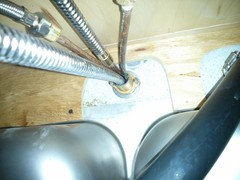
| I have an undermount sink that is separating from the granite right at the point where the faucet is!!!!! I have temporarily used a broom stick to wedge it back up. I have been reading that brackets should have been used for undermounts. There are no brackets. I am going to have to find someone to help me repair this mess. I can't leave it rigged if you know what I mean. Ughh. |
|
| I have a poorly installed undermount sink. This is what the contractor crew used to keep the sink up against the silestone (drywall screws). You can even see the hole where they tried one and the wood started to split. Basically the sink would flex in the middle and there was a little bit of leakage started due to the silicone seal separating and flexing. I shoved a board up between the halves and wedged it. See my solution on this link: |
|
Please Note: Only registered members are able to post messages to this forum. If you are a member, please log in. If you aren't yet a member, join now!
Return to the Home Repair Forum
Instructions
- You must be a registered member and logged in to post messages on our forums.
- Posting is a two-step process. Once you have composed your message, you will be taken to the preview page. You will then have a chance to review the contents and make changes.
- After posting your message, you may need to refresh the forum page in order to see it.
- It is illegal to post copyrighted material without the owner's consent.
- HTML codes are allowed in the message field only.
- No advertising is allowed in any of the forums.
- If you would like to practice posting or uploading photos, please visit our Test forum.
- If you need assistance, please Contact Us and we will be happy to help.