





|
| X-post from Flooring, where I haven't gotten any response, so I'm trying here.
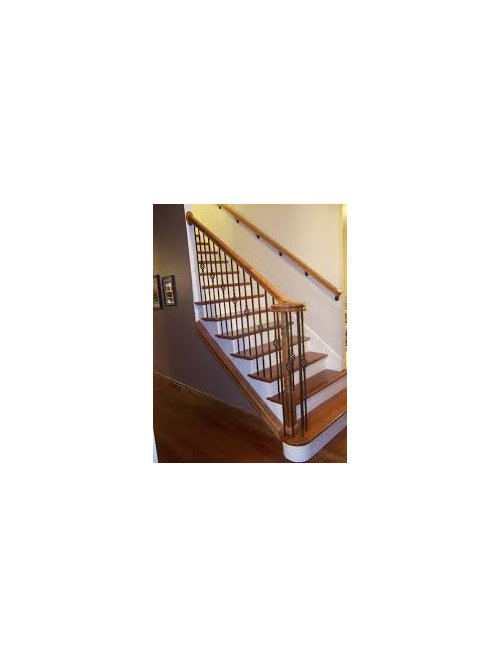
I'm redoing my stairs to have oak treads, oak handrails, and wrought iron balusters. This is the basic idea of my stair layout and what I want to do. First 9 steps are open on the left and last 6 steps are closed on both sides.
What I need help with:
|
Follow-Up Postings:
|
- Posted by sombreuil_mongrel (My Page) on Tue, Aug 23, 11 at 20:11
| Hi, I'm pretty rusty on volute turnouts, but the component they send you will have a sweeping arc at the top to accommodate any rise/run up to 45 degrees. You need to super carefully measure your stair angle and cut the sweep of the volute tangentially 90* so that it's exactly at that angle. It connects to the straight rail with a rail bolt; the joint is 90*; a butt cut. Expect to pare away portions of both abutting members to get a smooth transition. IOW if both profiles of both were identical out of the box, that would be a miracle. You want to lay out the ballusters evenly on the treads first, then plumb them up to the rail. On the underside of the rail,mark the first regular balluster, then mark the last; the neat trick is to then use a set of dividers precisely adjusted to lay out tick marks on the rail in exactly even increments. Takes a few tries to get the setting just so, but it really looks well to have them spot-on. By "regular" I mean not part of the turnout of the volute below; those are "special". I usually use a figure of 2.25" from the face of the riser to the center of the first balluster; just allow 3/4" Min. between the nosing and the balluster. The intermediate ballusters are centered exactly between those closest to the risers. Not familiar with the shoes (I work in wood) but if they fit an angle up to 45* you'll be fine, as most rails are by code far less than 45*, more typical to be in the 40* to 42* range. I would take it that these trim covers are adjustable within a logical range of angles. I have never (yet) had an inspector hassle over a semi-enclosed stair railing not being continuous. We always make sure they are at the exact same height, and that the proper returns are placed to not catch on sleeves, etc. I bet there are good online instruction manuals for ascertaining and cutting the appropriate angles for the volute/sweep. I'm sure I have confused things further, so my work here is done. |
|
- Posted by weedyacres (My Page) on Wed, Aug 24, 11 at 8:10
| Sorry for the misleading photo randomly pulled off the web. I'm not doing a volute at the base of the stairs, just a plain vanilla newel post that the railing will butt into. So for cutting the bannister angle, will the "lay it along the tread noses" method work? Thanks for the guidance on baluster placement. I need to do some pencil-and-paper calcs and layout. The shoes are fixed at 45 degrees (see below). It would seem logical that they'd make adjustable ones, but I haven't managed to find any. |
|
- Posted by sombreuil_mongrel (My Page) on Wed, Aug 24, 11 at 9:49
| If those are a softer metal, they could be "adjusted" with a belt sander or other abrasive technique to remove some metal for a scribed fit. But not a job I'd envy. If you lay the rail on the nosings, you can scribe a plumb angle along a side (with difficulty, following the profile. a compass point works well here) Once you either match this angle on the chop saw or with an angle-finder tool, you will have ascertained the plumb angle. The complement of this angle is the incline angle; find it by subtracting from 90. Ends up being a pair like 43/47; 42/48; 41/49. The total will equal 90. The volute end of the rail is going to be a 90 degree cut, because that will butt up against the upsweep of the component. But finding where to cut the component is very mindraking task. I would mount the volute on the newel (if you have one) or otherwise mock it up in its exact, true, final position. Then line it up visually with the straight rail sighting across the theoretical meetup point from the side. At the point where you see a perfect transition ( a sweet spot with neither hump nor dip) mark the sweep at the top edge. Then when you cut, make a perfect 90 to that tangent and you'll have your cut. And slight oops could be fine-tuned out by slightly adjusting the butt cut of the straight rail a tiny amount (89.5; 90.5, etc). Then attach with a rail bolt. Casey |
|
- Posted by advertguy2 (My Page) on Thu, Aug 25, 11 at 13:39
| I did my stairs last summer and to be honest with you, I've blocked the whole experience out of my mind. They were curved and I did the handrails and everything else. Anyways, the guy I purchased my stair parts from sent me the liink below which at the time was actually accessible without permissions. The guide is very helpful and discusses pretty much everything. I suggest you purchase it if you need some questions answered. Or, at least look for it elsewhere online. There is also a section in there that talks about iron ballusters. |
Here is a link that might be useful: Coffman Stair Guide
|
- Posted by weedyacres (My Page) on Fri, Aug 26, 11 at 9:20
| Hey Casey, sorry you wasted your breath twice on volutes. No volutes on my stairs, just a standard newel post. I did find a photo on the Coffman site (thanks advertguy) that looks like they don't use shoes on the top of the balusters, just the bottom. So I guess I don't need to worry about the angled shoes. |
|
- Posted by sombreuil_mongrel (My Page) on Fri, Aug 26, 11 at 19:04
| If you have the curved upsweep/easement on your cap terminus, the same cutting principle applies; cutting the volute is just harder since it's so bulky. I'd still mock up the terminus and see where to place the cut mark be aligning and eyeballing the smooth transition point. Casey |
|
- Posted by weedyacres (My Page) on Tue, Aug 30, 11 at 8:29
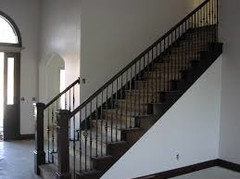
| Casey: NO VOLUTES! Here's a more representative photo:
Ok, I measured everything at home last weekend and the exposed tread is 10 1/2" with a 1 1/2" overhang. So my plan is to put 1/2" iron balusters on each tread at 3" and 7 1/2" from the face of the riser. That will space them at 4 1/2" OC all the way down, which gives the required 4" max opening. |
|
- Posted by sombreuil_mongrel (My Page) on Tue, Aug 30, 11 at 16:47
| Ok, I see now, the rail abuts the newel. You can just lay it in place on to of the nosings and mark carefully. Easy. 4.5" sounds right to me if your riser to riser run is 9" Casey |
Please Note: Only registered members are able to post messages to this forum. If you are a member, please log in. If you aren't yet a member, join now!
Return to the Remodeling Forum
Instructions
- You must be a registered member and logged in to post messages on our forums.
- Posting is a two-step process. Once you have composed your message, you will be taken to the preview page. You will then have a chance to review the contents and make changes.
- After posting your message, you may need to refresh the forum page in order to see it.
- It is illegal to post copyrighted material without the owner's consent.
- HTML codes are allowed in the message field only.
- No advertising is allowed in any of the forums.
- If you would like to practice posting or uploading photos, please visit our Test forum.
- If you need assistance, please Contact Us and we will be happy to help.