



|
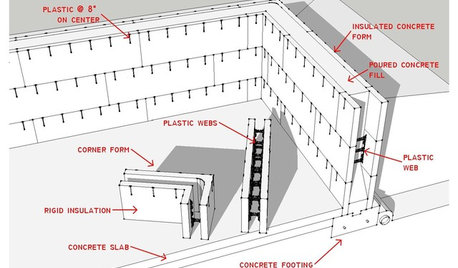
| I'm planning to extend my deck across the back of my house. It will require me to fasten a ledger to the concrete foundation of the house. The foundation is poured reinforced concrete 8 inches thick, and is 3 years old. What is the best way for an amateur to attach the ledger to the foundation? |
Follow-Up Postings:
|
| Rent a hammer drill and a 1/2 inch bit. Drill holes that meet waht the AHJ wants for spacing. Lead shell anchors and lag screws are not allowed in many places any more since they have poor withdrawal strength (the deck can pull the ledger away from the house and collapse). Any of the expansion anchors on the page below are simple to install. The same size hole is used through the ledger into teh masonry. This eliminates trying to spot holes from the wood to the masonry. |
Here is a link that might be useful: Rawl anchors
|
- Posted by john_hyatt (My Page) on Sun, Aug 13, 06 at 18:59
| I use a rotary hammer,same 1/2'' bit, ss threaded rod and the two part hilti material,as a given it is high dollor stuff the two hole gun is around $60,they have a quick set and one thats a little slower but a person can build bridges with this stuff,it is impossible to get the rod out after this material has set up.Tap con the ledger to the wall just to hold it in place,drill thru the ledger into the wall,push the hilti into the hole it mixes as it runs thru the gun, twist the rod into it, use a big washer and double nuts. Bang Bang you are done forever. John |
|
| Thanks for the info and links. I'll use expansion anchors. |
|
- Posted by brooklyndecks (My Page) on Tue, Aug 15, 06 at 5:44
| Java mon, I use lots of galv. 1/2"x4" lag bolts into lag shields...expansion anchors. My decks aren't collapsing. steve |
|
| I used the same, only 5", and lots of em. |
|
| "I use lots of galv. 1/2"x4" lag bolts into lag shields...expansion anchors. My decks aren't collapsing." Not allowed by code uin many locations. The link below is a typical set of deck requirements. |
Here is a link that might be useful: Deck Construciotn Guide
|
- Posted by brooklyndecks (My Page) on Tue, Aug 15, 06 at 16:39
| yeah, I've read the fairfax county code already. I'm in Kings county, Brooklyn. I don't use lead shields. When I'm done bolting my ledgers into brick with two 1/2" bolts every 18", there is no way that the ledger is ever going anywhere. If I had any doubts, I wouldn't do it. steve |
|
| Then what are you claiming the "lag shields" are made from? The harder material have even less strength then the softer ones, and the soft ones are a disaster. |
|
| Just to give you an idea how bad lag shields are, a ½ in diameter long lag shield embedded 3 in deep into 2000 PSI concrete has a tension load rating of 2085 pounds. With normal derating it is allowed to hold 208 pounds. A ½ inch Rawl Power Stud embedded 3 inches deep in 2000 PSI concrete has a tension load rating of 5100 pounds. With derating 510 pounds. A 208 pound withdrawal every 18 inches on a deck is pitifully low and can easily be exceeded under normal conditions. As soon as the deck has any pitch the loads change from shear to tension. Lag shields are not a safe method of attaching ledgers to concrete for deck support. |
|
| Like Whoopi said..."Speak English, Mick!" I assume tension load is the ability to not pull out. Of course nobody has mentioned how much torque was applied to the bolt. So now what is derating? I'm suspect of what youre gonna say cause both 200 and 500 lbs are not big numbers. But I do appreciate you sharing. |
|
- Posted by john_hyatt (My Page) on Tue, Aug 15, 06 at 21:38
| Im telling you guys,go with the hilti system/ss threaded rod.Its a total done deal. J |
|
| You build decks and do not even know what shear and tension loads in fasteners are???? "Of course nobody has mentioned how much torque was applied to the bolt. " Cause it actually does not matter once you apply enough to obtain the maximum rating of the fastener. More torque can actually decrease the strength. If the shield starts to rotate in the hole the withdrawal resistance has been seriously compromised. It can turn at the start of tightening a little, but once it starts to expand it must stop rotating and not start again. You have not provided adequate resistance to the fasteners pulling out of the wall (tension loading). Higher or larger the fastener spacing needs to be tightened up based on the actual area. Positioning the anchors in a perfectly straight line in the wood also reduces the strength. The wood can simply split along the line of anchors and the deck pulls away. As a PE I testify at trials over deck collapses. |
|
| Don't assume all the forum contributors build decks. They don't. I understand shear and tension strength as it relates to the fasteners themselves. But when we're talking about the ability of the deck to pull away from the slab we're talking the combination of the bolt, shield, and concrete. You didn't define "derating", you only applied percentages. |
|
| The derating is the percentages of the optimal installation load. Where human safety is involved and installation is not supervised by licensed engineers and actual testing performed to verify the installation, it is typical to allow loading of anchors to not exceed 10% of the ideal installation strength. For supervised installations the loading is normally ~12%, and for non-life type loads 25%. You do not get a lot by doing the testing, so it is rarely performed. It is cheaper to just add enough fasteners to meet the 10% rating. The derating makes up for the variation in installation (holes size, smoothness, variation in concrete, installation technique, etc) and the lack of any testing to ensure the actual installation. In many cases even the strength of the concrete the anchors are installed in is not reliably known. To be allowed for use the devices are required to be listed by a recognized testing authority and they must be installed with full compliance of the device instructions and any special conditions in the listing. Listings typically list optimal load ratings for the anchors in various strengths of concrete. Other conditions to meet the listing are device spacing from edges and other fasteners and device depth. Only a few people died before lag shields were disallowed and more secure fastening means required. In the overall scheme of things the cost difference per job is very small and the gain in safety has been excellent. Deck collapses from ledger pull away have significantly decreased. The most recent failures have been pulling away of entire band joists. There are probably going to be some additional changes in a few years if the problem persists. I know many posters here are not deck builders, but at least one above is and appears proud he does not know what he is doing. |
|
- Posted by brooklyndecks (My Page) on Thu, Aug 17, 06 at 5:44
| Brickeye, I like to stay out of these debates, especially with know-it-all number crunchers...but you seem to want to drag me back in. You like to use terms like derating, and throw numbers and %s at us. you know what they say..."figures don't lie, but liars figure" let's look at your data...you say those 1/2" bolts with 3/4" you're an engineer, and you testify at trials over deck collapses. how many trials have you been to where a deck collapsed because of lag shields? I'd like to read some supporting articles. Even if you can site a few examples, who knows who the contractor was, or who he hired to do the installation. Was it his first deck? was it a friday afternoon or monday morning? into brick? 1/2" bolts? you can throw your numbers around, but you're not a deck builder...and you're certainly not on my site to witness the way I set a ledger. Most decks collapse because the builder used nails to fasten a ledger into a rim joist. I've read articles about them. I never even deal with rim joists or nails. here in brownstone Brooklyn, my clients all have brick buildings. I've built plenty of parlor floor decks in the last 15 years, and I am confident that they will stay up at least until the wood deteriorates (nothing lasts forever). Proud? yeah I'm proud of my work. check out my website if you want to see what I do. and don't worry about my liability insurance. steve |
|
| Thanks for the explanation Brick.... It's as I thought, I would state it as "being we don't know who built it, we're allowing for most things to go wrong." |
|
- Posted by irishbrewer (My Page) on Thu, Aug 17, 06 at 7:46
| Not all anchors are created equally. The red-head wedge-type anchors work very well in concrete and are commonly used in construction/industrial applications. Because the wedge grips the concrete more and more as you torque the nut, you do want to make sure you apply the proper torque during installation. Also, make sure you drill the proper diameter hole. I have included a link to the specs below and as you can see, even the little guys can develop quite a bit of strength (scroll down to the strength tables using the link) - much more than a couple hundred pounds quoted by brickeye. |
Here is a link that might be useful: Red Head Wedge Anchors
|
- Posted by irishbrewer (My Page) on Thu, Aug 17, 06 at 11:34
| Note: I should have said "...much more than a couple hundred pounds quoted by brickeyee for the lag shield anchors" IMO, the lag shield type anchors are very much inferior to the wedge type shown in brickeyee's link and the alternate link I provided. These anchors can be purchased at a reasonable price at the big box stores and they work well so I don't see a good reason to use the lag shields. |
|
| "Because the wedge grips the concrete more and more as you torque the nut, you do want to make sure you apply the proper torque during installation." >>>> That's exactly what a lag shield does. |
|
| "That's exactly what a lag shield does." Lag shileds are all made from softer metals (lead or zinc being common) and do not have the strength of steel expansion anchors. Red head, Rawl exapansion anchors, they all work about the same. "If the deck is level that's alot of weight going straight down." Decks are rarely level ebnough to eliminate tension loads, and are very unlikely to stay level for very long after construction. Wood moves. |
|
- Posted by irishbrewer (My Page) on Fri, Aug 18, 06 at 13:49
| Further to brickeyee's point about sagging and the load on the anchors: "Even the sagging of joists affects the loads on the anchors of the ledger." The sagging of the joists causes a rotation of the ledger board and due to the constraint of momvement caused by the concrete wall, the ledger board does not rotate about the anchor bolts but rather the lower edge of the ledger that is in contact with the concrete. This results in a tensile load on the anchor bolts rather than just a shear loading. As such, the pullout performance of the anchor bolts is important. |
|
- Posted by Derek(derekjoel@gmail.com) onSat, Mar 28, 09 at 11:27
| I looked at the Red Head anchor and not only do they support very good load #s, they also state the following: "Allowable values are based upon a 4 to 1 safety factor. Divide by 4 for allowable load values." That is vastly different from the 10-1 safety factor talked about earlier in this thread. Using the #s provided by The Smith Fastener Company website for shear and tension loads, you could fasten your ledger to your foundation so that even several full size pickup trucks yanking on it couldn't pull it out. |
|
- Posted by Melanie :)(Melm813@yahoo.com) onMon, Aug 15, 11 at 13:42
| Can someone in English please tell me hoe to atattch a ledger to concrete porch slab for the purpose of adding three foot staircase? |
Please Note: Only registered members are able to post messages to this forum. If you are a member, please log in. If you aren't yet a member, join now!
Return to the Porches & Decks Forum
Instructions
- You must be a registered member and logged in to post messages on our forums.
- Posting is a two-step process. Once you have composed your message, you will be taken to the preview page. You will then have a chance to review the contents and make changes.
- After posting your message, you may need to refresh the forum page in order to see it.
- It is illegal to post copyrighted material without the owner's consent.
- HTML codes are allowed in the message field only.
- No advertising is allowed in any of the forums.
- If you would like to practice posting or uploading photos, please visit our Test forum.
- If you need assistance, please Contact Us and we will be happy to help.