



|
| My dream of having my first backyard pool isn't going so well.
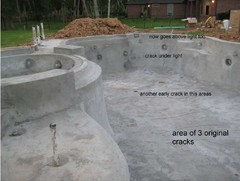
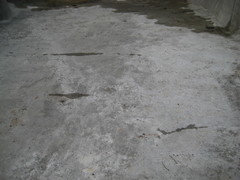
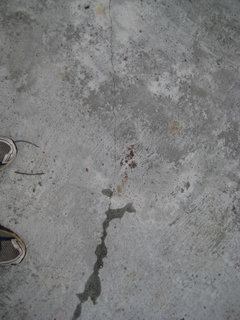
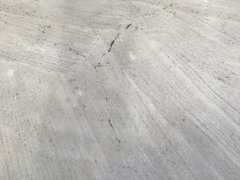
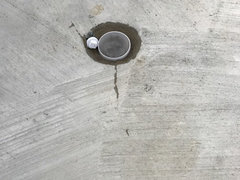
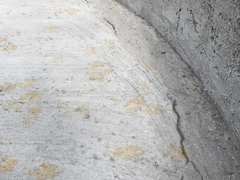
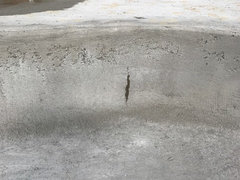
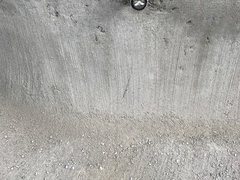
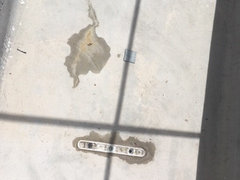
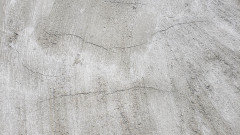
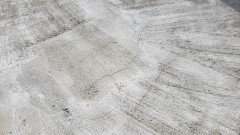
I contracted a very reputable (and still think so) pool company but with a week after the gunite was installed on April 12 I noticed 3 cracks going width-wise of approx 4-6 feet in length near the shallow end of the pool. Over the next few weeks I noticed a few more cracks. One 4-6 feet in the deep end (5-6 feet) going in a horizontal direction. Another in the deep end going up the wall. Earlier this week I noticed 3 more cracks on the walls in the shallow end extending from the direction of the 3 initial cracks. In total I am now looking at 12-13 cracks in various parts of the pool from 2-7 feet in length. My builder says he's never seen anything like it in his 20 years. When the pool was dug he commented that the soil, although mostly clay looked good and that he'd never had a problem in that kind of soil. At about the 3 week point the gunite company sawed squares and chiseled down 1-2 inches to see how deep the cracks were. It was hard to tell but it looks like the cracks went deeper. The outside of the pool was watered after the plumbing was installed and water seeped out of nearly all of the cracks. Gunite people came back a few days later without my knowledge and chipped aways at the cracks and poured in some hydraulic cement and basically claimed problem solved. The cracks in the hydraulic cement have reappeared. I read a similar story on this board where they used epoxy injection to fix the cracks. I was thinking this was a possible fix here until the several new cracks appeared and now I'm wondering if the gunite is seriously compromised and more cracks are likely to appear. One pool person I talked with today suggested using a jackhammer and removing the concrete 1-2 feet around the cracks and reapplying the gunite. He said the beauty of gunite is that it will bond with new gunite at any age. He's done this many times adding spas to old pools. Any thoughts or suggestions would be appreciated. By the way, for the 5 days after gunite went in I faithfull watered every inch of the pool 5-6 times a day. As soon as I figure out how to add pics I will. Thanks. J |
Follow-Up Postings:
|
- Posted by jonathan_11 (My Page) on Wed, Jun 1, 11 at 18:21
|
- Posted by lmhall2000 (My Page) on Wed, Jun 1, 11 at 20:22
| Ooh, I'm not liking this...I would almost want a complete redo...to me, cracks like this could be a sign that the shotcrete company did not have the right mix put together...too little of something or too much of something...you're paying a lot of money, I would have the shotcrete people out to your house with the pool person..and one other 'expert'...(non-partial expert) and have a mano e mano discussion. Get it ALL in writing and do not let them put pebble sheen on top of that...I would also call the pebble sheen people...as this may void their warranty (if you're using that product)...I'm one to do the hard work up front to save you loads of headaches in the future! Good luck! Tara |
|
| How old is this shell? Has anyone told you and did you follow through with watering at least a couple times, preferably three times a day? What is it sitting on? |
|
- Posted by jonathan_11 (My Page) on Wed, Jun 1, 11 at 22:41
| Poolguyny, gunite was shot on April 12, about 7 weeks ago. Yes, I watered thoroughly 5-6 times a day for 5 days exactly what gunite co. instructed. J |
|
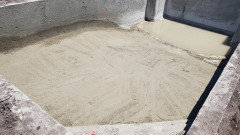
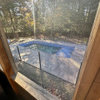
| Since we are looking at cracks. How worried should a be about this one? Sorry if I am hijacking your thread....
|
|
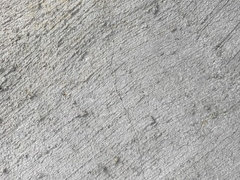
| jonathan 11, Anytime there is unsually cracking of a shell it is a good idea to contact the engineer who provided the structural plan for the pool. A meeting with the PB, gunite contractor, material supplier, and the engineer would be appropriate. Other non-structural reasons for the cracks might include: They could be shrinkage cracks. If the ground under the shell is excessiely dry, it can draw moisture from the gunite causing this type of cracking. The floor cracks could be tooling problems from working a little rebound into the floor. I've seen terribly checked gunite surfaces that are not structural. Usually, these instances occur in extreme temperatures of high heat. Good luck. |
Please Note: Only registered members are able to post messages to this forum. If you are a member, please log in. If you aren't yet a member, join now!
Return to the Pools & Spas Forum
Instructions
- You must be a registered member and logged in to post messages on our forums.
- Posting is a two-step process. Once you have composed your message, you will be taken to the preview page. You will then have a chance to review the contents and make changes.
- After posting your message, you may need to refresh the forum page in order to see it.
- It is illegal to post copyrighted material without the owner's consent.
- HTML codes are allowed in the message field only.
- No advertising is allowed in any of the forums.
- If you would like to practice posting or uploading photos, please visit our Test forum.
- If you need assistance, please Contact Us and we will be happy to help.