




|
| We had water delivery lines for our two sinks in master bathroom redone two times (initially there was a single supply for the entire bathroom with no shut off valves for the faucets at all). Then it was one shut off for both faucets and finally we have a possibility of shut off valves for each water line.
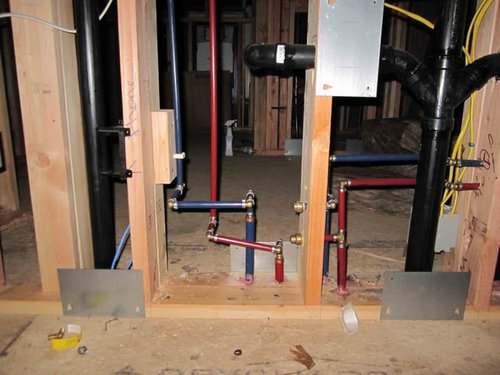
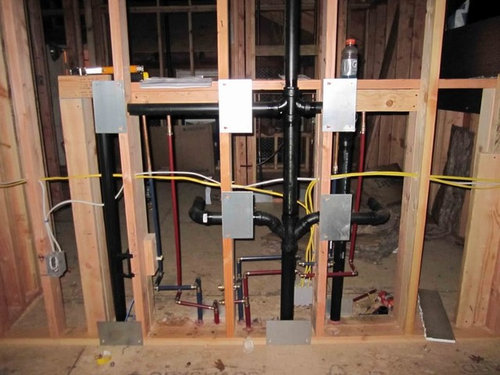
After two changes we got what is shown below (these are "back views"): Is it of concern that we have so many "connections" and some "dead ends" there? Is it worth paying to have it redone to reduce the number of connections? If so, how many would you say are necessary? In the new construction the tubing from the faucets can go straight down, but need to turn under the floor (ceiling of the powder room) to land within internal wall to reach the basement and make another turn to land in old basement where the water supply is located. |
Follow-Up Postings:
|
| "some "dead ends" there" Dead ends are not allowed in supply lines. Are you n a municipal supply or a well? You will need that pressure to get good flow around all the bends, most of which look pretty required for using rigid pipe. A fixture supply load calculation will tell if the flow velocity is going to be excessive. Without knowing more about what is going to be installed there is no way to tell about flow velocity. |
|
- Posted by lazypup (lazypup@yahoo.com) on Thu, Dec 15, 11 at 17:35
| The code does not permit a dead end longer than 12", but contary to popular opinion it does still allow 12" to permit making vertical stubs for hammer arrestors. |
|
| I am with municipal supply, but I do not know the exact pressure of supply line is in my house. These particular faucets are far away from water entry to the house (like 70 ft from water entry to the house). There will be two sink faucets on these lines. Since these faucet are wall mounted and no vanity under the sinks, they told us we cannot have shut off valves in the wall (they offered us valves on the bedroom wall if we wanted them on the second floor, which we declined). Maybe I should ask- would you like to close a wall on supply lines like these shown on the picture? Is anything in that picture against the code? Beyond looking as something that maybe prone to leaks (so many connections and so many bends) would such delivery line create any other problems- like noise? We thought that with PEX we should be able to get a continuous line (maybe with two or three bends with connections when it turns wall to ceiling and ceiling to wall) from the basement all the way to these faucets. The shower and toilet are supplied with different lines. |
|
| Take what I say with a grain of salt. I'm not a plumber, but I play one on TV. That seems like a lot of unnecessary corners to me. I don't understand why the pipes in the left stud bay are coming towards the camera and then back again. And is the cold pipe on the right side looping around the electrical wires? Wouldn't it have been easier to just push the wires out of the way and go straight? |
|
- Posted by weedmeister (My Page) on Fri, Dec 16, 11 at 16:35
| I'm not a plumber either. But can you have cutoff valves in the wall if there is a 'door' in front of them? With the double thickness of this wall I'm surprised at the double zigzag the pipes on the left are doing. And I'll ask: is there some standard or best practice with PEX installation that restricts how much 'bend' or stress you can have on the pipe and where it meets a fitting? |
|
| the big black pipe is DWV: has anyone told you the cross is 3/4 S trap? Post it on terrylove.com |
|
| "...the big black pipe is DWV: has anyone told you the cross is 3/4 S trap? Post it on terrylove.com..." may I ask why? and maybe what for? |
|
| OK, I posted it. we shall see... |
|
- Posted by lazypup (lazypup@yahoo.com) on Fri, Dec 16, 11 at 20:05
|
| a fixture cross is not a wye cross and not a double San-Tee cross. a fixture cross is better than a double San-Tee cross. Both will drain. |
Here is a link that might be useful: fixture cross image
|
| OK. Thank you. THe electrical wires are not really "in front" of the studs... The image is not clear- this is framing for our shelf above the faucets and the framing is not in line with the wall plane (just not so clear on the picture). I learned about the fixture cross when I posted on the other forum... Besides asking to correct the code vialation for drainage- what should we ask for in terms of delivery lines? Do not bother? I understood that the pressure loss will be minimal, but is this proper application of PEX plumbing? PS. I am getting ready to ask for another plumber all together - am I unreasonable? |
|
- Posted by lazypup (lazypup@yahoo.com) on Fri, Dec 16, 11 at 22:05
| I don't care what you call it,,the fitting that is connecting the fixture arms to the stack will not pass code |
|
| efs, after you fix the DWV cross you will know whether you have people to rely on to redo the pex (which takes little time). Either way. If you needed an answer more urgently you would have gotten stronger urgings from everyone. The detailed information from lazypup is educational but doesn't say anything is so bad that it is important or urgent. Wait until you fix first the one thing that needs fixing. If that is easy or if that is like pulling teeth. |
|
- Posted by lazypup (lazypup@yahoo.com) on Sat, Dec 17, 11 at 1:23
|
| Thank you very much... You made my day - I learned something new. My major worry at this point is that this vialation is clearly visible, but if that was done incorrectly chances are that there are other mistakes that are less obvious. I have A LOT of drainage going all around the first floor ceiling and I do not feel like taking pictures of every connection and asking you guys to tell me whether they are correct , i.e. legal (he was going down with pipes from the second floor and then realized when downstairs that these pipes need to make multiple turns before they land where they need to go, but was too stuburn to modify what has already been done upstairs to make the first floor piping less complex). |
|
| Good to check while you're checking: the upside-down double San Tee and the (perhaps) auxiliary vents. What are these connected to? I'd like to know a lot more about these vents. (Although vents are not bad, they are all good to have, good in every way, and one can never have too much venting). I'm just asking while the photo is there. The upside down c |
|
| "they used the fittings to make the necessary offsets to get around both the Aux. Vent and the drain stack." It likely would have been better to go below and move where the lines come through the bottom plate so they are on the other side of the stack & vent when they come through the floor and bottom plate. "There is nothing technically wrong with that PEX installation other than the fact that it looks a bit amatuerish' One of the advantages of PEX is that it IS flexible (within limits). The fewer fittings reduces the friction (and thus the pressure drop) since the PEX can be run in gentle curves. |
|
- Posted by lazypup (lazypup@yahoo.com) on Sat, Dec 17, 11 at 15:55
| Once again, you seem to be fixated on the pressure loss, but the resultant pressure loss is not enough to even be a factor here |
|
| but the number of unnecessary connections is a concern as a possible source of leackage. I do not plumb houses but I do plumb PEEK tubing with unions and fittings for high pressure chromatography, so I know where leaks happen... not in solid piece of tubing (unless broken) while connections.... |
|
| ditto: pressure loss is not a concern here. ditto: if you choose to redo the supply lines it will be only because you want to run the line without "unions and fittings". Good for peace of mind. No one knows if it will spring a leak or not. There are unions and fittings all over the house, by the way. The more you think about it the crazier you can go. "You" means anyone, not the OP. |
|
| "Once again, you seem to be fixated on the pressure loss, but the resultant pressure loss is not enough to even be a factor here" So the lack of pressure loss makes thie dumb use of excess fitting in a PEX instal acceptable? Give me a break. It looks like the amateur hour. Take advantage of it. Every one of those joints is a possible source of a failure. It does not mater how reliable the connection is, NO connection is more reliable (and cheaper). There WILL be pressure loss from flow. A hack, at best. Or is putting in excess joints OK as long as it meets the minimum flow at the end of the line? |
Please Note: Only registered members are able to post messages to this forum. If you are a member, please log in. If you aren't yet a member, join now!
Return to the Plumbing Forum
Instructions
- You must be a registered member and logged in to post messages on our forums.
- Posting is a two-step process. Once you have composed your message, you will be taken to the preview page. You will then have a chance to review the contents and make changes.
- After posting your message, you may need to refresh the forum page in order to see it.
- It is illegal to post copyrighted material without the owner's consent.
- HTML codes are allowed in the message field only.
- No advertising is allowed in any of the forums.
- If you would like to practice posting or uploading photos, please visit our Test forum.
- If you need assistance, please Contact Us and we will be happy to help.