



|
| Which of these is the best configuration for a toilet drain ?
Going to assume that C is incorrect because of no immediate vent pipe; that leaves A or B.
Thanks,
|
Follow-Up Postings:
|
- Posted by lazypup (lazypup@yahoo.com) on Wed, Oct 10, 12 at 11:49
| A & C are prhibited....now if you will just tell us what state your in, I will give you a complete plan for your project..... |
|
| Thanks Lazypup, I'm in Arkansas. I've posted this on several other forums and so far, the B's have outnumbered the A's. The A proponents mostly say that it's a straighter shot, thus less chance of clogs. The B proponents say that the A allows too much rush of water, thus restricting the vent. I'm still 'up in the air' about which one to go with, but, not being a plumber, Why would A be prohibited ? (By the way, the main stack is also the main vent) Thanks, |
|
- Posted by lazypup (lazypup@yahoo.com) on Wed, Oct 10, 12 at 21:46
| In both A & C the watercloset is installed on the top of a vertical riser, however, Code requires that a watercloset must be installed on the upstream end of a horizontal fixture arm. In addition, in fig A the fixture arm is attached to the main stack by means of a Wye. Code prohibits installing a Wye on a vertical stack except when attaching a vented branch. I have attached a drawing showing the completed solution for your project. As you can see, it is much simpler than your first proposal. Begin by attaching the watercloset on a 3" closet bend with a 2" low heel inlet and a 3" line to the main stack. Connect to the stack with a tee. You may then run a 2" line from the closet bend up to 8' to the tub P-trap, which is under the floor. You then extend the tubs waste & overflow outlet down through the floor to the P-trap. The kitchen drain & vent as shown. In your drawing you had concerns about 66" from the kitchen trap to the vent/stack. Under the IPC the proper size for a kitchen sink drain line is 1-1/2" which would allow you 6' (72") maximum developed length (actual length of the pipe) from the trap weir to the vent opening. Code also allows us to increase the pipe diameter by one nominal trade size, which would then be 2" and that would allow a maximum length of 8'. Under the International code the vent may be reduced to 1/2 the diameter of the line being served but not less than 1-1/2", except vents serving a watercloset must be a minimum of 2". If the TDL (total developed length/ actual length of the vent pipe exceeds 40' from the trap weir to the vent opening on the roof, the vent line must be increased by one nominal trade size.) The main vent MUST terminate through the roof. Now not on the lower right hand side and you will see the Main Cleanout. Code says that you must have a main cleanout within 3' of the point where the main drain exits the structure. The main cleanout is the official point of demarcation between the house main drain and the house sewer and that is important because code allows different materials for the main drain & house sewer. |
|
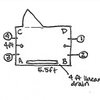
| In the following picture, assuming that the 'other drainage' pipe cannot be moved, which would be the better arrangement, A or B ? Thanks, |
|
- Posted by lazypup (lazypup@yahoo.com) on Tue, Oct 16, 12 at 13:00
| Both A&B are prohibited by code |
|
| Thank you for your advice. What makes these two arrangements not meet code, and how then would the toilet have to connect to meet code ? Thanks, |
|
| No vertical riser to a WC. |
|
- Posted by lazypup (lazypup@yahoo.com) on Thu, Oct 18, 12 at 20:32
| In A, if the line marked "other drainage" has an auxiliary vent it would be okay, but if it is an unvented fixture arm it would be prohibited because you cannot connect a fixture arm below a WC |
|
| One last time on the toilet drain. Because of obstructions and space limitations, I need to have the toilet drain into the stack lower than the tub and sink. Would there be any potential problems with this arrangement, that is, having the sink and tub drain into the stack about a foot above the toilet inlet ? Thanks, |
|
| Then remove the obstructions. Toilets cannot have vertical riser. |
|
- Posted by lazypup (lazypup@yahoo.com) on Tue, Oct 23, 12 at 20:05
| First of all, I gave you a complete layout that would meet code. If there is an obstruction that prevents you from doing it in the manner I described, then kindly either explain the obstruction or post a photo and I can work out a solution. in your last illustration you state that both the tub & lavatory have their own vents. The question then becomes, how are you venting the bath becaue you may not have a horizontal vent line until the vent reaches an elevation at least 6" above the flood level rim of the highest fixture served by that vent. You also seem to be insistant upon running the horizontal main drain about 2ft below the floor in a crawlspace. In a crawlspace the drain should be kept as close to the floor as possible, preferably in the joist bay to prevent frost closure in winter. |
|
| NEVER tell a plumber you cannot go through something. It can be a PITA, but if the pipe must go there, you can get through anything.' |
|
- Posted by lazypup (lazypup@yahoo.com) on Thu, Oct 25, 12 at 18:43
| Or you can go around it....LOL |
Please Note: Only registered members are able to post messages to this forum. If you are a member, please log in. If you aren't yet a member, join now!
Return to the Plumbing Forum
Instructions
- You must be a registered member and logged in to post messages on our forums.
- Posting is a two-step process. Once you have composed your message, you will be taken to the preview page. You will then have a chance to review the contents and make changes.
- After posting your message, you may need to refresh the forum page in order to see it.
- It is illegal to post copyrighted material without the owner's consent.
- HTML codes are allowed in the message field only.
- No advertising is allowed in any of the forums.
- If you would like to practice posting or uploading photos, please visit our Test forum.
- If you need assistance, please Contact Us and we will be happy to help.