







Natural remedies for heartworm?
I just learned that Wolfy, my husky-shepherd, has heartworm. He has no symptoms, and he'll be given another blood test on Monday to determine the extent of the infection.
Wolfy is almost 13. He has severe arthritis (for which he takes Previcox) but seems to be in good health otherwise. However, the vet said his bloodwork revealed that one of his kidneys is compromised, and this could be a problem if we decide to treat the heartworm because the treatment (which involves arsenic) is very hard on all the organs.
I read up on the treatment, and it sounds brutal. Given Wolfy's age, I don't know if I want to put him through that. So I'm exploring all options.
I see lots of websites devoted to natural remedies for heartworm. The only thing I've read so far are several first-hand accounts from several people who had success using black walnut and/or wormwood. This particular website was not selling anything.
Have any of you heard of, or tried, an alternative treatment for heartworm?
Thank you!
Susan
Comments (40)

anita22
16 years agolast modified: 9 years agoI have not tried any natural remedies for heartworm. However, I am exploring natural remedies for cruciate ligament/joint problems (in lieu of the surgery) and my rescue coordinator highly recommended the website www.naturalrearing.com
I understand that the owner, Marina Zacharias, is an herbalist who works closely with holistic veterinarians. I just read several accounts there of successful herbal/nutritional protocols for the treatment of heartworms.
Hope this helps.
alisande
Original Author16 years agolast modified: 9 years agoIt helps a lot. Great site! Thanks so much, Anita.
Related Professionals
Bayshore Gardens Architects & Building Designers · Linton Hall Interior Designers & Decorators · Englewood Furniture & Accessories · Evanston Furniture & Accessories · Kearny Furniture & Accessories · Burlington Cabinets & Cabinetry · Los Altos Cabinets & Cabinetry · Stoughton Cabinets & Cabinetry · Wadsworth Cabinets & Cabinetry · University Park Cabinets & Cabinetry · University City Flooring Contractors · Carmel Flooring Contractors · Lake Nona Flooring Contractors · Monrovia Flooring Contractors · Atascocita Flooring ContractorsMeghane
16 years agolast modified: 9 years agoThere are at least 4 ways to kill heartworms in dogs. First I want to make it VERY clear that while the treatment for heartworms may be hard on a dog, heartworms are 100% fatal if not treated, especially if the dog is not prevented from getting more heartworms. Yes, an infected dog can become MORE infected and it may cause heart failure even faster.
First thing to do is to get your dog on heartworm prevention, specifically Heartgard, immediately. This will prevent further infection.
There are 2 different protocols for treating heartworms using melarsomine, the arsenic-LIKE (we don't use straight up arsenic anymore) medication. The standard protocol uses 2 injections of melarsomine 24 hours apart. It is good for dogs with minimal heart damage.
The second way to use melarsomine is to split the treatments, so you don't kill all the worms at once. The dog is given one injection, then 4-6 weeks later given 2 injections 24 hours apart. This is actually the preferred method of the cardiologists at school, because the risk of pulmonary thromboembolism is much lower. Pulmonary thromboembolism occurs when the worms die, and migrate into the vessels of the lungs, cutting off blood supply to the lungs. It is the most serious complication of treating heartworms as it can result in sudden death.
A third way to kill heartworms is the "slow kill" method. This is administering Heartgard once monthly year round for 2 years. It is only appropriate for asymptomatic dogs who are not very active, so your dog may qualify for this treatment.
In severely compromised dogs- those in congestive heart failure- surgery to remove the worms is possible only by a cardiologist. I've seen this also successfully done in cats.
Another consideration is Wolbachia infection. This is a parasite that lives inside heartworms and contributes greatly to the adverse effects of treatment. Dogs should be pre-treated with doxycycline 30 days prior to heartworm treatment (using melarsomine) to minimize the effects of sudden exposure of wolbachia due to the killing of heartworms. Here is a link for more information: http://www.dogaware.com/heartworm.html
No matter what treatment you end up using, keeping your dog from being active is the single most important thing you can do for him. The risk of pulmonary thromboembolism is much greater in active dogs than in dogs whose exercise is properly restricted.
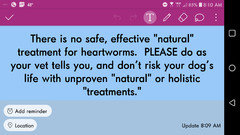
As far as the risks to your specific dog, your vet is the person to ask about that after complete staging is done. I want to emphasize that heartworm disease is 100% fatal when not treated, and while there are certainly risks to treating heartworm disease there are ways to minimize those risks specific to your dog. While I am generally for a natural approach to treating most diseases, there is no scientific evidence that any of the "natural" remedies actually work or are safe. I personally would not treat my dogs with anything other than the most appropriate scientifically proven recommended protocol- heartworms are WAY to dangerous to justify playing around with unproven remedies.
Here is a link that might be useful: immiticide product label
dobesrule
16 years agolast modified: 9 years agoDefinatly agree with Meghane here. If your dog is not heavily infested then I would go with the heartguard treatment.
Lisa
anita22
16 years agolast modified: 9 years agoFWIW, I also agree with meghane and dobesrule. Good that you are doing research and hope your vet communicates well so you end up with all the info you need to make a good decision.
debd18
16 years agolast modified: 9 years agoMeghane, I was surprised that you said to put the dog on heartworm preventative immediately. I had always heard that could kill a heartworm positive dog and that's why they should be tested before starting preventative treatment. Could you please explain? Thanks.
Meghane
16 years agolast modified: 9 years agoThe recommendation that dogs that have heartworms cannot have heartworm prevention comes from the old days when we didn't have the newer once monthly preventatives. DEC, the old daily HWP, would cause severe GI distress that could lead to shock and death if given to dogs that have heartworms. Therefore if a dog was off prevention, they had to be tested before starting HWP again. Now that we have other preventatives, we can give HWP to dogs even if they are positive. In fact it is highly recommended that dogs with heartworms start taking Heartgard immediately to prevent an even worse infection. And now it has been shown that giving Heartgard to stage I (the least clinically affected) positive dogs slowly kills the worms in a safe manner.
I haven't heartworm tested my dogs in years because I give them prevention year round. I tested my strays immediately when I got them and again 6 and 12 months later to make sure they were not infected (it takes 6 months for an infected dog to test positive), but they were on HWP as soon as I got them. The other reason to test is to make sure the product is working, or if you don't give prevention year round, in case of an early spring or late fall mosquito.
mazer415
16 years agolast modified: 9 years agoBe careful when using natural remedies, they can have devastating side effects and are not as effective in most cases than the current medical treatment...Please do alot of reading regarding whatever natural or holisitc treatment you decide on. PS - Im sorry to hear your dog is infested...heartworm is a horrible pest. Are you treating your pup for its arthritis??
alisande
Original Author16 years agolast modified: 9 years agoI, too, thought it was ill-advised to give Heartgard to a dog with heartworm. Good to have this information. Thanks, Meghane and everyone. Wolfy has an appointment with the vet tomorrow. She hasn't mentioned starting him on Heartgard, but I certainly will.
The alternative treatment that was suggested to me consists of heartworm nosode, Tibetan Anti Parasite (I don't know yet what's in that) and an organic Black walnut tincture. I'm still weighing my options.
Mazer, yes, Wolfy is on Previcox (canine version of Celebrex) for his arthritis. He tolerates it well, but it's so expensive! It costs about $100 a month, which is a lot for me.
Susan
debd18
16 years agolast modified: 9 years agoThanks for the explanation, Meghane. That's good to know.
annzgw
16 years agolast modified: 9 years agoAnd I believe, just as with humans, one has to be careful when using herbal treatments along with pharmaceuticals.
alisande
Original Author16 years agolast modified: 9 years agoI took Wolfy for his blood test today and it showed microfilariaor, as it was explained to me, the adult heartworms are producing babies. The vet refused to start Wolfy on Heartgard, saying it was a dangerous thing to do.
Meghane, you're a vet, aren't you? My vet is young (I'm guessing early thirties), and I would think she'd be on top of this issue. The woman who recommended the alternative treatment also said it was imperative that Wolfy get started on Heartgard immediately. I can check with other vets in the area, but I'll be surprised if they don't all think alike. Although Wolfy's original vet (whom he saw up until last month) never even suggested heartworm prevention, so who knows?
She said that given Wolfy's age, if we don't treat the heartworms it's possible, even likely, that he will die of another cause.
The treatment she outlined included the following: HWtreat, adulticide, and Ivomec. Cost is about $480.
Today she recommended a urine test to see how his kidneys are functioning because his bloodwork showed an elevated BUN. She explained that we wouldn't want to embark on treatment that would cause his kidneys to fail. So I guess the next step is for me to collect a urine sample.
Meghane
16 years agolast modified: 9 years agoI'll be a vet in 2 months, so technically not yet.
Not all vet schools are as good at teaching about heartworm disease. I noticed you are in the frigid zone 4b, so there probably isn't a lot of heartworms there, and therefore vets don't keep up with the recommendations so much. NC happens to be in a very endemic area, so we see a LOT of heartworm disease and do a LOT of treating, plus we have to use prevention year round, or the dogs WILL get heartworms.
This is directly from the American Heartworm Society Guidelines except I inserted the brand names of products in parenthesis.
"Administration of a chemoprophylactic dose of a macrocyclic lactone (Heartgard/Ivomec, Interceptor, Revolution) should begin as soon as the dog is diagnosed with a heartworm infection. While controversial due to the theoretical risk of inducing resistance to macrocyclic lactones, it may be beneficial to administer a macrocyclic lactone for up to six months prior to administration of melarsomine (Immiticide), when the clinical presentation does not demand immediate intervention. The reasoning for this approach is to reduce circulating microfilariae and kill migrating D. immitis larvae, and in the case of ivermectin (Heartgard, Ivomec), stunt immature D. immitis and reduce female worm mass by inhibiting the reproductive system. Milbemycin also sterilizes female worms, but it does not affect worms older than four months. Administration for greater than three months should result in reduced antigenic mass, which in turn may reduce the risk of pulmonary thromboembolism. Depending on the season and geographic locale, administration for three months also will allow immature worms to reach an age at which they are known to be susceptible to killing by melarsomine."
As far as using Immiticide in renal disease, the drug label states that at 2-3 times the recommended dose every day for 14 days, some dogs developed renal disease. Immiticide is not renal toxic at normal doses, so there is no contraindication for treating based on that.
That said, your vet is correct that you're not likely to buy him a bunch of time by killing off the worms immediately, and since he isn't clinical and probably already calm (wouldn't need exercise restriction) his quantity and quality of life would remain at least the same.
OTOH, the renal disease may actually shorten his life. I'd ask the vet about if there are other options besides NSAIDs that would help Wolfy with his arthritis, as all NSAIDs can have bad renal effects. Since he already has some degree of renal disease (how much depends on additional diagnostics such as urine specific gravity, urine protein:creatinine ratio, etc.) it would be better to avoid NSAIDs for him. A different medication such as Tramadol may help control his pain, and big bonus for you, it's a LOT cheaper than piroxicam. There are other options too if just Tramadol is not enough, such as gabapentin, but they tend to be more expensive (we have awesome pain management service and club).
Just based on what you have said, I'd be inclined to do just the monthly Heartgard as a slow kill and try to manage his renal disease and arthritis.
alisande
Original Author15 years agolast modified: 9 years agoI have an update!
The vet I was seeing when I started this thread flatly refused to prescribe Heartgard. I went back to Wolfy's original vet, who readily agreed to prescribe it, and in fact said it was his preferred treatment for an elderly dog with heartworm. I was relieved to get this resolved so readily.
AND, after making a game of it and tossing the Heartgard (by halves) over and over to the reluctant Wolfy, I'm delighted to say that he finally ate his first dose.
Thanks again for the invaluable help.
Susan
cindyxeus
15 years agolast modified: 9 years agoI agree 100% with everything Meghane said.I'm all for natural alternatives, but not when it comes to heartworm.
Meghane
15 years agolast modified: 9 years agoI'm so glad that Wolfy is getting treated. It's a shame your vet wasn't wiling to help him, but I;m glad that your original vet is up to date on this treatment.
My ferret loves his Heartgard (yep, ferrets get it too, usually fatal) prevention every month, but he doesn't play catch. He grabs it from my hands and runs off into a corner to eat his very special treat. My dogs are on Interceptor and take their prevention in peanut butter, along with the rest of their pills.
mazer415
15 years agolast modified: 9 years agoI am glad you have gotten heartguard. Please put any other animals on it immediately. We have to ground some hamburger and dip the heartguard chewables in the grease for one of our dogs, the other gets pill form shoved down his throat since he wont eat anything and the other one eats his chewable. I am very glad you did not choose any alternatives, wormwood can have some very detrimental side effects. Also what is the update on your pups kidneys??
gmoney1227
15 years agolast modified: 9 years agoI have a 7 year old Shih Tzu who since he's been a puppy, has gagged and dry coughed periodically. But about a month ago, he started throwing up everyday, once a day for about a week. So I took him to the vet. I told the vet I had changed his food abruptly about a month before his vomiting began. I didn't think the food was the cause since he didn't begin vomiting until a month after I changed the food. And he'd vomit hours after he had eaten, and it was just bile.
So my vet put him on some antibiotic that he said is to treat all sorts of worms, except heartworms. I also decided to change him back to his old food, just to be safe.
So now two weeks later, he's only thrown up once since, but lately that snorting, gagging, dry coughing that I described earlier he's done since a puppy, has turned from every now and then, to several times a day.
I'm concerned... could this be heartworms? If it isn't... any ideas what it could be? And even if it isn't heartworms, or if it is... should I put him on Heartguard? Thanks in advance for your help.
PS. Since he's in indoor dog, he's never had fleas. But recently I took him to get groomed and shortly after, I found fleas on him, so I put him on Advantage. Could there be some link to what's happening to him now, and the fleas?
Meghane
15 years agolast modified: 9 years agogmoney1227- a dry hacking cough could be heartworms. I would get him tested because if he does have them, he needs to be treated. Heartgard would be part of the treatment but not the only part. Your vet would be able to tell you the heartworm risk in your area and when you need heartworm prevention.
The cough could be a lot of different things though, including collapsing trachea (common in small breed dogs), allergies, or any other number of problems; impossible for me to say. I don't think Advantage had anything to do with it; I've never heard of coughing as an adverse reaction to it.
gmoney1227
15 years agolast modified: 9 years agoThank you meghane :-) I will definitely talk to my vet and let you know what happens.
In regards to my comment about the fleas and Advantage, I wasn't assuming it was the Advantage causing him problems, I was thinking maybe the fleas did. Any thoughts?
wildcraft
11 years agolast modified: 9 years agoSo, what are the effects of using a heart worm prescription year round on a dog. To me it seems uncannily close to drugs we humans take, that negatively affect our vital organs, by making them work harder, poisoning the body, as one needs to to kill worms and parasites. I know heart worms are fatal. I also have seen the negative effects of giving preventative medicine...even though the drugs don't prevent heart worm but kill them. Perhaps we need to figure out other ways of cleansing our dogs, with black walnut hulls, which dogs are apt to chew themselves when infected. In nature, animals will eat plants that a medicinally active when they are sick. They wouldn't touch wormwood or black walnut if they were healthy, but somehow they know. Just an extra tidbit for ya. If you live in an area with standing water, garlic oil sprayed on the surface will kill mosquito larvae. It really works. Used if at my ads place on a lake for years, never had a mosquito even though he was in the marshier area of the lake.
fairfield8619
11 years agolast modified: 9 years agoThe vast majority of people and their pets live healthy lives because of preventative medicine. I would not mess around with black walnut hulls and such stuff. Do what the vet or the doctor tells you to. Animals in the wild live short and often hard lives. We have progressed a long way in medicine, why go backwards to witch doctors and stuff like that. Please don't encourage people to self diagnose their pets.
fairfield8619
11 years agolast modified: 9 years agoYour mind is made up, there is nothing you will listen to. Unfortunately you have unwarranted paranoia- it is rampant these days. I wish you good will.

spedigrees z4VT
11 years agolast modified: 9 years agoI live in northern New England and I have had my dogs on HW preventative year round for the past decade at least. The advice of my vets here is to treat with preventatives year round, and to test once annually for HW (as well as Lyme which is epidemic here, and other tick born diseases). There are several options for monthly HW prevention, which include heartgard (ivermectin) and its generics, as well as revolution (selemectin).
In the old days we prevented HW with the daily carbamazine citrate tablets from Oct - May, but times have changed, and newer drugs have emerged. This older medication could be harmful or lethal if given to a HW positive dog, so we always tested for HW each fall before starting our dogs on this drug.
When the monthly HW preventatives came out the original advice was to test our dogs once every two years, but now they recommend annual testing due to the growing prevalence of heartworm disease, and perhaps also due to increasing resistence of the parasite to the drugs.
Heartworm is a lethal disease if untreated, and it is easily prevented. My grandfather's dog, and my best friend as a kid (in a sense my first dog) died from heartworms in the early 1960s when the disease was basically unknown in CT and the rest of the northeast, but was beginning to travel northward. Duke was too far gone to treat. A decade later when I got my first dog, my first beautiful collie, you can bet I was relieved and delighted to have a medication available to protect him from the same fate as Duke.
I've owned 7 dogs in my lifetime. All have been on HW protective meds, the first 3 for the winter months, and the latter 4 more recently, year round, as the disease has spread northward. None of these drugs has caused harm to any of my dogs, and the only one of my dogs to ever have had the disease is my little rescue dog who contracted it in the south where he came from. The kind lady who pulled him from the pound treated him for the disease before I adopted him.
Heartworm is nothing to fool around with. You owe it to your dogs (and cats) to provide them with protection.
erinp6
10 years agolast modified: 9 years agoWe have a 1 1/2 year old JRT who was tested last Spring and noted to be OK, he has been on preventative meds since that time. We found out yesterday he has heartworms. We were shocked to say the least and very disappointed that this product did not work. Our 7 year old JRT takes HeartGard as well and we haven't had any troubles. Both take it year round.
Thanks for all of the good info above. Our boy is small (13 lbs.), young, and otherwise healthy, so he should take the treatments OK.
We're just really ticked off that getting tested and taking the preventative medicine did not work for us. Is there anything that can be taken with the treatments or afterwards with the HeartGard to ensure that this doesn't happen again? My understanding is that this is going to costs upwards of $1200 for the treatment. Since we thought we were preventing it the frist time, we'd like to make sure it doesn't happen again (with either dog!)
Thanks!
lzrddr
10 years agolast modified: 9 years agoFirst question... your 1.5 year old dog was tested last year... up until then had it been on preventative or was he living in a heartworm climate for 1.5 years without protection? If it was the latter, sometimes a negative test is negative because it did not pick up an early infection, or if the test was a microfilarial test, it will miss infections of worms if they are all one sex (if not infected with both sexes- no babies, and no positive microfilarial test).
What test was done to show your dog has heartworms? If it was a microfilarial test, be sure they got the species right... sometimes a technician will identify a harmless microfilaria as a heart worm (Dipetalonemas can look like Dirofilaria microfilaria to an inexperienced or careless technician). And if it the test was a serological one, those can sometimes come out positive and there are no heart worms (we see that sometimes here in California where we have very few heart worms, so have learned to recheck all positive tests- many times the subsequent tests are negative). I recommend retest with BOTH tests before you start a potentially risky treatment (not to mention expensive).
Also, if your do has been on Heartgard religiously, usually the company will pay for all the treatments (be sure you let them know your dog was on it year round!). Still, no fun to go through that treatment.
Find out if your dog is heavily infected or not, as sometimes a single worm is not that big a deal and even keeping your pet on Heartgard has been shown to kill off a few adults eventually, or at least lessen the worm burden. I find it hard to believe your pet has many worms if he's been on the preventative that consistently.
Marinewifenc
10 years agolast modified: 9 years agoIf your dog is only 1.5 years old and tested neg last time to hw he can't be heavily infested. The $1200 treatment is completely unnecessary for him. It takes 6 months for lavae to become adult HWs and all larvae can be killed with ivermectin monthly leaving only the adults which will die off on their own.
I foster dogs and we go with the slow kill method all the time and it has been effective in all my dogs within a year. If your vet doesn't like the slow kill method find a vet that does. Heartworm treatment (not preventatives but the actual treatment) is dangerous to a dog, especially old ones, and totally unncessary for a young dog or one who isn't heavily infested.
My most recent foster was HW postive female 1 year old, one year later on ivermectin monthly she is negative. She had two postive tests before her negative. Additionally treatment with doxycycline usually wo weeks on can speed things up and done every 6 months or so. Mine have not needed the doxy. Doxy is a very cheap drug so find a vet who will write a prescription for it and fill it through dr fosters.
eahamel
10 years agolast modified: 9 years agoI rescued a dog about 1-1/2 years ago. She was very heartworm positive. She was 6 and had never been on preventive and lived outdoors. The vet could hear the heartworms with his stethoscope, that's how bad they were. He didn't want to use the shots on her because he thought they would kill her. They don't use the shots any more because of the doxy treatment, see next paragraph.
The vet used what's called the "slow" treatment, which is the doxy at 3 month intervals for a month each time. Treatment started with a steroid shot to weaken the heartworms. She gets ivermectin every month, as do my other dogs. After 1 year she is negative! The vet thought it would take 2 years to clear them up. It didn't affect her at all, not like the heartworm shots would. Cost was approximately $175 total, spread out over a year.
The person I got her from took her to the vet to update her shots and get her heartworm test, and they gave him a detailed outline of a heartworm treatment that was frankly ridiculous, unnecessary treatments and tests, and would cost around $1400. I told the owner to forget that nonsense.
Marinewifenc
10 years agolast modified: 9 years agoI feel the need to write more.
eahamel: That is great that your vet recommended the slow kill method. You have a great vet.Heartworm TREATMENT is the scam of the century for vet clinics. I too was quoted $1400, and refused ivermectin period. ivermectin is perfectly safe for dogs with heartworm, some heartworm pills can kill a dog with heartworm but ivermectin is not one of them. Every one of the $1000 treatments outlined a period of ivermectin to start things off. Any vet that won't discuss the slow kill method with you is not a vet to go to.
Also to avoid any confusion ivermectin is a heartworm preventative, it's the generic form and regularly prescribed preventative. So treating your heartworm positive dog with ivermectin is not costing you any more than you should have been paying anyways. Dogs should be on heartworm preventative. I have seen too many cases of heartworm positive dogs to believe otherwise. Knowing heartworm will kill a dog I will not let a dog go without a preventative.
Also, probably obvious but I want to say it just in case. If you have a 50lb dog, you can not buy the pills for 100lb dogs and break them in half. The medicine is not evenly distributed in a pill so that half may not have any in it. Give it with food and make sure the dog doesn't throw up. And a 52 lb dog should not be given the 50lb and under pill.
There are far far more things that can hurt your dog than a heartworm preventative. I don't agree with anyone ever skipping that, or skipping any vaccines.
Want to do something great for your dogs health? Don't skip the heartworm piill. Start with food, lots of food are unhealthy, lots of treats are unhealthy, most dogs aren't dewormed after being a puppy, bowls aren't cleaned often enough, toxic plants all over the yard with dogs, and puddle water, there's no avoiding it, your dog is going to drink it, and gardia makes for quite a sick dog. avoid any of that. avoid bad store brand topical flea and tick oil. Just don't skip out on that heartworm pill.
In regards to poisoning your dog with heartworm pills. I guess all I have to say is this, garlic is poisonous to dogs. Black walnut is also toxic to dogs. So if they are killing the heartworm they are doing it because they are toxic to the dog. Unless you are a chemist who knows the exact amount to avoid toxic reactions I would stay away from any treatment toxic to dogs, one may do just fine and one may not. At least with heartworm preventative many studies have been done in that area.
chickadee4
10 years agolast modified: 9 years agoYears ago we discharged the patients with the oral liquid antibiotic instructing the correct dose and how often and what to do if you skipped a dose or the child vomited.
About 70 percent of the time the moms would call saying they did not have enough medicine . On each dose they gave just a little more .Each bottle only held the maximum dose to be given over the ten or 14 day requirement.They ran out on day 8 or 9.This is no different when using garlic or other natural things to rid the animals of worms. People tend to overdose!!!!!
I use garlic on my dogs and plan to do this with the chickens. I do not dose any dog who weighs less then 20 pounds with garlic. I actually rotate them on and off the garlic . The mosquitoes leave them alone. I also test for heart worm and have been negative for 8 years.
The key to any effective medical program is observation. You titrate the dose and watch to see if it is efficacious.
As I see it Ivermectin and garlic are both toxic and you need to be vigilant . Just cause one dog tolerated the interceptor or ivermectin does not mean every dog can use it. I have had goldens who go ataxia on heartgard so we went on interceptor. I prefer the garlic due to the price and effectiveness.
When we lived in Europe we did not use heart worm medicine. when we moved to California they placed the aussie on ivertmectin . I told them she was drooling, ataxia and out of it..... They insisted I keep giving her the heartworm med. " yes she had the gene>Why is lipitor bad for women? Some women can not tolerate this med. It is no different with canines
With any drug or food each living organism processes it differently. YOu are not tossing treats to your pet when you give the monthly heartworm medicine. Just as you check your face in the morning, You all need to do a health check on the animals.I told my neighbor that I have two packs of coyotes .
He said it is unnecessary to take his cat in.
Just as the neighbor thinks there is no harm to the cat others do as they please with drugs and overdose.
They think a little more won't hurt.I use black walnut.
I use it sparingly. The dose is drops NOT an entire dropperful.
I use garlic and this too is used in small doses and rotated.
When people ask what the dose is I tell them to use the interceptor or heartgard.
I do a tick check after each outing. It takes a minute to do each dog.I only posted cause some know what they are doing in using black walnut and garlic.
I just found worms in my free range chickens. I can give piperazine or ACV or garlic. THe piperazine will mean to toss their eggs . Apple cider vinegar will be placed in their water. I will sprinkle garlic powder on their feed as soon as I know how much to give.OK descending from my soap box

Judy Maxwell
8 years agoSusan
I have a border that has heartworms so bad that she wakes us up coughing and gaging.. I did not want to use the shots so I found a mixture this man makes up out of natural ingredients. I now have given this to her for two weeks now and she has all but stopped the gaging. The man who does this is on youtube and is now dying of cancer. Just look for videos on youtube..it's called Creation Healing...all I know is it works..I give her the dropper about 1/4 full every day....judymaxwell73533@gmail.com
SaltiDawg
8 years agolast modified: 8 years agoThis is one of the most incredible - and scary - threads ever.
Now eight years later I'd follow my Vet's Protocol if I had a dog test Heartworm Positive. If I disagreed, I'd research and consult a second Vet.
The real elephant in the room is the question as to how all of these owners of infected dogs allowed their pet to become infected.
lenadroujko
7 years agoThank you everyone for the information.
Meghane, I find you very knowledgeable and was hoping you can advice me in this complicated scenario.
My 9 year old GSD was tested heartworm positive early spring 2016. She also got first signs of DM (degenerative myelopathy) in January same year, and was diagnosed in the spring. Since then we’ve been treating her with alternative medicine for heartworm, on and off, with breaks, but unsuccessful. Although, we are able to contain lower level of microfileria (1124 according to the latest blood test in November), but she still tests positive for heartworm. The reason we are scared to expose her to the full-blown conventional treatment with antibiotics and shots is because her immune system is already compromised by the DM (as you know it is autoimmune disease). Currently she is on DR. Clemmons supportive medicine for DM (aminocaproic acid (EACA) and n-acetylcysteine (NAC) and vitamins, etc). You are probably familiar with Dr. Clemmons and his research on DM, where he provides in depth articles about DM dogs, etc. Bellow is the link to his site, in case you're interested: dog2doc.com
http://dog2doc.com/neuro/DM_Web/DMofGS.htm
In short, my dogs back legs are slowly declining, she still walks, but with help now. We do everything we can to keep her walking, including proper diet, exercise, supportive medicine, antioxidants, acupuncture and chiropractic adjustments. Based on this information, what course of a LEAST invasive heartworm treatment would you recommend? i'm afraid that conventional treatment may trigger faster decline in her ability to walk and faster progression of the disease.
I really hope to get an answer. Please help!
We also ready to purchase a wheelcahir for her, but there are so many options, and I just wanted to ask if anyone may recommend a supplier, or a website, or a particular wheelchair that will suite the best criteria such as functionality/mobility, weight, easy in use, cost effective, etc. We would greatly appreciate your input!
palmbob
7 years agoI think at one time it was hypothesized that degenerative myelopathy was a immune related problem, but I think that theory has been disproven. It is now considered a genetic mutation, or a heritable condition. As far as we can tell, the immune system does not seem to be involved and treating for immune problems/symptoms has had very little effect in the past. Actually, very little other than physiotherapy has had much effect on this condition so far, but research is in earnest since it is so pervasive and problematic.
So if your pets heart worm disease is clinical, you could treat it less aggressively with low dose avermectins and Doxyclycine... most cases will gradually show a decrease in worm burdens. I have never seen any physical neurologic or muscular decline with any treatments of heart worm disease, though aggressive treatment with heavy worm burdens is a bit risky (pulmonary complications or embolisms can occur).
lenadroujko
7 years agoThank you very much, Palmbob for your prompt reply. I appreciate it. I'm under a lot of stress and worries in this unfortunate situation. with so much information available out there i feel like hitting brick wall... Are you a vet?

kwie2011
7 years agoLenadroujko, join the degenerative myelopathy yahoo group. You'll get the best inflrmstion and support available in that group. Their combined knowledge is immense. I don't know what is have done without then during my GSD's long battle with it. You'll also get help with slings, carts, and so on.
Just go to Yahoo.com and look around for a groups list, then search out the DM group and send them a note.
Bob is correct. DM is genetic. The DNA test can be purchased online now for about $35-$75 depending on the lab. If a dog had two copies of the gene, there's something like an 80% or 90% chance of developing symptoms. Sadly, no immune-suppressing drugs help. Mercifully, it isn't painful at all, and dogs adapt very well.
Get a cart while your dog can still walk. Doing so makes the transition to a cart very easy. Mia loved hers. She hiked, chased a ball, and ran like the wind in that thing. DM is easier on dogs than it is on the people who love them.
if you need help, PM me through my profile.HU-748459008
4 years agoI need to know what to do with a dog that is roughly 6 years old and is infested with heartworms. What would be the safest route to help him?
SaltiDawg
4 years agolast modified: 4 years agoYou come to a decade old thread? If you KNOW your dog is heavily Heartworm infested, it means you have seen a Vet.
Don't know why you are here... take your poor dog to the Vet for treatment.
The fact that you allowed your dog to become heavily infested suggests that you have not done well by your dog as far as providing health care. Is your dog well fed, current on Rabies Shots and other shots? How about flea and tick control?











wildcraft