

|
Follow-Up Postings:
|
- Posted by mainegrower (My Page) on Tue, Dec 29, 09 at 5:37
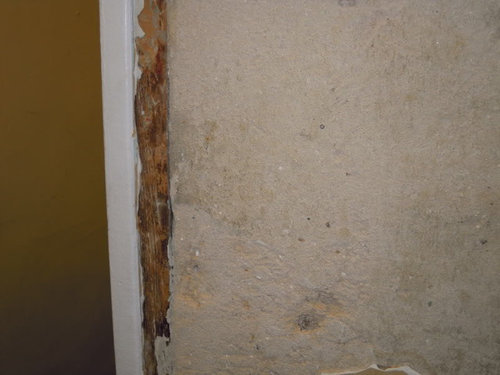
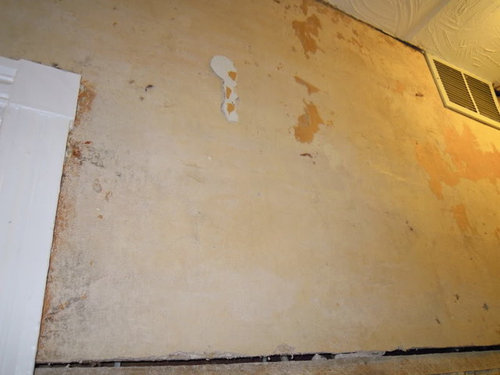
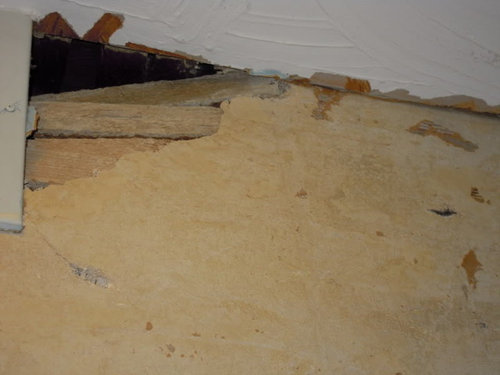
| It was common in houses of this vintage to not have a finish plaster coat. The intention was that the walls would always be papered. If you intend to undertake the restoration yourself, be prepared for a difficult and time consuming task. In places where sizable areas of plaster are missing right down to the wooden lath, pieces of sheet rock cut to fit and attached to the lathing with drywall screws is probably the easiest first step. Smaller holes can be filled with joint compound. Areas of crumbling plaster need to be removed back to sound areas, Finishing the whole wall smoothly is not easy. Fiberglass mesh comes in 3 to 4 foot wide rolls. This has an adhesive on one side so it can be applied to the wall like wall paper. After that, it's layers of joint compound sanded and smoothed between coats, followed by primer and paint. The trouble with using joint compound is that it does not provide a hard surface like finish plaster, so it is prone to damage. Using actual plaster is not a DIY project. Plastering is a highly skilled trade that takes years to master. There used to be a product called Nuwall - not sure if it's still on the market. This was a fiberglass cloth applied to the wall and then impregnated with resin. Left a hard, durable coat, but was never as easy to do as the manufacturer's directions implied. |
|
- Posted by christophern (My Page) on Tue, Dec 29, 09 at 6:16
| Nu wall is still out there but it is VERY difficult to work with.I hang paper for a living and found this product still hard to do. It does the job very well though. |
Here is a link that might be useful: nu wall
|
- Posted by sombreuil_mongrel (My Page) on Tue, Dec 29, 09 at 16:22
| If you wanted to, you could do the repairs with the original lime and horsehair plaster. It just has a rather long delay between when it is complete and when it can be painted. The time is measured in months. Before this summer, I was unacquainted with lime & horsehair, but the experiences I had with the material were mixed; it's kind of finicky and troublesome. There is a growing consensus in the preservation world that using gypsum-based repair products (Gypsolite/Structolite, Durabond, Easysand, gaging plaster, patching plaster, plaster of paris) are all doomed in the long run because they fail to chemically bond to the lime beneath. So, unless you choose to use old-fashioned lime, you need to assure a mechanical bond for the patching material. We have been using plaster bonding agent to get a bond between old and new for many years. Brands are Link and Plasterweld (among others). It's brushed or sprayed on to cleaned plaster surfaces, or any kind of substrate like wood lath, brick, etc. Then the required patching material is troweled on. In cases where the plaster is entirely missing, a scratch coat is applied (Structolite type) followed by a brown coat (same material) and if a float finish is all that's needed, you may be done. If a white coat is called for, it can be done with typical lime & gaging, or for the less intrepid, Durabond 90 can be troweled on and worked smooth; uneven areas being worked smooth later with ordinary (green-label) drywall mud or a harder product such as Easysand. Casey |
|
- Posted by slateberry51 (My Page) on Tue, Dec 29, 09 at 17:36
| Not much to add, but after repairs and before painting my 120 yo bare plaster walls, my painters gave them a coat of Farrow and Ball stabilising primer. It's a product we stumbled on and they were very impressed with it. At the time I did not appreciate the significance of the phrase "alkali resistance" on the product sheet, but since then I've heard about people running into trouble painting over old plaster. Apparently it is more alkali than modern base surfaces. So, it might be useful for you. from their advice sheet: Disclaimer: I'm a huge farrow and ball fan, but I like Ellen Kennon too. Not affiliated with either co. |
Here is a link that might be useful: stabilising primer
|
| "If you wanted to, you could do the repairs with the original lime and horsehair plaster. It just has a rather long delay between when it is complete and when it can be painted. The time is measured in months. " Straight lime putty was not commonly used in the US for plastering, mostly because of the very long cure times. The base coat (brown coat) was lime putty, sand, horsehair, and gauging plaster. The second coat (scratch coat) was lime putty, sand, and gauging plaster. The surface was textured when partly set to provide better mechanical bonding for the finish coat. The finish coat was lime putty and gauging plaster. If the surface dried (like over a weekend) it was dampened before the next layer was applied. The curing time is around a week in a heated space, and after that it can be painted. Bonding to old plaster with Easysand or Durabond often fails since the old material is very dry, and pulls moisture from the new preventing it from curing correctly (Easysand and Durabond cure by chemical reaction, not drying out like pre-mixed joint compound). There are also binding agents. Many are polyvinyl acetate based the same as Elmer's Glue. Old plaster walls intended to be papered may not have a finish coat, but a smooth scratch coat. One thing often missed in plaster work is the use of retarders to slow the setting time of the plaster. "Plastering" by Sawyer is a standard text. |
Please Note: Only registered members are able to post messages to this forum. If you are a member, please log in. If you aren't yet a member, join now!
Return to the Old House Forum
Instructions
- You must be a registered member and logged in to post messages on our forums.
- Posting is a two-step process. Once you have composed your message, you will be taken to the preview page. You will then have a chance to review the contents and make changes.
- After posting your message, you may need to refresh the forum page in order to see it.
- It is illegal to post copyrighted material without the owner's consent.
- HTML codes are allowed in the message field only.
- No advertising is allowed in any of the forums.
- If you would like to practice posting or uploading photos, please visit our Test forum.
- If you need assistance, please Contact Us and we will be happy to help.