


|
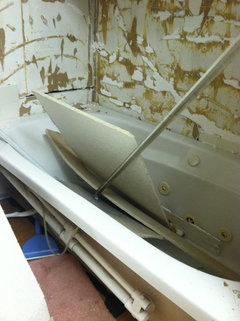
| I've been working on the bathroom, now. (Sequel to "The void under the stairs", really). As I usually do, I've ended up doing more than I probably should've. :-). Why just dig out all caulking, when you could rip out everything??? Right?
The silicone(?) caulk that I dug out was yucky with grey & black stuff. (Gee, that doesn't look right..), so - of course, I HAD to see what else was going on. Now, after destroying the perfectly good shower wall panels, I now find that there are a few things that make me unsure how to proceed. First, I've discovered that part of the walls around tub are drywall - & part of them are plywood. There's no rhyme or reason to it - top 1/2 of one wall plywood... Bottom 1/2 of another is plywood. It's been so long since we replaced the old shower wall that we didn't remember what was back there - we just left it as it was & put different panels up. (We did not put drywall or plywood there, btw, it was existing).
The other question - many bath/shower surrounds I've looked at say can be installed directly to drywall... Some don't. Should I put something else up first, even if manufacturer says it's not necessary? I want to do this right - & not ever do it again. I'm at the point where I need to either remove more material - the plywood or the drywall?) or get going buying & installing a new surround. Suggestions? |
Follow-Up Postings:
|
- Posted by columbusguy1 (My Page) on Sun, Aug 28, 11 at 21:31
| First, ks, what does the top of the tub look like...is there a lip at the back edge which goes up the wall a bit? If so, this is where you would have fastened the tub to the studs. If not, that complicates things a bit....:) From what I can recall, neither drywall or plywood should be used around a tub of any sort...unless it's a special item like cement board, which won't mold. If there is a lip on the tub top, then this board sits just above the tub IN FRONT of that lip. You would need to caulk and seal all the joints in the cement board, using mold resistant materials...THEN I'd install the enclosure panels as per recommendations. I've not done this, but that seems the best way to prevent leaks...my shower is an add-on attachment to the original faucet, and shower curtains keep the water away from the window and wall behind the tub. |
|
| "Should I put something else up first, even if manufacturer says it's not necessary?" You should always follow the manufactures instructions. BTW - if you have water getting out of the tub, it really doesn't matter if there is wood or drywall behind it. Something bad is going to happen either way. The only way to avoid damage is to keep the water in the tub in the first place. |
|
- Posted by ks_toolgirl (My Page) on Tue, Aug 30, 11 at 0:55
| Took ages to reply! Prep for school, family needing me, & bath demo all have me SO beat - I might fall asleep typing. More research has shown me that DH was correct - wood does react in a bad way to bathroom environment, therefor not recommended in this situation. It's going - started already. Columbusguy - there is no "flange?" on this tub. It was, it seems, intended to be a drop-in, alternate inset instructions were followed. They came with the tub, but are gone & can't find any online info corroborating it. Billl - a (separate printout) instruction from manufacturer was what was used, as an alternate installation option. I wish I'd saved it - Can't find same info now online. Like it never existed at all. I'd love to keep the water in the tub in the first place! However, it's also our only shower - & 2 young boys (4 &12) taking baths? Man-cubs are splashy-by-nature, lol. I keep scolding... People keep giving "bath toys"... A relentless battle. :-) FWIW, I'm not destroying the bathroom walls for the fun of it... It's to fix the problem, permanently.. I'm trying to make sure there will be no leaks - ever again. |
|
- Posted by columbusguy1 (My Page) on Tue, Aug 30, 11 at 14:53
| ks, since there's no flange to the tub, any surround is going to be a problem because water will just roll right over the side should the caulking fail...as you discovered. :( This just occurred to me, it may work: use that ice-dam preventer film around the rim of the tub--run it up about a foot, and stick it to the top of the tub so that it will be covered with the surround or a thin layer of drywall first...then caulk all the joints and bottom of the surround. If water should get behind the surround, the ice dam 'rubber' should stop it. Just a thought. |
|
- Posted by ks_toolgirl (My Page) on Wed, Aug 31, 11 at 0:03
| Ok, I've found a "Tub flange kit", online this afternoon. This is where I need to start, right? It's from menards - & a tad pricier than others I saw... http://www.menards.com/main/plumbing/bath/accessories/tile-flange-kit/ p-78628-c-5868.htm Will proper installation of something like this get me started in the right direction? I don't want to replace the spa-tub, cash is becoming an issue in this bathroom fiasco. |
|
- Posted by columbusguy1 (My Page) on Wed, Aug 31, 11 at 0:33
| ks, from the quick look I had for drop-in tubs, the top of the tub seems to curve down, rather than lay flat on a supporting structure...is yours like that too? If so, I don't see how this flange from Menards could work as it would at best be pointing out horizontally or also down. If the top of your tub is flat, then it MAY work...but since you would still have to caulk it, I'd save the $50 and try another solution. As I said, it depends on the rim of your tub whether this might work. Could you post a pic of the tub edge so we can tell what type it is? |
|
- Posted by ks_toolgirl (My Page) on Wed, Aug 31, 11 at 1:43
|
- Posted by columbusguy1 (My Page) on Wed, Aug 31, 11 at 2:10
| Man, ks...I sympathise with you--took out such a dropped ceiling in my kitchen about a year after moving in---started on one side, halfway across, saw the original plaster was gone in the far corner when some ass did plumbing work on the bath upstairs! So, had to just keep going, and discovered a couple pipes on the far side run below the old ceiling also...had to box that side in, and drywall the old ceiling also! Want fun? Put up drywall on a ceiling with one other person and a t-brace propped up on a milk crate! :) At least the fluourescent light and crap is gone, and so is the 70s cabinets. Got a brass fixture and found a hive-like shade that matches my main light in the living room! The pic shows what I needed...I THINK...the flange would snap onto the bottom of the rim, and thus do no good at all in keeping water from getting behind the wall...maybe someone with more experience could confirm that? I'd still go with the ice-dam self-stick material around the back and sides--attach it to the flat part of the tub rim, and run it up the wall, then tile or put up the surround. |
|
- Posted by ks_toolgirl (My Page) on Fri, Sep 2, 11 at 0:23
| Columbusguy, is this what you meant? Have you heard of this material being repurposed in this way? Thanks for your help. http://www.tarcoroofing.com/products/leak_barrier/ss400.asp Sorry to all, for being such a "forum-glutton", over poster. I don't have the knowledge I should. Too many years on the sidelines daydreaming, now I'm trying to QB. Spirit isn't broken, but it's cracked. |
|
- Posted by columbusguy1 (My Page) on Fri, Sep 2, 11 at 1:26
| Now I'm feeling like a forum hog too. :) That's the stuff, ks. I've had no experience with your problem since my tub is the old free-standing clawfoot type, but I can't see why it wouldn't work in this case--really less damaging conditions than outside. :) |
|
| "I'd love to keep the water in the tub in the first place! However, it's also our only shower - & 2 young boys (4 &12) taking baths? Man-cubs are splashy-by-nature, lol. I keep scolding... People keep giving "bath toys"... A relentless battle. :-) " Keeping water "in the tub" has nothing to do with how much they splash. It is all about the design of the system. Water is going to get past the first barrier whether it is tile or a surround or whatever. You want a second barrier behind that which slopes back and returns the water to the tub area instead of the wall cavity. Depending on the surround material you are using, that might be a poly sheet stapled to the studs or a modern topical membrane or an after market flange. |
|
| Gee, we didn't know any better so we drywalled and wallpapered our bathroom (and put a water-based finish on the wood floor - oh well). Our kids took every bath in childhood in that tub. Yes, I constrained their splashing although I will allow that mine were (a) a girl, and (b) a boy whose primary behavioural role model was the aforementioned girl, so in aggregate they likely were less splashy than 2 of (b). 18 years later, we are still on the original wallpaper, just a tad curled at a few of the edges. Not bad, considering. Our secret? Space FOR THE ESCAPED WATER TO DRY, thanks to an old-style freestanding tub. I freely admit I am NOT your "mop behind the tub every week" housewife (um, I'm not going to say how often I actually do this), so it wasn't a matter of wiping it up, but a matter of it being able to dry. I agree that if you can return the escaped water to the tub, by all means do so. But the other back-up for this system could be to vent the space around the tub - into the bathroom? through the wall into the next room? - so air goes through it. If you got jets on that there tub, perhaps you need a panel to have them accessible anyway. Can you make that one of those attractive antique vent covers or something equally authentic? Granted, where air goes, there too can go dust and maybe spiders, but a fine mesh behind can limit that. Just a thought. Karin L PS: Nice escape. Had a few of that nature myself. |
Please Note: Only registered members are able to post messages to this forum. If you are a member, please log in. If you aren't yet a member, join now!
Return to the Old House Forum
Instructions
- You must be a registered member and logged in to post messages on our forums.
- Posting is a two-step process. Once you have composed your message, you will be taken to the preview page. You will then have a chance to review the contents and make changes.
- After posting your message, you may need to refresh the forum page in order to see it.
- It is illegal to post copyrighted material without the owner's consent.
- HTML codes are allowed in the message field only.
- No advertising is allowed in any of the forums.
- If you would like to practice posting or uploading photos, please visit our Test forum.
- If you need assistance, please Contact Us and we will be happy to help.