





pine flooring refinish
Hi everyone,
I live in an old 1925 foursquare home that unfortunately has gone through alot of PO renovations.
The space I am inquiring about is our upstairs. We have three bedrooms and a bath. Since we've moved in, (2 years)
we've stripped wallpaper, gutted one bedroom, tore out carpeting and have since refinished all the rooms with fresh paint on the walls, doors and woodwork.
I have old pine floors throughout. I have considered carpet and have decided against it. I had an estimate done and the cost to refinish is less than carpet. I am thrilled because I prefer the natural floors, hands down.
My questions on the floor are this:
How nice do refinished pine floors come out?
Are the endless carpet nails and tackstrip removal extremely apparant?
What kind of filler is used when filling cracks, nail marks, etc..
Our floor installer also told me that he'd use a water based finish. He said that the oils are becoming illegal to use and that the product he uses is professional grade and extremely durable.
Can someone that has had pine floors educate/prepare me for what I am in for and also what to expect?
Thanks so much!!
Dawn
Comments (71)

sarahandbray
17 years agolast modified: 9 years agoI know this is an old thread, but are there any pictures of pine with waterlox anyone wants to share? I, too, am considering Waterlox as a compromise between DH's love of the super-poly gym floor look and my desire for the richness and authenticity of tung oil!!
-Sarah
bulldinkie
17 years agolast modified: 9 years agoPoly doesnt necessarily mean high sheen ...They have low,satin sheen too .We used satin just a slight shine.
Related Professionals
Federal Heights Kitchen & Bathroom Designers · Magna Kitchen & Bathroom Designers · Springfield Kitchen & Bathroom Designers · Reedley Kitchen & Bathroom Designers · Terryville Kitchen & Bathroom Designers · Crestline Kitchen & Bathroom Remodelers · Lincoln Kitchen & Bathroom Remodelers · Morgan Hill Kitchen & Bathroom Remodelers · Republic Kitchen & Bathroom Remodelers · Spanish Springs Kitchen & Bathroom Remodelers · Tulsa Kitchen & Bathroom Remodelers · Clayton Architects & Building Designers · De Pere Architects & Building Designers · Fort Lewis Architects & Building Designers · Plainville Architects & Building DesignersUser
17 years agolast modified: 9 years agoOur heartpine floors in our 1890 home are not "soft" and they certainly don't have splinters. They are all 2 1/2" wide boards...the statement about heart pine only being wide is mistaken. There are all kinds in our historic district but the vast majority are exactly like ours. They sand up beautifully and look like honey. We also have some that is "wormy" which I love also. We had them all coated with satin poly...4 coats. They still look good 3 1/2 yrs later and get a lot of hard use due to much company and water from the pool tracked in. Just my 2 cents.
bulldinkie
17 years agolast modified: 9 years agoI agree with trail runner.We have random widths.Some are 8"a board,the board next to it is 5",3" all in one floor.
lil_geek
17 years agolast modified: 9 years agoQuick (sort of of topic) are the pine borads your 'subfloor'? OUr subfloor is 4-6 inch wide, just over 1 inch thick pine boards. In most areas of they house they are covered or painted. DH wants to work to refinish them and make them 'wood floors'.
For anyone who has finished these floors I would LOVE to see the pictures!! The bare wood ones I am all for, but the rooms that have been painted seem like a daunting task!
User
17 years agolast modified: 9 years agoYes ours is the subfloor. We had insulation put in under them via the crawlspace . 3 1/2 yrs ago. The front area in our home has very old narrow oak floors . It is nailed down over the heartpine...my DH said "don't even think about it !!". I don't want to tear them up even though they do splinter easily ( much more of a problem than pine will ever be) as I like the more formal look and they are very old just not as old as the heartpine under them. You don't need a subfloor I guess is what I am trying to say. Good Luck. Caroline
spainygun
17 years agolast modified: 9 years agoSpeaking of splinters, we have a circa 1900 house with old pine floors in pretty bad condition with lots of nail head holes, cracks, and deep gouges with splintering. Will sanding and many coats of sealer smooth the edges enough that our baby can learn to crawl on them safely? or is it time for carpet or new wood flooring?
mary_lu_gw
17 years agolast modified: 9 years agoSorry, no pictures yet....but we have 5 gallons of Waterlox sitting waiting to redo our wide pine floors. I liked the idea that I can re-apply again in the future without sanding as it will bond to itself.
Yes, our flooring is soft. The PO had a roller chair by his desk and when you look at the floor at an angle at that spot you can see the dents left in the floor from his chair.
As our home is 140 yr. young, we only intend to lightly sand as we do not want to remove the patina.
irislover7b
17 years agolast modified: 9 years agoI've got Waterlox on a narrow board probably pine kitchen and pantry floor in a 1920's farmhouse. I have wiped some Waterlox onto some scratches to touch it up, and it works fine. The wood is soft and far from perfect, so I like the fact that I can touch it up when it needs it. I don't think these boards were ever intended to be left uncovered. I think they had linoleum to start with. These boards wouldn't have looked great when they were new. Too many splintery streaks and imperfections. I like the floor anyway. There are even a few scorch marks, from the feet on an old wood cook stove getting too hot. I think the wood in the rest of the house will be better, judging by the floors in the closets. I haven't had the vinyl scraped up yet to find out. I think it's pine, as well, though. I'll use the Waterlox on the rest of the floors when we get around to having them done. The tung oil smell didn't bother me, and it only took a few days to air out.
dayleann
17 years agolast modified: 9 years agoJust to clarify softwood/hardwood. This is primarily a silvicultural distinction. So-called "softwoods" are from conifers; "hardwoods" are from deciduous trees. When the terms were developed, they had some meaning: the wood from most slow-growing deciduous trees does tend to be harder than that of conifers.
However, in either category, there is a wide range of hardness (and other factors). Softwood hardness overlaps considerably with hardwood, particularly after the wood has aged some. For instance, Douglas fir, technically a softwood, is harder than most hardwoods, with more tensile strength. That is why it is so often used for weight-bearing and spanning in construction. Poplar, a "hardwood", is a very soft wood that is used a lot for decorative elements as it takes to shaping and carving very well-- but never for flooring!
In the Northwest, where I grew up, it is not uncommon to see old houses with good crosscut df flooring you'd almost have to use a jackhammer to dent, they are that hard (I've bent nails using old df boards to build with-- had to predrill). Here in New England, I've lived in houses with old pine flooring whose charming character was only enhanced by the dents and odd cracks accumulated over the years.
My current home has a tiny post & beam core with multiple additions ala New England, and floors that vary from addition to addition, sometimes joined in creative ways. They do show their age, and need some refinishing. I've gotten some good hints here-- thanks. My perspective is that I live in an old house, and if I wanted my floors to look like a new house, I should live in a new house. I love my funky old house and wouldn't do anything to it that would clash with its character.
Dayle Ann
sarahandbray
17 years agolast modified: 9 years agoOur house has the old growth heartpine floors and I think they're pretty tough!! No knots--very clear, and they take a beating with three dogs and two little kids.
I would LOVE LOVE LOVE to see pictures of people who have redone with Waterlox!!!! I really think that would work well, but I don't want to go with it without seeing it first--and I'm too chicken to do it myself with my 1 & 3 year olds in the house--we'll have to clear out as it is when the flooring guy starts working no matter what!
Sarah
tigerpurring
17 years agolast modified: 9 years agoThe thing I wonder with Waterlox is, if I need to touch up the floor will I ALWAYS have to use Waterlox? (What if they go out of business?)
franandchuck_earthlink_net
17 years agolast modified: 9 years agoThanks to all - I've learned a lot! My pine floors have a tung oil finish that needs to be refreshed. I have 3 dogs & a cat, and there is some staining. Will I have to sand to get the stains out, or is that a fruitless task with pine? Also, it is a medium fruitwood stain, but the dogs have scratched it down to the unstained pine. Any suggestions?
mightyanvil
17 years agolast modified: 9 years agoThere are so many floor finishes available that it is sometimes impossible to know what they really are without looking at the ingredients.
What is commonly called "Oil-based Varnish" is about half petroleum-derived solvent (mineral spirits) and half synthetic resins (alkyd and/or polyurethane) that have been modified with vegetable and/or plant oils (sunflower, safflower, soybean, etc) that harden by cross-linking (polymerization) when exposed to oxygen in the air. Organic metal salt driers are added to catalyze cross-linking and speed curing. All contain about 45 to 50% solids. They are easily identified by the mineral spirits (petroleum distillates) listed in the ingredients.
The industry & specification names for these products are:
Solvent-based, oil-modified Alkyd varnish
 Solvent-based, oil-modified Alkyd-Polyurethane varnish
 Solvent-based, oil-modified Polyurethane varnishVariations on these products are:
 Moisture-cure Urethane Varnish
 Swedish Finish or Acid-cure Urethane VarnishWhat is commonly called "Water-based Acrylic or Polyurethane Finish" is about 2/3 water and 1/3 acrylic and/or polyurethane resins in one or two parts and (in order for polyurethane to dissolve in water) glycol ether solvents (ethylene glycol, & propylene glycol are the less toxic ones) and catalysts to promote faster and better chemical curing. Some can be identified by the California health warning on the label. (The danger is from direct skin contact with carcinogens during application)
The industry & specification names for these products are determined by the proportion of Acrylic and Polyurethane content:
 Water-borne, Acrylic finish,
 Water-borne, Acrylic-Polyurethane finish
 Water-borne, Polyurethane-Acrylic finish
 Water-borne, Polyurethane finishThe most durable and water-resistant finishes are oil or water-based Polyurethane, then oil-based Alkyd and then water-based Acrylic. Alkyd has better UV resistance. The oil-based versions have a much higher VOC (volatile organic content) than water-based which are limited in the US but some states have set a lower limit. VOC can be lowered in solvent based finishes but it requires more refining and is more expensive. The water-based polyurethanes are more difficult to apply correctly but dry faster allowing more coats to be applied in given time period making them the favorite finish of many contractors. The higher solids content of oil-based varnishes allow fewer coats than water-based finishes but they are much slower to dry and susceptible to dust. Oil-based polyurethane varnish dries a bit faster than the alkyd version. Some water-based finishes (especially acrylics) provide a more clear and less warm looking finish and are less likely to darken later.
Water-borne polyurethane can raise the grain and cause a stain from a tannin reaction to the high pH level on certain woods like white & red oak, cedar and redwood, so a sanding sealer is often a good idea.
All of the above finishes form a hard surface film and therefore must be sanded or softened chemically in order to be recoated at a later date.Other more natural looking but less durable wood floor finish possibilities are:
 Wax
 Lacquer
 Shellac
 Natural oils (Linseed & Tung Oil) see website link belowbillinformation_comcast_net
17 years agolast modified: 9 years agoWe have an early 80's built house, with 8" wide pine boards in half of the first floor. It is stained, and 80% of it looks great, but there are several sections where dog claws and foot traffic have it gouged and the original color is showing between the grains. I'd rather not get into sanding it all just to fix some of it - but can I get away with that? Is there any hope that I can match a stain with a color that has been down for 25 years? There is no inconspicuous place to try a match.
jaymeguokas
17 years agolast modified: 9 years agoMy 1880's rowhome has wide pine floorboards that were definitely a subfloor, and meant to be covered with carpet (the house is blocks from old carpet factories). They have deep inconsistencies in height, and every 5th board is flatsawn wood so that there are splinters the size of my arm, no joke!
there was no hope of adding an oil finish because they were so distressed and ugly, and sanding was out of the question (would have had to sand off hald the thickness of the board), so I finally decided to PAINT them, Yes, I know that is a dirty word. But I think in this case it was true to the history of the house, since these aren't finish floors. and i am very happy with the results.
terryr
17 years agolast modified: 9 years agojaymeguokas, When I removed the carpet, then the little tiles, then the thick subfloors used long ago, what I found were wide plank pine floors. 2 bedrooms had been painted around the perimeter, which meant that the original owners had a large area rug down. You could see where the rug would have lain, as the wood was bare. 1 bedroom was stained and shellaced (who knows when, not done originally, the paint was still apparent just into the room where a metal threshold probably was), with the hallway, alcove and back area and back stairs painted. I believe my floors were painted as it was much cheaper back in 1896 to paint and not stain and do some sort of top finish on them. I was told a while ago it was the poor mans finish.
george1
17 years agolast modified: 9 years agoWe unknowingly rolled a chair on top of pinewood floors, leaving deep dents on the wood floor. The floors are about 30 years old. Any suggestions as to how to repair it. I had heard that leaving a wet towel overnight covering the affected area would cause the wood to rise. Any experience or suggestions? I'd hate to make matters worst.
sharon_sd
17 years agolast modified: 9 years agogeorge1: Try a damp terry towel and a hot iron. The steam is driven into the fibres of the wood, swelling them. It works best with raw wood, but you may have broken the finish enough for moisture to penetrate.
You can do this starting at the least obvious end. If this doesn't work, a wet towel left overnight won't help before the finish is ruined.
LorettaF
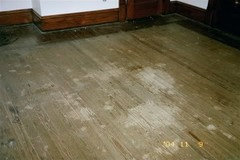
17 years agolast modified: 9 years agoOur house was built in 1927 and has fir flooring upstairs and oak downstairs. We've had 2 rooms refinished upstairs so far. I paid to have the floors refinished as we just didn't have the time/energy/equipment. The floors had never been finished in the middle, only around the edges, so our "floor-guy" had to do a little fancy footwork to get the two areas to match...but he did a beautiful job of blending them.
As for filling in holes/cracks, etc., he only filled in the holes that had been there for previous space heaters. The other "imperfections", ie, chips and gauges, are simply the floor's "character" and would disrespect this old house. He didn't do anything to those. After all, I like old houses because of their history and character.
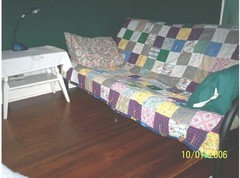
I like dark wood and the rest of the house's woodwork is dark, so I had him go dark on the floors. Here are some pictures:
Before:
After:
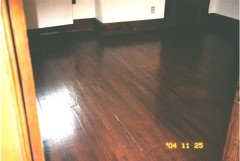
Second room:
joelyn
17 years agolast modified: 9 years agoHi!
I have been reading your posts and there is just so much information!. We have a 1925 foursquare. We have pine floors in some room and carpet in another. We tore up one of the carpets and have found wood in good condition, but they stripped the stain. They did not strip the stain in the corners, so we know the basic color, but due to age the base boards are a darker color. The wood does look alittle dry. What steps do I need to take to revitalize the wood and make it look gorgeous again. How do I take care of the dryness? I found an moisturizing oil by Pledge and then there is Murphy's wood soap. Is either good for an unfinished wood?
Thanks,
Joelynredbirds
17 years agolast modified: 9 years agoI have to chime in my support for the Waterlox camp. We're slowly getting our kitchen remodeled. I used Waterlox, on recommendation of this forum, for all of our new cypress countertops and I absolutely loved the results. The new wood drank the first coat, and the next 2-3 coats made the wood look progressively more beautiful.
We have what we believe to be old cypress floors and have sanded them ourselves. We had to take off quite a bit because some portions of the floor had been painted long ago but they seemed to come out great. As soon as we get some final edge-sanding done, we are going to finish them with Waterlox, as well. In the rest of our house where we have wood floors, the immediately-previous owners of our house put poly down where apparently there had always been an oil-based finish. We have dogs and a kid and they are hard on that plastic-y finish, it is even coming up in some places (perhaps due to the previous oil finish).
Since Waterlox is almost all tung oil, I wonder if you could follow up with a coat of tung oil, should that company go out of business (heaven forbid!)?


amtrying
17 years agolast modified: 9 years agoHello to all. I have a reclaimed pine plank floor in a 150 year old building in Montreal, Quebec. The planks are about an inch and a half thick and are tongue and groove. The wood is very, very dry. I would like to maintain the character and charm of the wood. However, I am intending to make the building a rental property and am concerned about the wear and tear and maintenance. Has anyone tried applying an oil finish to get the color and depth and then topping it with a varnish to achieve durability. Has anyone tried combining the two??
saraigift
16 years agolast modified: 9 years agoHow do you guys deal with splinters in old soft pine flooring? I want to refinish mine, but there are alot of flaked up spots with splinters and when sanding off the old finish it seems to just get worse.
kferg
16 years agolast modified: 9 years agoHello,
I have a 1926 bungalow with heart pine floors. Planks are 2" wide linear grain. Most of the floors have a heavy dark colored wax buildup that I would like to strip away. What's the best way to do this (chemical or sanding)? If chemical is best, what should I use, or if sanding is best, what grit do I start and end with? If possible, I prefer to steer clear of terribly toxic chemicals.The living room floor of my home seems to have either varnish or oil based poly on it. We removed the carpet from this room only 3 months ago and already our 2 dogs have scratched the finish horribly. The waxed floors have been exposed much longer than that and they show virtually no wear from the dogs. With this in mind, I'm leaning towards refinishing with a penetrating finish like Waterlox. Has anyone else used this product on heart pine floors? If so, pictures? Any guidance on sanding and finishes for this type of floor would be appreciated.
kzarina17
Original Author16 years agolast modified: 9 years agoWhen we had our floors refinished, we decided to have them completely stripped by a professional. They used a drum sander and edger and this was the first time our floors were ever stripped. (They too are old heart pine) With four children and a very busy home, we chose polyurethane, the look is nice and very durable. I don't know if I'd recommend Waterlox with three dogs. I've refinished a cedar chest and used Waterlox and it is no where near as durable as the oil based poly on our floors. Dog claws just do a number no matter what finish is applied.
Hopefully someone else can give an opinion, this is just my experience. I can honestly say that I am so glad that we ditched the carpet and had our floors done.
Dawn
varch
16 years agolast modified: 9 years agoI recently removed old carpet from my stairway and found a nice old pine stair(a honey colour with pronounced grain). Unfortunately the stringers had been stained, which bled through onto the treads and rises(but only in the corners near the stringer) so I sanded this area by hand with a 40-60 grit sandpaper, which removed the stain in those localized areas. However, the area that I sanded was obviously different than the area that were not sanded(it was more of a blonde colour with less pronounced grain) so I used a palm sander on the remainder with an 80 grit. The original wood had that honey colour and the areas that I sanded were now more blond. I originally wanted to clear coat the stair, however, now I have areas of the original wood and sanded areas, which are very visible. Any recommendations, is there a stain or bleaching agent that will blend the two.
later
15 years agolast modified: 9 years agoI sanded off very poor condition, dry, partly painted and waxed pine floorboards nearly eight years ago, back to new bright yellow unfortunately - I had not used a sander before and I went over it too much. This is a heavy use area with a fire place that coal likes to fall out of. I can say that scratches do appear, but I rarely get to repair them as they seem to blend in on the next wash and/or oiling.
I filled large gaps, (lots of them as most of the tongue and groove had broken) with beading glued in and sanded off with the belt sander, I filled small gaps with wood glue, some of it fell through. I made patches for holes where pipe work or vents had been removed with new pine.
I finished it with Danish oil, I have washed it a quite a few times with wood floor cleaner (soap and water mix) I have re Danish oiled it once or twice - it has gone a rich honey colour except for the gaps that I had filled with the beading, they remain bright yellow, which gives a pin stripe effect! (I think the beading must have been ash or some other wood as the new pine patches have mellowed to the same honey colour) The stripes are not unpleasant.
I haven't had any boards splitting where I have filled gaps, though this could be due to being in a stone house were the temperature remains fairly constant).
I have some small areas that have the tendency to splinter, I think this is due to the boards being washed with water in the past and raising the grain. I have simply raised the splinter and glued it down with wood glue, sanded lightly with paper and re oiled - unnoticable after a couple of weeks.
The scorch marks from the coal end up looking like knots. Many builders have dented it and the piano loosing a caster and being dragged across the floor added to it's patina :)I intend to do my bedroom next, it is in v.bad condition and I have patched it from all over the house where I have replaced some floors with new pine. So this room has a mixture of painted, waxed and old and new untreated wood. The main problem is the depth of new boards being about 2mm below the others, so I am opting to sand very lightly rather than putting ply packing underneath so I will end up with some boards being proud of the others, this time I have screwed the boards down as I need to be able to lift them for utilities, I will fill screw holes with wood putty later (haven't used this before).
I like dark floors really but because of the tendency to scratch that would make deep scratches stand out more and require more maintenance.
Does anyone know what the dark brown gunk like wax is on old floor boards, I think I would quite like it if it was re applied, it isn't a stain as you can remove it with the sander, although it clogs the sanding paper up terribly.
Circus Peanut
15 years agolast modified: 9 years agolater,
I bet the "dark brown gunk like wax" is, in fact, wax.
You've probably already laboriously sanded it off, but you can also get wax remover in liquid form that works nicely. Kudos on the hard work you've put in - there's nothing more rewarding than reviving a beautiful old wooden floor.
You can still find modern (and not so modern) floor wax in many varieties today, if you'd like to try it over your danish oil. You might want to invest in an electric floor buffer if you go that option.
doug_1920
15 years agolast modified: 9 years agoHelp Needed ASAP: We have a 1922 bungalow and just got the floors sanded. Against the advice of my spouse! But there were so many gouges and raw chips. Thougt I had got a good contractor, yadda yadda; and now the caramel colored heart pine and yellow pine floors are skinned bald, have one coat of poly and the contractor is on hold until we resolve the issue. Went from caramel and cinnamon color to bright butterscotch like a basketball court. The mixed woods - so nice with patina - look calico and are way too bright. If the contractor had not gone so deep, no problem but there it is. We feel like our puppy has just gotten killed. I need to salvage this mess and want to see if we can add a tint to darken the next coat and try and better match the original color. Or do I hand glaze then then varnish. Or (and I don't want to go any deeper and do more damage then I have) do we have to re-sand and start over with some sort of tint/stain then finish. The contract refused to stain the pine - which I bought - but his efficient machines took off too much of the old surface. Any help would be greatly appreciated!
sombreuil_mongrel
15 years agolast modified: 9 years agoI finished this brand new pine beadboard to match my century-old floor below it. It's a multi-step process but it can be done.
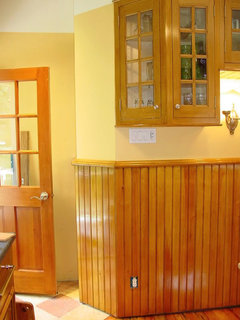
The first coat of stain was a very light color called "New Pine" a gel stain from Woodcraft stores. Then, a coat of garnet shellac to seal that. Then a toning/glaze coat of fruitwood stain (you may prefer early american) again in a gel stain, carefully wiped off to get just a hint of color. Finally two more coats of garnet shellac. You can't tell that it's new pine from Home Despot.
Casey
arlosmom
15 years agolast modified: 9 years agoDoug, I don't think you need to panic yet. We had our heart pine floors sanded down and poly-ed four years ago and they were initially really really orange. Scary orange:
{{gwi:2003686}}
{{gwi:2003687}}But they mellowed and now they are beautiful and deep and rich. I'll take new pictures and post them later today so you can see how the color has mellowed. My theory is that the sanding exposed wood that wasn't oxydized or exposed to sunlight. With a little time and exposure, they get deeper in color. That's what happens with cherry too, yes?
We used oil-based poly because our floor guy said the resulting color would be richer.
I don't know about yellow pine, but I suspect it will mellow as well.
Good luck.
arlosmom
15 years agolast modified: 9 years agoMe again. I'm not sure the photo shows how much better the floor looks now -- the photo still looks pretty orange to me, but the floor is a beautiful deep color (the scratches make me cringe):
We're just finishing up an addition where we used heart pine re-milled from old beams as our flooring. Here is our old flooring (in our house for 103 years) butting up against newly milled old wood. I'm expecting the new floor to deepen to the same color as the old:
All have 4 coats of oil based poly.
doublewide
15 years agolast modified: 9 years agoI am new to floor finishing, but I learn from expierience. I was stipping pine floors with chemical stripper. After multiple failures with several brands, I consulted some trusted friends for advice. I could not strip off a layer of "waxt" substance under 3 other layers of oaint. A professional refinisher hypothesised that it was lead paint I was dealing with because of the inability of the chemical strippers to remove it (modern strippers aren't formulated to strip lead paints) and the age of the house. NOTE: lead paint discontinued in1977-pre 1977 watch out). After testiong the "waxy" paint layer with a lead test kit, it was found to be a lead beased paint.
The only way I found to remove it was to use a heat gun. Very slow work, but it removed the gummy layer.
Heat guns to remove lead paint MUST be used in conjunction with respirators rated to protect against lead fumes. Wash hands thoroghly before injestion of ANYTHING. DO NOT remove respirator while in the room with the lead fumes. LEAVE THE ROOM TO TEAK A BREAK.
AO Saftey sells a respirator rated to protect against lead for about $45.00 retail.
sandragail
14 years agolast modified: 9 years agoI have old soft pinewood floors and have been wanting to redo them due to general wear and a large lab! Has anyone used Waterlox and if so, what were the results?
sombreuil_mongrel
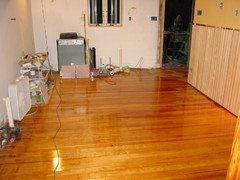
14 years agolast modified: 9 years agoThis is waterlox of southern yellow pine (ca. 1905)
Caseybrickeyee
14 years agolast modified: 9 years ago"pine and hardwood are two differant animals! hardwood usually has 2" wide boards, pine usually is 4" or larger. hardwood is, well, hard, it doesn't scratch as easilly, so it hold up very well. pine is soft, it will scratch very easilly and the covering will flake off."
The actual hardness of the wood is not determined by hardwood vs. pine (or softwood).
Douglass fir and heart pine (longleaf pine) are very hard woods.
The finishing process is pretty much the same for the two, with physically softer woods taking a lighter touch with the drum sander.Strip wood floors rely on all the gaps to absorb the movement, so filling them is almost never appropriate.
If you had a room 10 feet across the grain, it would take 40 strips of 3 inch wide flooring to cover.
If strips expand and contract 1/32 inch (not a very large number for real wood) over the seasons, that is a total change of 1.25 inches.If you glued all the pieces together that is the allowance you would need to prevent buckling (like a 'floating floor').
By nailing only one edge of tongue and groove flooring (the tongue edge) the pieces are allowed to expand and contract separately.The spread out movement over the entire width of the floor allow it to maintain a good appearance throughout the year.
antiquesilver
14 years agolast modified: 9 years agoBrickeyee, that's excellent advise. I just wanted to add that botanically, hardwoods are decidious & softwoods are evergreen. So far as I know, actually hardness has nothing to do with it. I'm guessing, but I suspect the term 'hardwood floor' was a marketing gimmick before the end of the 19th century to sell more expensive oak flooring as a status symbol of quality. Hence the reason that so many Victorian & later houses have oak parquet on the main parlor floors & plain pine on the upper bedroom floors.
sombreuil_mongrel
14 years agolast modified: 9 years agoExcept for Larch and Live Oak, which are perverse. Larch is a deciduous conifer, and Live Oak is an evergreen hardwood.
Caseycoeeyore
14 years agolast modified: 9 years agoWhat is the best filler to use for the nail holes that will match the would and absorb any stain or finish we may want to use?
We live in a very dry climate and the gaps between the boards are huge and do not change with the seasons so I would like to fill them too, could I use the same filler?atlantic123
13 years agolast modified: 9 years agoMy husband and I purchased our first house this winter. We removed all the carpet linoleum, asbestos adhesive, nails, staples, varnish, etc. We used a belt a belt sander on our hands and knees, and finally treated the floor with Waterlox. This was a CHORE! It took us over a month to finish our 1300 square foot house (except for tiny bathroom and tiny kitchen). Luckily, we still had a month and a half left remaining on our lease to our apartment. It would have been IMPOSSIBLE to live there during all of this.
We are tremendously happy with the results. Every nail and staple hole can be seen, but we like that. The look isn't for everyone, but we adore them. The kitchen floor will be treated the same way within a few months. We will also use Waterlox on a butcher block counter in the near future.
Before & After Sanding
http://www.flickr.com/photos/jamieham/4685412941/sizes/l/in/set-72157624115228515/
Waterlox results:
http://www.flickr.com/photos/jamieham/4301441523/in/set-72157624115228515/
jurraca
13 years agolast modified: 9 years agoWe have a pine floor with wide planks. We have been through it all and back with this floor - the story is looong. In any case, we have now stained the floor (about 900 sf), and have decided to that we want a poly for like a gym floor, but we do not want a glossy finish. We have too much - dog, 6 kids, and a lot of traffic. Any suggestions on a product? Thanks for the help.
gellfex
13 years agolast modified: 9 years agoI'm struggling to decide what to do in a rental apartment that has a wide pine subfloor in the kitchen. The choices are to finish it or put down laminate. I'm tempted to get it finished because it's classier and reversible, unlike the laminate which will require undercutting of all the casings and raising the radiator. The cost difference isn't really the issue, Costco laminate is ~$1.70/ft and I lay it myself vs $2/ft refinishing, I'm just concerned about how it will turn out and how long it would hold up in a heavy use area like a kitchen. Laminate has it's drawbacks in an area of potential water spills too.
Any thoughts?
sgibson416_gmail_com
12 years agolast modified: 9 years agoWe had our wide plank floors professionally refinished in March.He used poly finish--3 coats .looked wonderful but now in May,we are getting sticky balls of poly bubbling up between the boards.People are waking on the floor and smearing the goop all over the floors. Why? How do we fix this and how do we clean the floor without affecting the finish?
Mason1895
12 years agolast modified: 9 years agoHello group!
I am new here and I am looking for some help. I bought my 1895 Masonic Queen Anne Victorian about 6 months ago. 98% of my home is original. I have been pulling off the carpet hiding my beautiful wood staircase. My question is with the finish on the staircase steps. The floorboards are all in great shape and are the wide planks. They look to have been finished with a paint of sorts and then a varnish type product ontop. Does anyone know what this finish might be? I would like to save teh finish and it only needs to be refinished in a few spots.
sombreuil_mongrel
12 years agolast modified: 9 years agoHi,
Congrats on acquiring such an interesting home.
I think the mystery finish is a faux wood graining; when the original finish (probably shellac or oil varnish) became tatty looking, to save a complete refinishing, somebody decided to cover the flaws with the paint/stain/varnish method. Graining is notorious for being nearly impossible to touch up.
The steps involved would be a very deep cleaning to remove gunk. Then any chips in the grain coat may be filled in with artists colors (even wood-tone sharpie-type markers) and finally a new layer of varnish to protect the artistry for another few decades. The aptness of the colors mixing and application will tell in the finished product.
If you did decide to strip it to the original finish (maybe it's some fabulous hardwood!) the job will be more or less difficult depending on how much grain base paint embedded itself in the pores and scratches of the wood. You would probably find yourself touching up the indelible paint spots with markers or paint to color them to match the hardwood.
CaseyNuestraCasita
12 years agolast modified: 9 years agoI know this is an old thread, but so much good info. Was reading where some had pine upstairs and hardwood downstairs. Do any of you have a picutre of how to transition between the two floors? I'm installling wide plank pine downstairs and will stain them a medium brown color. I will keep the same color going up the stairs ( with white risers) but want to keep the top natural pine with waterlox top coat. How would that landing strip look? Thanks for any info I can get on this!
Pauline
wendyxx
11 years agolast modified: 9 years agoPlease help, we sanded down our sub flooring which we think is pine. Of course it has nail holes, etc. Is it possible to bleach them so that they turn out a white grey color. I really don't want a yellow color.
Debbie Downer
11 years agolast modified: 9 years agoBleaching is hard to control - can end up very blotchy - & the chemicals harsh. You're probably better off with a white or light gray stain. Google whitewash floors for images - is that what you had in mind?




housekeeping