





|
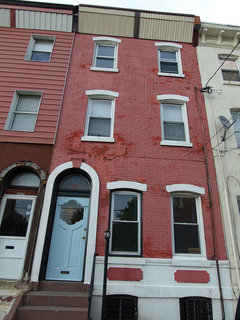
| I've got a 3 story brick row home, circa 1880, and i recently noticed that the brick facade is bulging slightly, maybe 4-5 inches in the center of the house. I know they used to fix this problem with big star-shaped bolts. I am wondering how to find out if this is necessary, whether there is another solution, and whether these bolts are still used! Any advice would be appreciated... |
Follow-Up Postings:
|
- Posted by sombreuil_mongrel (My Page) on Tue, May 9, 06 at 22:00
| The tie rods and star- or s-shaped "washers" were often original measures used to connect the gable walls of masonry structures. The floor joists would hold the bearing walls from spreading, so another way had to be found for the non load bearing walls. I suppose they may have been retrofitted to earlier structures, too. Four to five inches of bulge must make for some wildness at the wall/ceiling-floor intersection. Do you mean a bow (horizontal plane) rather than a bulge (vertical plane)? Casey |
|
- Posted by jaymeguokas (My Page) on Wed, May 10, 06 at 12:05
| A BULGE or a BOW, I'm not sure... the wall is pretty much where it should be at the top and bottom of the facade, but in the middle of the house (the 2nd floor) it has emerged from where it should be. The facades of these old houses is a layer of "nicer" (harder, better quality) brick, that is "plugged in" to another interior brick wall every foot or so. When I took some moulding off a window, I could see that the plugs have pulled out of their sockets, and debris (mortar, brick dust) has tumbled down inside this gap to fill the bottom. I should probably talk to an engineer to see if the bulge/bow is a structural problem. Ive heard these star bolts can fix it, but there is NO info online. Thanks for your help! |
|
| Those bolts were also added as protection from earth quakes. For example, all the old houses in Charlston, SC had these bolts installed after a large earthquake destroyed parts of the city. I would definitely talk to an engineer. Even if they still use these bolts, I doubt its a DIY. Is there a possibility that the wall could fall? You may want to tape of the area until help arrives. Last thing you need is your house to fall on someone. That only works out in movies;) Also, could this be water related? Did you recently treat the brick with a non-breathing product? |
|
| They are not actualy bolts at all, but the load spreading washers of tie rods that run all the way across the building from exterior wall to exterior wall. It is a lot of work to install them if the ceilings are intact. The rods are typically about 3/4 inch diameter and up and both the rod diameter and washer size need to be designed based on the anticipated loads. They are not very effective at pulling bulges in walls back in. |
|
- Posted by jaymeguokas (My Page) on Fri, May 12, 06 at 10:46
| The house was painted red years ago, maybe this paint is preventing the bricks from breathing? Also, there is an area under a window that needs re-pointing, its one of the many things on my list of things to do! It sounds like once I deal with these moisture problems, all I can do is hope the wall don't fall down. Maybe I should talk to an engineer, |
|
- Posted by sombreuil_mongrel (My Page) on Fri, May 12, 06 at 19:06
| If the inner and outer wythes of brick are separating, you must have a world of woes. This will never happen under any normal circumstances. I can only imagine it taking place due to lots of water repeatedly entering the wall and freezing/expanding apart. The affected section will have to be relaid. I have worked with only one mason in 23 years who could or would attempt this. Unfortunately for us all, he died a fews years ago. Good luck finding a mason with the confidence and ability to undertake your repair. Casey |
|
| Is there an update on the bulging brick wall ? I'd like to add to the advice strongly suggesting an inspection by a structural engineer asap. Around here when that happens, the building is vacated, the street is closed down, a sidewalk shed is put up, and the brick facade is replaced. It's not something to fool with. |
|
- Posted by cityboyinburbs (My Page) on Mon, Jun 12, 06 at 16:08
| We see this all the time in Philadelphia, mostly in 2 and 3 sty homes c.1900 and earlier. The bolts are usually a "retrofit" when the wall starts moving. The wall generally looks "pregnant", but if you like we could call it a *pot-belly* as easily. They drill back usually 5-6 joist, and as someone earlier said, fit the holes with about 3/4" all-thread, and then effectively bolt the Facade to teh joist. Talk to a Mason and he'll tell you it may work, but it is only a sure fix to hold the surrounding 16 brick as they say. Cause: Usually the foundation of that curtain wall has moved. Sure Fix: Remove wall, support foundation, build new wall. Sorry, but that's the truth of the matter. |
|
| Interesting thread. The lime mortar (pre-1920 or so), as opposed to portland cement/lime mortar, is subject to water dissolving the lime, weakening the mortar, and letting it lose both compressive strength and bond strength. Foundation subsidance may also be found to blame. We recently pulled a two-story row home back 2 1/2 inches (Wilmington, DE 2006). The rear wall (parallel to the joists) had bowed (vertically and horizontally; when the middle moves, it buckles in both planes). We formed a gridwork of 2x8 planks backed by 4x4 posts; cable come-alongs were attached to the 4x4s, and anchored through the stairwell inside with other timbers. The wall bulge (or bow) was reduced to less than one inch. Old lime mortar falling into the void between the wythes (the brick layers) prevented the reduction all the way to plumb. Be sure to remove any impedance between the framing and the inner wythe (i.e., flooring, studs, drywall, etc.) before pulling in the brickwork. Cracks were then ground out to 1 1/2 inch depth. These were repointed. Buckled sections over two arches were pulled and rebuilt. Then, 10" diameter "star" plates were installed on 7/8" all-thread going back thru 4 3x10 rough-sawn joists, and washered and nutted. Solid bridgings (cats) were installed between the joists. This combined the strength of the joists; essentially letting a 12x10 framing member, and the yellow pine floor plane, to resist brick movement. Finally, the cables were released and the "stars" held the wall. A structural engineer should make an initial analysis and recommendation. On this house, the first engineer said that he would not approve bolts. Rather, it would cost $8,000 to demo and rebuild. A second engineer was called, and he approved the bolts as the only cost-effective manner in which to tackle the problem. It cost $2000. When properly installed, these bolts prevent the brick facing from sagging toward the street. The framing plane and flooring create a structural anchor. The bricks can't move without dragging the framing out into the street. We (my father, and then myself) have performed this operation since the 1960s in West Chester, PA and surrounding communities, and in Wilmington, DE. This method has stopped further movement and preserved the structural integrity of many buildings. Star bolting has been proven for over 100 years (either as original design, or as retrofit) to maintain structural integrity. Finally, the bolts may be round, oval, square, diamond, or star shaped. They should be at least 1/4" plate, and at least large enough to hold against at least 6 or 8 bricks. Those bricks than apply drag to other bricks around them, etc. A 20 ft wide house face will usually require 3 bolts per floor. Hope this helps. A real mason and preservation technician. |
|
| Uncabilly, I don't want to hijack this thread. Since we are talking about mortar, can anyone discuss the proper lime mortar mix for old brick. Many of the guys who call themselves masons here in my town, do not seem to understand my desire for a mix that is appropriate for the hardness, or lack of, for my bricks. They also apply their mix and leave a wide and sloppy line. I keep thinking I could do a job that looks like that. I want to pay someone to do a job which looks more like the original line. Any suggestions? We also see homes here with wood siding which looks like stone. One of these homes has a dramatic "bow" to the front of it while its "twin" does not have the problem. I shudder when I look at it and wonder what it must be doing to the entire wall from ceiling and windows to flooring. I know I would be losing sleep over it. Good luck with the fix and please let us know what the final outcome is. |
|
| Uncabilly, Please get in touch with me, it sounds like you can solve my problem for a reasonable price. I am in Philadelphia, and all the masons I talk to want to rebuild the wall. I would MUCH rather pull it back into place and secure it there. Send me an email: jayme@fastmail.us THANKS! |
|
| I sure agree with Uncabilly. I live in a nearly two hundred year old brick home and it has been retrofitted with this system, long before we owned the home and that's been around thirty years. It's a pretty common site in old brick homes around here and yes the shifting and bulging may be due to subsidence. Can you say expansive clay soils? We do not, nor ever have had a water problem. Whomever did this in our home, and I suspect many years back it was a mason, knew what they were doing. In Europe they call a home like mine a "character home". Not a window is square, nor any two of them the same size. But, when I went to an engineering school many years ago, we had the same system on our civil engineering building. LOL. Embarrassing, yes? And it was a newer building. Can you say earthquakes? I suspect this old house will be around another couple hundred years when many of the newer ones are history.......not to say I'd trust all old brick buildings. So, I do recommend you get somebody who knows what they are doing. |
|
| Thanks for all the advice. I was actually losing sleep over this, then I realized that its not going to fall down anytime soon. Actually, what put it in perspective was noticing the problem in a lot of other row homes, sometimes worse off. It IS something I need to deal with though. Again, Uncabilly, please contact me. It sounds like you are a professioinal who has dealt with this before and you are in my area. Thanks, |
|
| Check out a hi tech masonry stabilization product called 'Stablwall' - it can be used on bulges/bows up to 2' and is made from high tensile carbon fiber fabric that is epoxied diectly on to the wall. It holds the brick together as a cohesive unit & can be homeowner installed. It's been used commercially for years. |
Here is a link that might be useful: Stablwall
|
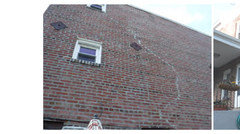
| That looks like it is for foundation walls, whereas this is a 3-story exterior wall, so i don't think Stablwall is my solution. I have done all kinds of renovation work, but the procedure Uncabilly recommends doesn't sound like a D.I.Y repair! I am hoping to find a professional who will attempt this pulling-back-in-place of the facade, and anchoring it with bolts. Here is a photo, though it is hard to see the problem unless you are at an angle: (you can see the house to the right has star-bolts) |
|
- Posted by civil_mike_o(mike.oneby@earthtech.com) onThu, Mar 29, 07 at 1:51
| The photo helps considerably. A description of where the bulge is located would further assist in the discussion. From your photo, I make the following observations: My personal opinion from the limited information in your postings and in the photo: My advice: General thoughts: Sorry it's so long. I hope it's useful. |
|
| I am considering buying a house in Philadelphia with a similar problem and am having difficulty locating a structural engineer or dependable contractor in the area with expertise in this matter. Does the City dept. of inspections provide any info? I tried to email Jayme, but the mail is being returned??? |
|
- Posted by dallmensch (My Page) on Mon, Jul 2, 07 at 7:16
| Hello Jackcob, Jayme, and others: I just had the same experience in trying to email Jayme. It's no wonder that he/she didn't hear from uncabilly! I have the same question, how to find a reliable engineer and or contractor in Philadelphia. I would like to get/stay in contact in order to share information on the bulging brick problem. (The post by civil_mike_o is very good, but he's apparently not near Philadelphia.) |
|
| Hi, Jayme here! Sorry the emails were bounced back, that email address is dead. I actually got a bunch of email about this post already, lots of GardenWeb members with similar concerns in Philadelphia!! who knew. My update (and THANKS civil mike for the information): If anyone finds a good Phila. area mason for this job, please lemme know, cheers... |
|
- Posted by Beth Schad(bethschad@hotmail.com) onTue, May 20, 08 at 14:06
| It is Spring 2008 and I am looking for a mason who will travel to Philadelphia to install star bolts on the front of my 3-story twin in West Philadelphia. It is a stone face - not a brick face. At present, when it rains water is leaking in through the stone face and coming down through the ceiling of the front entryway. |
|
- Posted by newtochicago (My Page) on Sun, Sep 11, 11 at 18:10
| Hello - the bulk of this post is older, but hopefully you guys can still give me some advice. We recently moved to Chicago and are renting a house - 2 days after we moved in we noticed a bulge in one of the walls. We own our house in San Francisco, and we've done a lot of work on it, but it's a framed house, so we have no experience with brick. My dad's a structural engineer in Eastern Europe - I sent him the pictures, and he said: break your lease/move out. Now, he has lots of experience, but might not be relevant. The house was built in 1890, and several parts were added/remodeled since, as late as 2005. We contacted the property management company, and they said they'll pass the info to the owner, but there's been no response for several days. Does this look dangerous? Should we move out? |
Here is a link that might be useful: Buckling wall in Chicago
|
- Posted by sombreuil_mongrel (My Page) on Mon, Sep 12, 11 at 8:10
| It looks like a brick veneer wall; and it looks like it's getting ready to fall off. The owner could face a huge liability issue when it does, whether he was warned or not. Unless he fixes it right away, heed the words of your father. Casey |
|
- Posted by badgergrrl (My Page) on Mon, Sep 12, 11 at 19:12
| I would call a city building inspector as well, they may be able to force him to fix it, or else list the place as uninhabitable. At the very least, they would give you adequate documentation to back you up when you break your lease. Check with the Chicago tenant resource center - I think it's Tenants Rights? They can also advise you, and give the correct folks to contact. |
|
| uncabilly, please contact me. we need work done or referrals to professionals in Vermont for this type of work on a 3000 sq ft federal!! |
|
- Posted by SunnyPhilly (My Page) on Mon, May 20, 13 at 21:39
| uncabilly, also would love to hear from you, i live right in your area...also looking for references on my home. thx :) |
Please Note: Only registered members are able to post messages to this forum. If you are a member, please log in. If you aren't yet a member, join now!
Return to the Old House Forum
Instructions
- You must be a registered member and logged in to post messages on our forums.
- Posting is a two-step process. Once you have composed your message, you will be taken to the preview page. You will then have a chance to review the contents and make changes.
- After posting your message, you may need to refresh the forum page in order to see it.
- It is illegal to post copyrighted material without the owner's consent.
- HTML codes are allowed in the message field only.
- No advertising is allowed in any of the forums.
- If you would like to practice posting or uploading photos, please visit our Test forum.
- If you need assistance, please Contact Us and we will be happy to help.