





|
| I finally am going to lay my tile floor! I hope to start tomorrow.
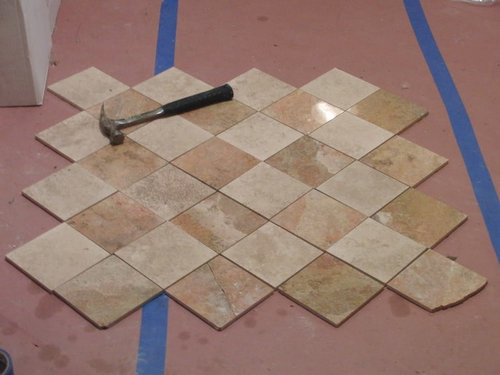
I am doing a 6"x6" travertine tile floor, and I have two kinds of tile, reddish and tannish. I am going to lay them in a checkerboard on the diagonal: The red tiles are mostly a nice salmon/coral color, but there are a number that are a dramatic ruby color. I really like those. There are also other darker ones that are not so red, but are more muted.
I am wondering if anyone has any tips or strategies for placing differently colored tiles in a pleasing, pseudo-random manner? Should I try to deliberately place one ruby tile and one dark tile every 6th and 10th tile, respectively, for example? Should I "shuffle" the tiles in the box, and just take them as they come? Roll a die? Any tips or suggestions welcome! |
Follow-Up Postings:
|
| Just take the tiles out of the box in any order. 1000 times. Then average their placement. :-D You're not looking for actual randomness. A random draw could yield a floor that looks like a grilled Cheesus. You want the appearance of randomness, which mostly means evenly spaced without forming an actual pattern. Pretend you're decorating a Christmas tree, and you don't want all the green ornaments together. |
|
- Posted by remodelfla (My Page) on Fri, Jan 27, 12 at 5:57
|
| 1. make many conscious choices 2. then tell no one 3. later you will have forgotten also = apparent randomness |
|
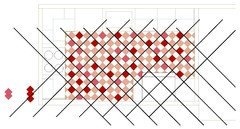
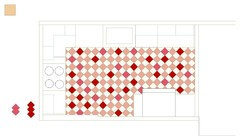
| We had a similar challenge with our backsplash. We had 6 different colors of tile-- 4 of equal amounts and 2 of lesser amounts. The tile store woman told us just to shuffle them, but with true randomness you end up with blobs of color. So this is what we did: We assigned each color a letter, A through F. We took a piece of graph paper and laid out a very large repeat pattern-- I think it was a 10x10 row repeat. If you do too small a repeat pattern, the repeat will be obvious. Then we laid the pattern out on the floor with actual tile, made some adjustments, and noted them on the graph paper model. Then we stood over our contractor during tile install to make sure he didn't screw it up. A random look that also looks good requires some planning. |
|
| I have to correct myself. It was larger than a 10x10 repeat, but I don't remember exactly how large. The method worked well. |
|
- Posted by circuspeanut (My Page) on Fri, Jan 27, 12 at 9:23
LOL Remodelfla, that's an excellent link: "Clients often want a random effect using different colours. You wouldn't believe how long we spend trying to get arrangements that look right. It takes a lot of time, and then the client comes home and says she can see a space invader near the cooker." Angie, have you tried posting over at the John Bridge Tile Forum (google it, GW software rejects the link) -- there's a friendly & helpful set of tile pros over there.
|
|
| Just lay it all out and then adjust them by swapping them around until it looks pleasing to you. It won't be random, but no one else has to know. It is easier to see what needs to move where when it is all in front of you. |
|
- Posted by pricklypearcactus (My Page) on Fri, Jan 27, 12 at 10:08
| I did what dianalo suggested with two installations of ostrich gray slate. I usually moved my favorite tiles to prominent areas, but otherwise tried to essentially randomly lay out the tiles. And then I would stare at the layout and swap tiles around until I found a layout that was pleasing to my eyes and to my partner's eyes. I think it helped having him provide some feedback as well because sometimes I would miss a "space invader" as circuspeanut's quote so eloquently put it. |
|
- Posted by mtnrdredux (My Page) on Fri, Jan 27, 12 at 10:32
| Oh, it's very very hard. You don't actually want random. As others have said, create a pattern, and then move things around here and there to mess up the pattern a little. My 3rd grader just did a project of Damien Hirst, of the spot paintings? The artist is a conceptual artist meaning he hires drafts people to execute. He spoke about how he got into an argument with a draftperson about random. He said you might get 4 yellow dots in a row, and it'll look awful but it IS random. You don't actually want that. You want the appearance of randomness. The possible exception is planting bulbs, where they suggest you mix them up and then just throw them on the ground and plant them where they land.... not something youd do with tiles anyway! Good luck! |
|
- Posted by mama_goose (My Page) on Fri, Jan 27, 12 at 10:54
| Stand in the middle of the room with a handful of marshmallows. Toss marshmallows into the air and where they land, place red tiles accordingly. When the kids get home from school give them the marshmallows in hot chocolate. ;) |
|
- Posted by sombreuil_mongrel (My Page) on Fri, Jan 27, 12 at 11:02
| The problem is it's not safe to tread on the stone tiles when they are just laying on the floor, so multiple attempts at layouts become laborious. If you later use a sealer/enhancer, the colors will deepen, perhaps some more than others; a further complication. The best plan I can think of is put all the "darks" in one pile, the "lights" in another, and create your checkerboard as you lay it; if one is just too dark, set aside and use in a corner or at an edge where furniture will help hide it. Casey |
|
- Posted by GreenDesigns (My Page) on Fri, Jan 27, 12 at 12:14
| Take a handful of pennies and toss them on the floor. Mark those points. That's random. Use the penny spots in key locations for any of your favorite tiles. Clusters are random, and they will occur. If you try too hard to not have some small clusters, then you are really talking a giant pattern, and that's too much work. It's only the larger clusters that may need some slight adjustment. |
|
- Posted by pricklypearcactus (My Page) on Fri, Jan 27, 12 at 12:55
| I should also mention that I purposely opened all of the boxes of tile so I could pull from different boxes as I worked. At least with the heavily veined/splotched slate I was working with, there would be some consistency in the tiles within a single box. I also agree with sombreuil_mongrel that a large tile layout can be difficult because you should not tread on the tiles just laying on the floor. So far I've been able to use my large living room (moving all of the furniture out of the way) so that I could walk around the layout completely to move tiles. I would often have to remove a few edge ones to make a path to the offending tile(s). I've heard of other people using their driveway. If you're intending to apply an enhancing sealer, you may wish wet the tiles as you work. I decided not to use an enhancing sealer, so I was able to avoid this complication. Sometimes I found it helpful to squint my eyes slightly to see just a blur of the colors and shapes. That helped me pick out areas that were too "heavy" or "light" (my tile was silver/gray/charcoal/black). In your case, you might use it to see the light and dark, as well as the color variations (red, yellow, green, etc). |
|
| Random = evil. Blobs of color. Disorder. Blank spaces. Lines that don't match. Uneven-ness. Ok. There. That's the anal, ocd part of me. I'm one who also recommends laying them out in a pattern, then moving the ones you like the best to the more focal part of your piece. Consider your stone a quilting pattern if you sew. Fabrics are viewed as values of light and dark. Mediums blend things together, blurring the stark lines between the two. There's even some red cellophane viewers that quilters use to block out the distracting color. The red turns colors into shades of black to light red. I'd love to see the ruby tiles! :) Good luck. |
|
|
- Posted by mtnrdredux (My Page) on Fri, Jan 27, 12 at 14:56
| It looks great! Make sure you have looked at every tile before you start and you are sure what color categories they belong in and if you want to use all of them. Sometimes there are a few clunkers. |
|
| Mtn: thanks for the voice of experience. It is not like I do this sort of thing every day! I did indeed go through each of the 650 or so tiles the day before yesterday and sorted them into about 5 categories of red and 3 of tan. The main problem was keeping a consistent mental scale for what is considered "light" or "gray"! I do have a number of awful orange ones, but few enough that I can bury them under the cabs. That is also where the ugly dark tan ones are going. I also have a large supply of extra 12x12s on hand, waiting to be ripped into 6x6's (which is where these came from). I hope some future owner doesn't try to change the layout after planning to keep the floor! :-) |
|
| I finally have a chance, and just wanted to update and acknowledge the help. Thanks, everyone for your helpful thoughts on this. I am following the procedure I outlined above. The tiling is proceeding, but very slowly. I find I can only do about 4 sq. ft per hour. I have about 130 sq. ft., so it will take a while! I am about 1/3 done now. I am really, really happy with how the floor looks. I think it is gorgeous. The ruby tiles look nicely distributed and quasi-random. Marcolo: I only did it 250 times, but the averaged colors were starting to get washed out, so I stopped... ;-) You and the others are correct, though: I am after the appearance of randomness, not the real thing. Like carefully mussed hair in a J. Crew catalog. remodelFLA: what a great link! I did play with that, although I wound up not using their excel sheet. The discussion was very helpful in synthesizing my thoughts, however. David: I like the idea. And, fortunately, with my memory it will only take me about 2 days to have forgotten! sass: that is a good, helpful idea. Large repeating pattern will likely not be detected. Especially as it will be broken up by things in the room Circus, I did post at John Bridge. From there, I learned that name of what I was looking for was a "distributed pattern," not random. Plus the mandatory digression into my subfloor! No actual advice on how to effect this, though. dianalo and prickly: that is a good way to pull it off. I'd probably need a bigger living room, though! Mtn: I'm curious, was Hirst advocating pure randomness and the draftsperson pseudorandom, or vice versa? mama goose and Green: Now we are talking. That will get us random, and not take any time! Casey: yes, thanks for correctly pointing out the problem with pre-layout. Also, I believe I will use an enhancer, based on how vibrant these guys look when wet. Prickly: Love the squint -- it really works. As for mixing the boxes, yeah, I have done that a lot. Christine: I don't quilt, but I like the idea. I have a funny image of quilters wearing what appear to be 1950s 3D glasses! Thanks again, everyone, for your help and input. I can't wait to post progress pix. I think I will start a "progress pix" thread when I get the floor done. I have the walls and windows in, and cabinets are in the garage (unassembled). |
Please Note: Only registered members are able to post messages to this forum. If you are a member, please log in. If you aren't yet a member, join now!
Return to the Kitchens Forum
Instructions
- You must be a registered member and logged in to post messages on our forums.
- Posting is a two-step process. Once you have composed your message, you will be taken to the preview page. You will then have a chance to review the contents and make changes.
- After posting your message, you may need to refresh the forum page in order to see it.
- It is illegal to post copyrighted material without the owner's consent.
- HTML codes are allowed in the message field only.
- No advertising is allowed in any of the forums.
- If you would like to practice posting or uploading photos, please visit our Test forum.
- If you need assistance, please Contact Us and we will be happy to help.