


|
Follow-Up Postings:
|
| Look for a stair renovation tread made to work with your existing conditions. This system, sorry I don't have the name, includes precut mitres and return trims. The return covers raw edges of the treads. Google it. Unfortunately, anything you do to this stair will not cure the code issue...the rise and run will remain the same. |
|
- Posted by weedyacres (My Page) on Mon, Jun 13, 11 at 15:14
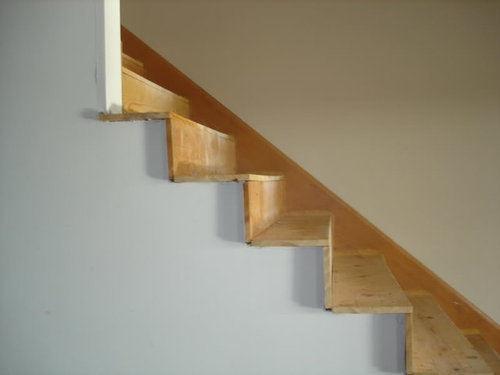
| The retro treads are actually more expensive than regular treads, so I'll probably just pop off the existing pine treads and attach the new ones down directly to the stringers. What's your advice on nail vs. screw (Q#1 above)? My concern over the raw edge is more about the riser than the tread. Any thoughts there? I know I can't properly "fix" the 9" (at least without replacing the stringers), but at least the treads will be 11" deep so that one's whole foot can fit on it. |
|
- Posted by sombreuil_mongrel (My Page) on Tue, Jun 14, 11 at 22:23
| I'd make a new 3/4" finish stringer that was mitered to the new risers. I'd make new treads to overhang 1 1/4" front and side, and run 5/8" cove under it to trim it off. The exposed end grain of the tread is acceptable, but for 1st class work, mitered returns are usually used. Casey |
|
- Posted by weedyacres (My Page) on Thu, Jun 16, 11 at 7:31
| sombreuil: So you're saying you'd replace the existing risers with new paint-grade ones? I was hoping to just face the existing knotty pine treads with 1/8" ply...a bit tough to miter into a 3/4" stringer. Come to think of it, mitering just the riser part of the finish stringer sounds a bit tricky too. I'll have to mull that one over. I'll definitely do mitered returns on the open treads. |
|
- Posted by sombreuil_mongrel (My Page) on Thu, Jun 16, 11 at 23:06
| In lieu of miters, they used a decorative stair bracket (cutout fretwork type) or simply a strip of lattice to cover the end grain of the risers, which were made flush with the stringer's face. To accommodate the cove/scotia, a second piece of lattice was applied under the tread return, forming an ell. A third alternative is a very small bead molding at the riser/stringer intersection, The riser is rabbetted so just 1/4" of end grain projected over the stringer, but held short and disguised by the small bead. Casey |
|
| weedy, when I built my house years ago, I did just what casey recommended. Treads are stained, risers and stringers are all paint grade poplar. I cut the stringers just as he described. The vertical cuts were mitered to join up with the mitered risers, the horizontals are flush cut and butt to the underside of the tread. A few other details but those are the basics. I was tool-poor back then, I remember doing all the stringer and tread cuts on the table saw. Ah, some things you'd rather forget. Or keep to yourself! lol I cut off the end-grain ends of the oak treads and added mitered returns. Also done on the table saw. But the joinery is still rock-solid, the miters tight, and the stairs still look terrific. |
|
- Posted by sombreuil_mongrel (My Page) on Tue, Jun 21, 11 at 7:37
| I do the mitered stringer cuts with a circular saw. That's why they make LH and RH saws. Table saw? You are braver than I am. Casey |
|
- Posted by weedyacres (My Page) on Tue, Jun 21, 11 at 17:57
| I went around to some Parade of Homes houses last weekend and checked out every set of stairs in detail. Alas, they all had mitered stringer/riser joints. Heeesh, looks like I've got to figure out how to do that well. I've got a pretty temperamental circular saw (time for a new one with a worm drive? :-) Thanks for the input. I may be back. |
|
- Posted by weedyacres (My Page) on Tue, Jun 21, 11 at 18:50
| Oh, got one more question: how to transition the upside-down skirting board into the 5" baseboard at the bottom of the stairs. Baseboard profile is different than the skirt board, so can't just miter them into each other. |
|
- Posted by sombreuil_mongrel (My Page) on Wed, Jun 22, 11 at 19:21
| Hi, in regards to the last Q, you could add a triangle of stringer material under the end of the stringer so there is a vertical flat for your baseboard to butt into. If the base were the same thickness, and you were using a separate cap molding, it could then miter back on itself and follow the underside of the stringer until you ended it with a return where the stringer ended. Casey |
|
- Posted by weedyacres (My Page) on Mon, Jun 27, 11 at 17:43
| Well, I tried my hand at this Saturday. Local stores didn't have the skirting in stock, so I bought a piece of 1x10 maple (was cheaper than poplar). I did some trials with a circular saw on some scrap wood and found that my saw is the wrong handed and I can't cut the miter the right way from the outside edge. Don't trust my skills enough to cut on a miter from the inside. Next moved on to my big miter saw, got it figured again on the scrap wood, but found, halfway through the maple, that it's not quite big enough to cut to the edge of a 1x10. Finished it off with a jigsaw. Jigsaw does have both-way miter. That's the plan on the next try. I'm thinking I'll just keep the lower edge square instead of routering it into something more decorative, and run it all the way to the floor. Then I'll cut the baseboard at an angle when it runs into it, and butt them together. |
Please Note: Only registered members are able to post messages to this forum. If you are a member, please log in. If you aren't yet a member, join now!
Return to the Flooring Forum
Instructions
- You must be a registered member and logged in to post messages on our forums.
- Posting is a two-step process. Once you have composed your message, you will be taken to the preview page. You will then have a chance to review the contents and make changes.
- After posting your message, you may need to refresh the forum page in order to see it.
- It is illegal to post copyrighted material without the owner's consent.
- HTML codes are allowed in the message field only.
- No advertising is allowed in any of the forums.
- If you would like to practice posting or uploading photos, please visit our Test forum.
- If you need assistance, please Contact Us and we will be happy to help.