






Contractor used grout not caulk around the tub
Ok, is this the cardinal sin? I'm sure I've read on this forum that this is a no-no. And guess what, the project's not even complete yet and I see some cracks on the vertical plane where tile meets front of tub apron. Should I have him remove it and redo with caulk? Sanded or unsanded?
Gah, I hate having to stress over these details but I do want this done right!
Also I noticed that the grout seems to suck up water and stay wet looking for a while, when it gets wet (they've been installing faucets so some dribbles of water are around). My contractor said that's because they haven't sealed the grout yet. Is this true?
Comments (67)

musicteacher
10 years agoMy contractor too used grout, only many years ago, and I am starting to see cracks. The grout is a taupe color but I have never seen caulk in more than white or ivory. White is fine where the tub meets tile, but what should I use in the vertical corners? Thanks for helping.

enduring
10 years agoThere are caulks to match Laticrete and Mapei grouts. Look at their samples of grout and see what matches yours and get that caulk. Lowes sells Mapei grout and caulk, but only the epoxy grout in the Laticrete line. I have used Laticrete caulk to go with my grout and have been very happy. I ordered my stuff online at a tile shop that the Laticrete site linked to.
Related Professionals
Corcoran Kitchen & Bathroom Designers · White House Kitchen & Bathroom Designers · Artondale Kitchen & Bathroom Remodelers · Apex Kitchen & Bathroom Remodelers · Emeryville Kitchen & Bathroom Remodelers · Lincoln Kitchen & Bathroom Remodelers · Omaha Kitchen & Bathroom Remodelers · Rolling Hills Estates Kitchen & Bathroom Remodelers · Spokane Kitchen & Bathroom Remodelers · Eufaula Kitchen & Bathroom Remodelers · Lynnwood Glass & Shower Door Dealers · Mount Holly Cabinets & Cabinetry · Reading Cabinets & Cabinetry · University Park Cabinets & Cabinetry · Mount Sinai Window TreatmentsStoneTech
10 years agoYou can get any colour caulk you need to match any grout out there from color rite dot com. They have siliconized acrylic, silicone, sanded, unsanded, matt or gloss.
Just give them the grout mfg name and colour or number. I always get silicone for showers.
Use painters tape to mask the areas to caulk, run the bead and dress it by dipping your finger in a dish of water that you have added a good squirt of dishwashing liquid to. This reduces the surface tension and makes it a breeze. Keep an old rag to wipe your finger with.
The Company will Fed Ex it to you in about 2 days. Silicone runs about $14 plus shipping.
enduring
10 years agoStoneTech, I tried the site "color rite" and I got to a site that sells paints and stuff for what looks like motor cycles. I typed "caulk" into their search box and nothing came up.
enduring
10 years agoDuh, I looked further down the google list and saw "colorriteinc" and with that link, there are sealants, etc. Thanks.
threeapples
10 years agoMy tile setter used grout at the change in plane where the tub meets the floor in my kids' bathroom. It's cracked all the way across. I'm sure he'll damage the tub scraping the grout away. How can I try to minimize damage when he does this?
threeapples
10 years agoMy tile setter used grout at the change in plane where the tub meets the floor in my kids' bathroom. It's cracked all the way across. I'm sure he'll damage the tub scraping the grout away. How can I try to minimize damage when he does this?
StoneTech
10 years agoThere are tools for removing it...going from a plain old utility knife to vibrating tools. If he's worth his salt, he should have no problem getting it out....
StoneTech
10 years agoThere are tools for removing it...going from a plain old utility knife to vibrating tools. If he's worth his salt, he should have no problem getting it out....
StoneTech
9 years agoANY "Change-Of-Plane" should be caulked with a silicone caulk. As said above, a metal-reinforced mud bed OR a Kerdi shower/tub would be the ONLY exceptions I am aware of.
Below is the link for Colorite
Here is a link that might be useful: matching colour caulk
Vertise
9 years agoI'm lucky, TEC XT crack resistant grout has held up vertically for 10 years. The horizontal areas at the tub flange, ceiling and floor did crack early on, however. Niche is fine everywhere. Glad I have matching grout in the corners and niche.. Looks awesome. Got caulk matched to the removed grout fragments at color rite. Tec's own matching caulk did not match at all due to color washout during grout installation. Dye lots could also be a problem. Custom is better, imo. They have a gazillion colors to match from at CR, so a custom mix is not neccessary (expensive).
Installers like to grout hoping to skip an extra trip needed for caulking the next day.
abbabug
9 years agoGary1020 talked about how caulk traps water and black mold starts behinds it...what do we do about the mold issue then if with any change of plane, it should be silicone caulk and not grout. Change the caulk often?
StoneTech you mentioned that the exception to the rule is a Kerdi shower. If I am using the Kerdi trays, what should be in there between the wall and floor?
fixingitmyself
9 years agoMy contractor used grout caulk at the joint between the wall and the tub. This application did not last long, so now I am going back to clean it out and apply a color-matched, sanded, silicone caulk - which "is king" as noted in the initial response. Thanks to all who posted - I learned plenty! (I also reviewed the TCA site, which I recommend to anyone else who is researching these issues.)
 PRO
PROBy Any Design Ltd.
9 years agolast modified: 9 years agoPosted by tartan habit : "Also I noticed that the grout seems to suck up water and stay wet looking for a while, when it gets wet (they've been installing faucets so some dribbles of water are around). My contractor said that's because they haven't sealed the grout yet. Is this true?" - Is that true? No way is that true.
Most cementious grouts are roughly 17% absorbent. And that is if they where mixed properly. Often tile setters mix too much grout and then add more water. Clients of mine in the past have seen crews (not mine) do this more than once. This can make the grout even more absorbent.
Now Epoxy grout is almost waterproof. Here is a good article explaining the difference.
[EPOXY VS CEMENT GROUT - WHAT IS THE DIFFERENCE?[(https://www.houzz.com/magazine/epoxy-vs-cement-grout-whats-the-difference-stsetivw-vs~15323992)Aletia Morgan
8 years agolast modified: 8 years agoHere's an issue - this has been a project from hell, and it continues. Finally to the point of tiling after 8 months, and we're running in to two issues (among many):
1- many times we noted w/installer the need to use @ plane changes, grout on flush surfaces. FWIW, he also wanted to use Epoxy grout, which we paid for (Spectralock Pro Premium). He did the grouting Wednesday - lots of stickiness, which was improved but not entirely fixed on Thursday. I hope it somehow can be resolved. But the big issue is the corners - all of them - he filled in with the epoxy grout. I'm assuming that's slightly better than using cementous grout, but when I asked him about it, he said he'd run caulk over the top - seems to miss the point entirely. I think it is a combination of lack of knowledge and (maybe more) trying to rush - I get the impression that the GC isn't keeping up with payments to him, which is another major concern. How can we "force" him to do it right? I don't know that this will be an issue with the final code inspection...but the GC is licensed in NJ - does that mean he has to follow TCNA guidelines?
2- the project also included installing two sections of glass mosaic tile - the instructions call for 1/16" thinset. But of course, we just do what we always do - and they were slathered with thinset so that I can't figure out how he's going to grout - the thinset is coming through to the surface over most of the span. Stuff wasn't cheap, either, but I think the chances of forcing them to rip it out and replace at $35 ft2 are minimal.
We've already had a history of them "taking their toys and going home" for weeks when we expressed concerns, so it's a bit of a dance right now.
Is there any way to insist on an authoritative person come in and evaluate the work done for correctness? As homeowners, we apparently don't count.
I'd appreciate any suggestions!
Aletia Morgan
8 years agoUnfortunately, the contract was not that detailed. It calls for installing all the tile, and includes this language only:
"All work to be completed in accordance to standard remodeling practices. Contractors shall conform to the State of New Jersey Uniform Construction Code and all local building codes, ordinances, rules and regulations pertaining to labor, material and
building specifications."
I don't know if this is enough.... To be honest though, none of the GC quotes we received were much more detailed than this. Obviously, I've already learned that I will NEVER enter another contract with a GC who subs out everything. I can be taught. But I"m not sure that having an attorney review the contract would have helped...
I feel for the guy doing the work - he's honestly trying to help us out, since the GC hasn't returned calls for several weeks now already. But he's overfaced on this project, apparently.
Argh. Thanks for your comments!Aletia Morgan
8 years agoThanks! I'm hoping that'll be the case here - the epoxy grout certainly helps. Now on to trying to resolve other issues...
But it is a fascinating (to say it nicely) problem about how to deal with contractors who don't want to do things per manufacturer specs, let alone "standards", and it feels like they have all of the power in the transaction. Certainly "buyer beware" applies, but how much can a homeowner know about the intricacies of construction and materials. Not the first, and not the last, but this kind mess tarnishes all in the business, because the purchaser then starts with a feeling that they're about to be taken advantage of the next time. We've done lots of renovations over the years through the course of 5 houses in 4 states, and never had anything like this mess.K Dip
8 years agoThis thread has been eye opening. We just had a bathroom remodel and the contractor grouted between the tub and the tile. He INSISTS this is fine. He said he sealed joints behind the grout and there will be no leakage. I, too, was surprised when the job was done and there was no caulk!! If I want to caulk myself, is there a reason that I cannot caulk OVER the existing grout? Thanks!
 PRO
PROCabot & Rowe
8 years agoIt will peel off. You need to remove the grout to the depth of the tile to allow for movement. Then fill with grout matching caulk.
- PRO
Cabot & Rowe
8 years agolast modified: 8 years agoAhmnj,
Whether spelled out in the contract or not, ALL contracts include the work follows manufacturers' instructions (primary in court), ANSI standards (secondary in court), accepted industry standards (tertiary in court) which in your case is what is written between the pages of the TCNA manual. "We've always done it this way" is not accepted industry standard. Somewhere in that mix is local building code. Judges always rely on the above listed specifications. What the fine folks at the TCNA have been doing to promote the industry and protect consumers and installers is to work with manufacturers to include the most up to date TCNA standards in their product instructions so everything matches. Pretty neat, huh?
chaski
7 years agoAnd then there's this from a home inspector: grout not caulk! grout not caulk where tile meets tub. His explanation makes sense: caulk traps moisture that's BEHIND it by not allowing it to evaporate. That moisture is coming from behind the tiled wall! Hence the puzzlement of why one can't clean caulk that appears to be sound. What's that gunk doing behind it and how did it get there? Everybody's concerned about caulking that seam to keep it waterproof from direct hits by shower water. (Why aren't people concerned about the wallful of porous grouted seams on tiled shower enclosures???--just that bottom seam....)
Caulk does keep shower water out, but that's not the problematic water. Shower water seepage through the porous grouted seams of the tiled wall runs down the back of the tiled wall and collects on the tub surface behind the caulked wall-meets-tub seam. (Or it continues downward causing damage to the ceiling of the room below.) With a grouted seam that won't happen cuz is porous and the moisture (from front and back) will evaporate. Yes, eventually the grout will age and crack from movement and need to be removed and replaced and again last for decades. Also a grouted seam looks better cuz matches the grout between tiles. While caulked seams fail yearly--now you know why--and get replaced repeatedly to remove the unsightly trapped gunk.
I just removed cracked grout (not a fun job) from the tub/wall seam that's been there since 1966 when the house was constructed. The last few years I've covered that seam with caulk only to have to replace it over and over again. Did I use grout this time? We're about to put the house on the market and didn't want the house inspector to report a fault in having grouted rather than caulked that seam and the buyers expecting that to be corrected. The tilt out there is pro caulk, not grout. So caulk it is. But when this problem comes up in our next house, we're going the grout route.
homepro01
7 years agoGrout is wrong at any point where there is a change of plane. It will crack and cause water to go behind the structure. A tub, a shower pan, etc should all be caulked so that it allows for expansion and contraction of the dissimilar materials and change in plane. The home inspector was incorrect in his statement.
Vertise
7 years agolast modified: 7 years agoContractors often don't caulk because it is easier for them to grout and not have to come back another day to do the caulking even though it's not to building standard
There are crack resistant caulks. Mine has held up well except for a couple of planes where it did crack and then needed to be removed and caulked later (by me). A pain but I do like having some of the joints grouted rather than the appearance of caulk.
gto3x2
7 years agolast modified: 7 years agoOk, then the compromise that I see as a solution is doing caulk with weep holes. i.e. no grout cracking at tub/tile joint, venting allowed by the weep hole to allow drying. Similar to brick walls. Also, the vapor barrier should come down from the wall stud and flash over the tub flang. Drawback: Everyone says "What's those little holes?", and "Water is going to get behind the wall". I don't see any way of achieving all problems, and each one has its issue.
Maybe even a continuous caulk line with a hole drilled in the tub behind the tile, piped to the drain line. Of course, appropriate size, slope, cleanouts and an air gap for proper indirect-waste draining. I guess a trap primer is sufficiently assumed not to be necessary. Maybe electric trace to evaporate the water and dry the area; sealed, of course, and open to the conditioned-space side. Provide 3 different manufacturers for consideration. Oh, but then the fire and smoke partition is breached. Hmm...no "reasonable" solution.
Personally, while the grout finishing does make sense, caulk handles immediate liquid water and has resiliency. Although not impossible, I can't see enough water accumulating to run down the vapor barrier.
- PRO
Cabot & Rowe
7 years agolast modified: 7 years agoThe home inspector is wrong. Aside from violating the industry standards, there is a simple explanation; Water always goes from areas of high concentration to areas of low concentration. Any water behind the tiles will not drain to the bottom due to gravity leaving the area right above the joint dry. This simply doesn't happen. The capillary action and hydrophilic nature of the thinset (and possible ceement board) behind the tiles will draw the moisture away from pooling at the bottom against the caulk. The moisture will even itself out behind the tiles pretty much until it's dried or reached capacity. If there is such strong gravitational pull on the moisture behind the tiles, it will come out the grout lines just above the caulked joint just as it does between every other tile with moisture behind it. If you have tiles with gaps behind them large enough to store liquid water you've got greater problems.
enduring
7 years ago@Cabot&Rowe, Thank you so much for your explanation of this. I have often wondered about it.

Bob Sible
7 years agoGrout is wrong! My contractor insisted on it in the last remodel, and it cracked in less than a year, and believe me any splashing from the tub moves straight into the kitchen ceiling. I would rather deal with mold. Moot point now though as I am gutting the bathroom to make it bigger, my NEW contractor will caulk all change of planes.
enduring
7 years agoFor what it's worth I dry wipe all my walls, corners, etc following bath or shower. I use a nice microfiber. I never have mildew/mold on my surfaces. I'll never leave a shower wet again.
- PRO
Cabot & Rowe
7 years agoBob Sible, your bathroom should be properly waterproofed BEFORE the tile is applied. No leaking should occur if the joint is caulked, grouted or left open !

Nancy in Mich
7 years agoI love my contractor. He is a magician and meticulous. He does everything in a remodel himself, except for painting, which he farms out to his one helper. He has a GC license, so he can do any of the work in my house. Of course, he is human and has faults and grouting the change of plane in my two backsplashes he has done was the biggie. Now it is time to do the bathroom and I am getting ready to call him and get him to fit me into his schedule.
The shower is going to be Swanstone walls and either a Swanstone or other solid surface base. No problem, he will read and follow the instructions. We are tiling the room walls and the floor, though. I understand the whole reasoning and the physics and the mechanics behind caulking the change of plane joints. What no one has explained is how this is done. When applying grout, how do you manage to NOT grout that joint, while grouting right up to that joint? Folks say that contractors don't like having to come back the next day to caulk, so I am hearing that the caulked joints are not caulked before the grout goes in (which seems to be the easier way, to me!). So do we fill the corner and bottom joints with something to keep the grout out? If you try to stop grouting just before the joint, won't you under-grout the line leading up to the joint sometimes?
What are your secret techniques for leaving the corners and bottom edges grout-free?
User
7 years agoThe secret is... After applying and shaping the grout, scrape out the grout from corners and edges while still wet. I like to use leftover chopsticks...
Gordon Guiltner
6 years agoGrout versus caulk. One will possibly crack and break up. One will possibly mould, rot or fall out. If I neatly applied the bottom row of tiles around a tub or shower { lets say 1/16 inch above the tub/shower pan} couldn't I just leave the space open? It would allow moisture/water to drain freely into the tub and could be occasionally cleaned fairly easily and if neat and tidy and well done shouldn't be an eyesore. All well designed bathtubs etc. have a raised bit behind the tile and backing that stops water from going anywhere and the backing should be installed hanging over the top edge of that raised bit leaving an inch or so gap between it and the tub. No water getting up there. No rot, no mildew/mold, no cracked mortar. Maybe the odd bug though I suppose. Apparently there are more bugs in our houses than we care to believe there are anyway. Quick scrub with an old toothbrush should take care of them.
enduring
6 years agoI've often wondered the same thing. If you caulk/seal the bottom, where does the minute water that infiltrates the grout go? Does it just wick back out, or does it accumulate and fall to the bottom of the tiled. Do weep holes get placed?
- PRO
Cabot & Rowe
6 years agoYes it gets wicked back out the grout between the tiles. No need for weep holes.
enduring
6 years agoThanks Cabot&Rowe. My walls have epoxy grout, so I should expect even less moisture migration onto the thinset. But I've always wondered with the standard cementous grout, how this worked in real life.
Kevin Sevini
6 years ago@enduring & Cabot&Rowe
I was wondering the same thing. I have cement backing board (cbu) with Redgard over it. I am ready to grout, and have been considering using an epoxy but am concerned that I will be making a "mold sandwich" by using a waterproof membrane (Redgard) and then nonporous porcelain tile with epoxy grout. The little water that might get behind the epoxy grout would literally have nowhere to go other than the way it came in, so a small hole could let in more water than could possible evaporate. (Picture a large ship with a small hole. The water could come in at a decent rate over time and accumulate, but that same small hole would be insufficient to allow evaporation of that same amount of water over the same time frame).
Kevin Sevini
6 years ago
Also, I am considering taking a 5" piece of Schluter Kerdi Band and taping over the CBU directly down to the tub lip with mesh tape and covering with Redgard, thus making a completely waterproof layer from tub to ceiling. I'm not sure if this is an acceptable practice or even a good idea. Any thoughts are appreciated. Thanks everyone. Here is a YouTube video that shows the KerdiBand idea at 7:32.https://www.youtube.com/watch?v=hs9w6VEM_pc
enduring
6 years agolast modified: 6 years agoI am a DIY'er and did a pretty significant bathroom remodel where I did all the tile work. On my shower, I used Laticrete Hydroban and durock for my walls. At all corners and at the tub flange, I used fiberglass tape embedded in thinset, sort of like your video. Much cheaper I imagine. The Schluter Band is water and vapor proof I believe. You will be using Redgard to achieve the same water management goal, so I don't believe you would need the Schluter product. All changes of material and planes will be covered with the fiberglass tape and thinset. All the fasteners will be covered with thinset. All valves are set with tape and thinset, or the product included with the valves. My valves came with a taping product that I thinset into place. Then everything is coated in the water management membrane such as Redgard or Laticrete. I filled in all small voids with thinset. I don't have a picture of the bottom of my shower pan and Durock, but I think I taped it with the fiberglass tape. It has been some time since I did this job.

Below, is my thinset and taped cement board. True Confessions, I don't think I have enough fasteners, nor the right kind, in my wall, and I worry about this flaw in my shower. I had drywallers hang this for me when they did the rest of the room. I assumed they used the correct fasteners, but they didn't. They started out with galvanized nails, which I believe would have been ok, but I wanted screws, so they switched to the drywall screws. I had the Durock screws, but didn't give them to the workers, assuming they had their own. They didn't. So after they left and I saw the, I tried adding my Durock screws into the wall. I couldn't do it, I just wasn't strong enough. DH was out farming and wasn't available to drive more in for me. So I proceeded. My mistake, as I learned later the drywall screws deteriorate in cement board over time because of the alkaline conditions. I confessed to DH that the walls might fall down in a few years. He said, "well when they do, we'll just fix it." What a relief I felt, I no longer carried this burden of knowing that I flubbed up:
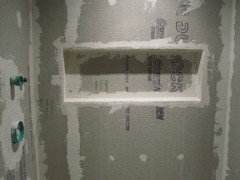
Here is the bottom where the coating is onto the shower pan. It hard to see, but the pan and walls are totally sealed in the Hydroban. Click it open to see the bottom of the walls at the shower pan, where I taped a plastic sheeting to protect the pan. Be sure to follow the recommendations for thickness with your Redgard. This is Laticrete Hydroban:

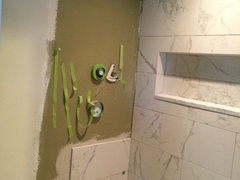
If you click the picture open you might be able to see the valves sealed with the Hydroban. This green tape is by 3M and is very strong used for taping concrete I believe. It was great to use to hold hanging tiles into place until the thinset cured. You will want this tape for your tiling job, I loved it:
- PRO
Cabot & Rowe
6 years agoAll grouts are not waterproof, including epoxy. Any water that can get in can get out
A Sully
4 years agoAs commonplace as it may be—-as seemingly logical as it may be—-it is still wrong in many cases to caulk between the tile and the tub. Caulking this connection is fine if the wall is some sort of one piece sheet or enclosure, but with tile it should not be there. The grout joints are designed to prevent water from penetrating the wall but any small amount that does penetrate is able to evaporate out and/or weep out along the bottom. If the tub/tile connection is caulked the water cannot wick out through the bottom grout joint and moisture builds up and is able to feed the mold that eventually develops. I am sure you have all seen that grey discolored staining of the caulk that you would swear is “behind” the caulk—-where it cannot be cleaned off? And you would be right—it is behind the caulk. The next thing that happens is that if there is enough water building up behind this area the water runs around the edge of the tub and down the walls behind the tiles “outside” the tub with the common resultant damage to walls and floors outside of the tub. You can always tell a professionally trained contractor when they GROUT at the tub line instead of caulk. Run away from the contractors that use caulking - they have not been properly trained to install tile in wet areas. Sorry caulk lovers - but you are just asking for trouble when you use that stuff.
- PRO
Cabot & Rowe
4 years agoThe above statement would be true if we were talking about standing water. Since the industry standard for thinset coverage behind wet area tiles is at least 95% there should be precious room left for standing water. The area behind the tiles is filled with thinset, which will wick the moisture in all directions (with some allowance for gravity) so it stands to reason a properly built wet area will not collect water behind the bottom row of tiles. Caulking all changes of plane remains the industry standard.
A Sully
4 years agoNope, the caulking interferes with the natural wicking abilities of the entire system. Caulking is not an industry standard, only poor quality workmanship uses caulking in tub and showers. I had my tub and shower tiled and grout used - no caulking and both are standing up perfectly, no mold no cracking. My previous homes I had were new build and new home builder's sub contractors love to use caulking because it's quick and easy and hides imperfections - I had nothing but problems with both of those homes. When I researched why, I found that they were using caulking in the wrong areas - it should never be used in tubs or showers. So claiming industry standards is a cop out in my opinion. Every proficient tile contractor I have spoken with said they would never recommend caulking. For one, when you have to re-caulk after less than a year due to mildew and seal failure it's a pain to remove, however grout is easily removed and re-grouted. Both require maintenance, it's just that caulking allows DIY tile jobs which help hide imperfections.
 PRO
PROMint tile Minneapolis
4 years agoCabot is correct . TCNA calls for 100% silicone joint at the tub to tile change of plane Welcome back to houzz C & R
 PRO
PROCreative Tile Eastern CT
4 years agolast modified: 4 years agoThe Pros (who have their Information listed for all to see) stand by industry standards which are in writing. A anonymous commenter with zero previous comments or trade credentials revives a thread from 2012 and voices a opinion based on personal bad experiences with 2 homes. Perhaps the tile installations were done poorly. C&R 's reply is spot on.
The most likely scenario that was experienced is the use of siliconized acrylic caulk which is garbage and yes it will mold in a short period of time. Yes it is made for the DIY'er due to easy clean up. The industry standards call for 100% silicone sealant. Unfortunately the majority of installers will use the cheap / easy way instead of the proper method.
To continue this discussion and condemn professional Tile Setters without any actual facts would just be A Silly:)
HU-152886717
2 years agoSo I used mapei type 1 over cement board with white marble subway tiles. Noo! And the GC grouted the bottom tub to tile and never sealed. The bottom row of tiles were completed soaked with in a week. So I had another company come in and strip the bottom row and use the right product behind that row. And used 100 percent silicone on the bottom tub to tile. Which according to mapei product specialist is what you are supposed to use. Then I sealed the whole thing with 511. So far after a month it seems pretty good with heavy use. White marble is tricky because when wet or moist it immediately changes color then it dries and goes back. Anyone have any other ideas or products that I could use on this for some extra protection. Really concerned about the longevity of this thing with that type 1 being behind my tiles in the shower and I know big mistake.
Nancy in Mich
2 years agoNothing will make your tile or grout waterproof. A pro who used to be here called marble “hard sponges.”








Gary1020