


Return to the Bathrooms Forum
| Post a Follow-Up
FAQ/Answers Bathroom Plumbing for dummies
| | |
Posted by sheilaaus122 (My Page) on Mon, Jun 23, 08 at 11:06
I hope this is not hijacking the previous thread of Showers- FAQ but I thought since Bill V had offered to answer a bunch, those were more likely to be tiling related. I thought maybe we should start a new one of plumbing related FAQ's and if we get lucky- answers will be posted here too.
I will start-
for a shower/tub configuration, what is needed besides the tub spout, the shower head, and the on/off thingy?
For a shower configuration(like the master bathroom with a separate tub) what is needed beside the shower head and on /off thingy?
And for both of the above, what optional fixtures do you like? (handheld, stuff like that). |
Follow-Up Postings:
RE: FAQ/Answers Bathroom Plumbing for dummies
| | |
| I am bumping this to keep it going. hopefully we will have a thread here of both questions and answers. In the meantime, let's post away. So far Bill Vincent~ most graciously~ has offered to answer the FAQs of tiling on the other thread. |
RE: FAQ/Answers Bathroom Plumbing for dummies
| | |
RE: FAQ/Answers Bathroom Plumbing for dummies
| | |
Here goes: I know that the on/off thingy comes in two versions, thermostatic (two handles) and pressure balancing (one handle), but which is more practical/easier to install/works better in the long run? Comments on big rain showerheads -- nicer or gimmicky/this year's fad? Ditto on spa shower setups with multiple sprays Ditto on steam showers For all of the above, what impact does installation have on one's water usage? This is very important in California and other areas affected by drought! Frameless glass doors, pros & cons Is there any practical impact (e.g., ease of use, maintenance, cleaning) to installing a wall mounted faucet or is this strictly an aesthetic/space saving preference? |
RE: FAQ/Answers Bathroom Plumbing for dummies
| | |
| I'm redoing my shower and would like info on frameless doors and suggestions/recommendations of faucets-especially inexpensive. I'm looking for roman tub with hand shower. |
RE: FAQ/Answers Bathroom Plumbing for dummies
| | |
| I'll copy in my message mistakenly entered in the tile FAQ thread: How many knobs/controls do you need with the different faucet/plumbing brands. For a very specific example (mine!), I've got a shower over tub. I want a thermostatic valve, and both a fixed showerhead and handheld shower. Under Grohe, this would mean one thermo valve trim plus three volume controls (one each for fixed showerhead, handheld, and tub spout). Under Hansgrohe, I can do it all with one control (though the control isn't as flexible as with the Grohe arrangement - for example, you can't just turn on the handheld, you'd have to cycle it thru the fixed showerhead). Are there other options? Practical impact of vessel vs. "normal" sinks would be interesting too. |
RE: FAQ/Answers Bathroom Plumbing for dummies
| | |
| I'm looking for a single handle shower faucet and a separate roman tub faucet with hand sprayer. |
RE: FAQ/Answers Bathroom Plumbing for dummies
| | |
Please- if anyone has any clues or answers, it would be neat-o to have both questions and answers here. Last night I posted on the plumbing forum asking for any knowledgeable person to take a look at this thread and offer some answers. Hopefully we get some. (I really do have good intenetions__) |
RE: FAQ/Answers Bathroom Plumbing for dummies
| | |
| Let me know if this is the sort of info you're looking for, if it's too basic, or not inclusive enough. It's a rough first draft and can be edited as required: The sort of where, what, and why of pressure-balanced versus thermostatic: Pressure-balanced or thermostatic temperature control valves are code-required in bathroom plumbing because they eliminate potential scalding and cold water shocks that can occur in a shower. If you are using the shower and a toilet is flushed, as the toilet uses cold water to refill the tank, the pressure in the cold water line drops a bit below what it was when just the shower was running. If you had a non-balancing valve, you’d still get the same amount of hot water that you originally were getting, but with the drop in pressure in the cold water line you’d have less cold water coming out of your shower head, creating a potential for scalding. Vice-versa, if someone turns on a hot-water faucet elsewhere in the house, the hot water pressure drops and you get a shower of mostly cold water. A pressure-balanced shower valve is designed to compensate for changes in water pressure. It has a mechanism inside that moves with a change in water pressure to immediately balance the pressure of the hot- and cold-water inputs. These valves keep water temperature within a couple degrees of the initial setting. They do it by reducing water flow through either the hot or cold supply as needed. Because pressure balanced valves control the temp by reducing the flow of water through the valve, if your plumbing supply is already struggling to keep up with the three shower heads and nine body sprays that you have running in your shower, if a pressure balancing valve kicks in and chokes down the water supply to keep you from getting scalded you could end up with insufficient water flow out of the heads in a multiple shower head setup. When it comes to volume control, in terms of being able to turn on the water a little or a lot, for the most part pressure-balanced valves are full-on when water is flowing or full-off when the valve is closed. Flow-wise, think of them as having no middle ground. Where flow and volume control are important, as in a shower that requires a high volume of water, a thermostatic valve may be the better choice. They also control the temperature, but they do not reduce the amount of water flowing through the valve in doing so. Thermostatic valves are also common with 3/4" inlets and outlets, so they can pass more water through the valve than a 1/2" pressure balancing valve. Which should you choose? In a larger multi-outlet master shower, while a 1/2" thermostatic valve may suffice, a 3/4" thermostatic valve might be the better choice. But it does depend on the design of your shower and the volume of water that can be passed through your houses supply lines. In a secondary bathroom, or in a basic master where you have only one head, or the common shower head/tub spout diverter valve, a 1/2" pressure balancing valve would be fine. If you want individual control and wanted multiple valves controlling multiple heads, then you could use multiple 1/2" valves instead of one 3/4" valve and all would be just fine. What do the controls on the valve actually control? While it may vary, a pressure balanced valve is normally an "all in one" valve with only one thing you can adjust…the temperature. The valve usually just has one rotating control (lever or knob) where you turn the water on, and by rotating it you set the water to a certain temperature. Each time you turn the valve on you’ll have to set it to the same spot to set it to your desired temperature. For the most part you really don’t control the volume, just the temperature. With the valve spun a little bit, you'll get 100% flow but it will be all cold water. With the valve spun all the way, you’ll get 100% flow, but it will be all hot water. Somewhere int eh middle you’ll find that Goldilocks "just right" temperature, and it’ll be at…you guessed it…100% flow. So with a pressure balancing valve, you control the temp, but when the valve is open, it’s open. A thermostatic valve can be all inclusive in terms of control (volume and temp) or just be temperature controlling. If it’s just temperature controlling, you will need a separate control for volume or flow. Example, with an all inclusive you’ll have two "controllers" (knobs or levers) on the valve, one to set the temperature and a separate one to set the volume. In this case you can set the temp as you like it, then use the volume control lever to have just a trickle of Goldilocks water come out of the valve, or you can open it up and have full flow of Goldilocks water coming out of the valve. You can leave the temp where you like it when you turn the volume off after you’re done showering. The next time you shower, turn the volume on, the temperature is already set. Some thermostatic valves are just temperature valves with no volume control. You’ll need another valve/control to set the volume. Read the product description carefully to see what you're getting. What size valve should I get? Yes, valves actually come in different sizes. The size refers to the size of the inlet/outlet nipples on the valve. For a basic shower, a 1/2" valve will suffice. For a larger multi-head arrangement, a 3/4" valve would be better. Realize that you’ll need a water heater that can supply the volume of heated water you want coming out of the heads, so don’t forget that when you build or remodel. Also realize that if you’re remodeling and have 1/2" copper running to your shower, capping 1/2" copper supply tubing with a 3/4" valve provide you with much benefit as the 1/2" tubing is the limiting factor. You can, however, cap 3/4" supply tubing with a 1/2" valve or a 3/4" valve. Is one better than another? Thermostatic valves are "better" in that with them you can control both volume of flow and temperature, so you have more control, and they hold the temperature to a closer standard (+/- 1 degree). They also perform better if you are running multiple outlets in the shower, as they do not choke down the amount of water in order to control the temperature. But you pay for that added flow and added control. Pressure balancing valves can be had for about $100-$200, thermostatic valves can be twice that amount. And more. Will I suffer with a pressure-balancing valve? For what it’s worth, when I built my house over 10 years ago I put pressure-balancing valves in my own house. While I have two outlets in my shower (sliding bar mounted hand-held on the wall and an overhead 12" rain shower head on the ceiling), I have a two separate pressure-balancing valves, one valve for each head. With both heads going in the shower, I notice no loss of flow in the shower when the toilet is flushed and the sink faucet is turned on simultaneously. I also notice no change in temperature. So they work for me. If you are remodeling, if you have your existing sink running and you flush the toilet and notice a drop in volume coming out of the sink, then a thermostatic valve might be the better choice even if you're not having a multi-head setup installed. If, as part of the remodel, you plan on running new supply lines through your house to the new bath, then properly sized runs will take care of that flow restriction and you can probably do a pressure balancing valve instead of a thermostatic. So in a house with tricky plumbing, or with a restricted water supply, or with multiple outlets running off of one supply valve, a thermostatic valve might be the safer choice. Mongo |
Part Deux
| | |
| Part Deux: Controls and Diverters This may be almost impossible to thoroughly attack because there are so many variations in what people want and in what different manufacturers offer. In general… You need a volume and temperature control. You can buy just the valve body, which is the chunk of expensive brass that gets buried in the wall, and buy a separate trim kit, or you can buy a package that includes the valve body and the trim kit. The trim kit is the bright sparkly metallic knob/lever/escutcheon bling that you overspend for so your friends and neighbors will go "oooooh" and "aaaaah". If you buy a pressure balanced valve, the valve in and of itself will turn on the water and allow you to control the temperature. If you buy a thermostatic valve, most valve bodies have two controllers on them, one to control volume and one to control temperature. Read the fine print though, because some thermostatic bodies just control temperature. You’ll need a separate valve body to provide volume control. Stops. Some valves come with "stops" some do not. What are stops? Stops stop water flow at the valve itself so the valve can be taken apart without having to turn the water off to that branch circuit or to the whole house. They are normally incorporated onto the hot and cold water inlets on the valve body, and they can be opened or closed with a screw driver. While I’m on this, I’ll also mention that some valves might mention having a "stop screw" to limit the maximum temperature. While a pressure balancing or a thermostatic valve will prevent you from being scalded if someone flushes a toilet, there is nothing to prevent someone from being scalded by setting the valve to allow 130 degree water to pass through it. Your first step is to lower the temperature on your water heater to about 120 degrees. For valves that have these stop screws, it’s then a simple matter of setting a screw that limits how far the temperature knob can be rotated. What you do is rotate the knob to set the water to the max temp that you’d ever want out of the shower, then you turn the set screw until it bottoms out. It will now prevent the temperature knob from turning past (hotter than) it’s existing position. Downstream of that volume/temp control is where things get dicey. You can have a simple setup where your V/T control just runs to a single shower head. Easy to do. You can have a standard tub setup with a shower head and a tub spigot, where the diverter can be a lever or push button that sends water either to the tub spigot below or to the shower head above. Also easy to do. If you want to supply water to more than one shower head, to a shower head and body sprays, or to both, either simultaneously or one at a time, then you’ll need more chunks of expensive brass to bury in your wall. If you want separate controls and the ability to have differing temperatures come out of differing fixtures, then it’s easiest to go with multiple V/T controllers. One V/T controller for the shower heads, for example, and a separate V/T controller for the body sprays. This allows you to run different volumes and different temperatures out of the different heads. Your shower head can be 105 degrees and your body sprays 110 degrees. Remember, the more hot water that you want to come out of your shower, the larger your supply tubing and valve bodies need to be, and the larger your water heater has to be. For sizing purposes, most shower heads and body sprays have a gallon per minute rating applied to them. In theory and planning only, if your hand held shower head is, for example, rated at 3gpm, your rain shower head rated at 4gpm, and each of your 8 body spray heads is rated at 1gpm, and you want to run them all at the same time…you’re looking at a flow of 15gpm. You need a water heater that can supply you with 15gpm of hot water, then you need supply tubing that can get 15gpm of hot water from your water heater to your bathroom, and you need valve/diverter bodies that can pass the required amount of water through them so you get decent flow out of each fixture. Typical plumbing is 1/2", typical valves are 1/2". For high volume situations, 3/4" tubing and 3/4" supply valves may be required. Out of the valves you can usually run 1/2" tubing to your shower heads and body spray heads. Back to the hardware. If you want a shower head and body sprays, and want to run either or both off of one valve, then you’ll want a diverter valve. Diverter valves can be anything and everything. They can be simple A/B valves, where you can run the water through the valve to only "A", your shower head, or only to "B", your body spray heads. But not both at the same time. Which leads to the A/B/AB valve, where you can send water only to "A", your shower head, or only to "B", your body spray heads, or to "AB", simultaneously to both. And from here things go wild. There are A/B/C/AB/AC/BC/ABC valves, and things just can go on and on from there. Diverter valves are usually described as having a certain number of "ports". 3-port, 4-port, 5-port, etc. Realize that one port is where the water goes in to the valve, the other ports are where the water comes out. So an A/B/C valve that has three outlets might be listed as a "4-port valve", with the fourth port being the inlet. Not all 4-port valves can do A/B/C/AB/AC/BC/ABC, you’ll need to look through the description to find out where it can send the water to. A 4-port valve might just be an A/B/C valve, or it might be a more versatile A/B/C/AB/AC/BC valve. Read its description. If you can’t get the customization you need from a single volume/temperature controller and a single diverter, you can run multiple diverters off of one V/T controller, or multiple diverters off of multiple V/T controllers. It all depends on how much brass you can afford, how much water you can supply, and if you have the space to hide all that brass in your walls. Diverters can be knobs, levers, push buttons, the choice is yours. But do remember that you need to match up the valve body to the desired trim kit so that the bling that your neighbors can see will fit on the expensive chunk of brass that they can’t see. You don’t want your plumber to bury that expensive chunk of brass in your wall, then tile, then find out later that your bling won’t fit. Very depressing. It’s all about reading the fine print. Mongo |
RE: FAQ/Answers Bathroom Plumbing for dummies
| | |
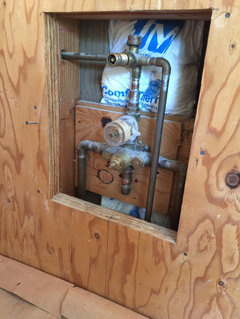
How to get the water out of your walls: A fixed shower head high on the wall, an adjustable hand held, an overhead rain shower head, or body sprays? Or all of them? Normally 1/2" copper tubing is run from the valve or diverter body to carry the water to the location of the outlet. If you're going to install something permanently, or if you're going to make a connection in a sealed wall, then it’s normally a soldered fitting. For things like showerhead arms, or body sprays, these are normally threaded connections. A threaded connection allows you to change out the shower head and arm for a different one if the old breaks, or for a new style if remodeling. When making up a threaded connection, you'll want to use something on the thread, either teflon tape, teflon pipe dope, or some other sort of thread sealer that will allow you to break the connection at a later date. A common way to connect your outlet to your spray head is to run your copper tubing to the location of the outlet, then solder a 90 degree drop ear fitting to the copper tubing.
You can see that the fitting has a smooth inlet for the 1/2" supply tubing to be soldered to, two holes in the "ears" to nail or screw the fitting to the framing, and a threaded outlet where the water will come out of. These fittings are manufactured in different configurations for different applications. That brass drop ear fitting will be buried in the wall or ceiling. If you are connecting a shower head, then the arm of the shower head gets screwed into the drop ear fitting and the shower head gets screwed on the other end of the arm. That works if it is a wall or ceiling mounted shower head. For a body spray, you’ll need a brass nipple like this:
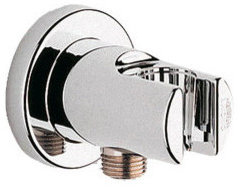
One end of the nipple screws into the drop ear fitting, the other end gets screwed into your body spray. Nipples come in various lengths to compensate for varying wall thicknesses. For a hand held shower, the outlet for the hand held is mounted just like a body spray head is mounted. I usually mount the outlet for a hand held down low near the bottom of the bar and offset to one side. That way when the head is hung on the bar, the hose hangs in a graceful "U", right up against the wall. Do a dry run with a piece of rope or string the same length as your hose, you don't want your hose laying on the shower floor.
Hand held shower are usually mounted in a vertical bar, the head can be slid up or down the bar to adjust the height of the head. If you don’t want a bar, then there are wall brackets that the hand held head can be set into. You can use multiple bracket, one high for tall people, one lower for shorter folk, even one low on the wall to hold the head for the leg shaving crowd.
Both the bar and the brackets are surface mounted in the wall, they are held on the wall with screws. You’ll normally drill a pilot hole, insert a plastic anchor into the pilot hole, then attach the bar or bracket by driving the screw into the plastic anchor. It’s easier to drill a pilot hole through grout than it is to drill through tile. Prior to inserting the anchor or driving the screw, I always squirt a glop of sealer into the hole, it helps prevent water intrusion. As to the hose for the hand held, some are plastic, some are metal. I prefer metal as they lay against the wall more consistently than plastic hoses. One end of the hose screws on to the outlet that you screwed into the wall. The other end snaps or screws onto the hand held shower head. Get a hose long enough so that it can reach all corners of your shower, and then some. It helps with rinsing and cleaning the shower, shaving legs, bathing young kids, or even the family dog. For wall mounted handhelds, you can get everything in one kit, or you can mix and match. Just make sure that everything is compatible so that you don't end up with a head that won't attach to a bracket. A good combination is a "standard" wall mounted shower head, OR a "standard" head as a hand held, combined with an overhead rainshower head. "Standard" heads give that nice spray that is strong enough to easily rinse your body or rinse shampoo out of your hair, they often have multiple spray patterns as well. Rainshower heads give a much gentler flow of water. They provide a different experience than a standard spray head. A rainshower head's flow might not be adequate to quickly rinse shampoo from hair. Some manufacturers have rainshower heads designed to mount on a standard arm that comes out of the wall. Those might not be a good idea, as the rainshower heads work best when they are mounted level, not on a tilt. If the head is mounted on an angle, instead of the shower of raindrops, you might something more like a garden hose effect coming out of one side of the head. Since the water "drops" out of the head instead of spraying our of the head, it's better to not have them too close to the wall. I think rainshower heads work best when plumbed to a central location on the ceiling. If you can only have one head in your shower, than a standard type head with adjustable spray patterns might be your best bet. When I was a kid, most of the hand held shower heads were of very poor quality. Hose fittings leaked or sprayed water everywhere, the multiple spray heads leaked or sprayed water all over. Today's handheld's are of much better construction. Construction note: If in a freezing climate, try to keep supply plumbing tubing out of your exterior walls. And if running plumbing for an overhead rainshower in the ceiling, if it's unheated attic space above then you'll want to insulate above the plumbing in the ceiling. Also, pitch the horizontal run of plumbing downwards a bit as the plumbing goes towards the rainshower head, so that when you turn the water off, the water in horizontal run of tubing will flow out the rainshower head instead of pooling and being captured in that horizontal run of tubing. Mongo |
RE: FAQ/Answers Bathroom Plumbing for dummies
| | |
| "Pressure-balanced or thermostatic temperature control valves are code-required in bathroom plumbing because they eliminate potential scalding and cold water shocks that can occur in a shower." Question: I'm redoing my 1941 bath. I need a new valve and trim kit for bath/shower. The plumber has given me a choice between the newer single handle setup or a special order on the one that works for the original setup with three handles. You say pressure-balanced is code. Could that be different here, or could the three-handle setup be pressure-balanced? I'm thinking not. I wouldn't think they'd offer an option that's not code. I lean toward the special order as I want a period look, but also want to do it right. Thanks, this is so helpful. |
RE: FAQ/Answers Bathroom Plumbing for dummies
| | |
| I'm fairly certain that if a plumbing code applies in your area, then unless you have a local exception, some sort of anti-scald device is required. I do think they are a good idea, especially in an older home. I know I've seen either a pressure-balanced or a thermostatic that can work with a 3-handle setup. Some of them you retrofit the valve in the wall and you can use your original old handles and stems. Lemme do a quick google... This was my first hit. Would this work with what you have? Mongo |
RE: FAQ/Answers Bathroom Plumbing for dummies
| | |
| Mongo, thank you! That is exactly the kind of info I'm (and I think we're all) needing! |
RE: FAQ/Answers Bathroom Plumbing for dummies
| | |
| This is amazing information Mongo, thank you so much! I was just on the internet looking trying to find out what a stop was. Thanks again! |
RE: FAQ/Answers Bathroom Plumbing for dummies
| | |
| Another thank you to Mongo - these are excellent explanations and very helpful. Thanks for taking the time to educate us! |
RE: FAQ/Answers Bathroom Plumbing for dummies
| | |
Yes yes thank you mongoct!And speaking selfishly for myself here, feel free to "dumb it down" even further! thank you kindly. |
RE: FAQ/Answers Bathroom Plumbing for dummies
| | |
| Thanks for the feedback kids! I just reread it in its entirety and it is a bit blotchy in some areas. If this ever goes to a true FAQ, I'll edit the text a bit and add a few photos/diagrams. Mongo |
RE: FAQ/Answers Bathroom Plumbing for dummies
| | |
I have just been reading all the great info. from Mongo. Thanks! I am looking for a list of all the necessary attachments I need in order to outsmart my plumbing supply store and order for much less online. But how do I know what to order? Why don't the product web sites give you a list? I have not found this elsewhere on GardenWeb. This is what I think: Lav. faucets - nothing extra required. Bathtub only: Roman faucet with hand held. Does this require 1 thermostatic rough and 1 volume control rough? Or two of each; one for the spout and 1 for the handheld? And some trim? Shower: shower head and hand held on a bar: same as for the tub? Or do I have to talk to someone? Thanks for any guidance. |
RE: FAQ/Answers Bathroom Plumbing for dummies
| | |
| Bless you, sporthill, for bumping this up. It's got so much good info that I need right now as I begin my way on the rocky road of bathroom renovation/expansion. Look for my post called "Faucets, etc. What do I need for an entire bath?" I got some veru helpful responses. I've already been through this with the kitchen. Oy, although I love the finished product. |
RE: FAQ/Answers Bathroom Plumbing for dummies
| | |
| bumping because it deserves it. |
RE: FAQ/Answers Bathroom Plumbing for dummies
| | |
RE: FAQ/Answers Bathroom Plumbing for dummies
| | |
| Hi bath people! I've spent all day looking for this answer on the Internet, to no avail. I've read this thread over, but am afraid that I may not have processes very well. My apologies if this answer is somewhere else. I've also asked this question on the plumbing forum, but no answer. Here goes: We're building a new house. Plumber installed Delta MultiChoice Universal Rough Model number R10000-UNBX shower valve. I want to buy Danze Opulence trim kit model number D502057BN. DH won't spend the money on the Danze until I can make sure that it will be compatible with the Delta shower valve. Any thoughts? TIA! |
RE: FAQ/Answers Bathroom Plumbing for dummies
| | |
| I've got a similar question - our kids' bathroom was remodeled about 5 years ago with a cheap American Standard tub/shower set. I'd like to replace it with a different finish/better looking face plate and spout, but I'd rather not call the plumber and tear out drywall to get to the diverter. How can I figure out which faucets are compatible with our diverter? Will it have to be an American Standard faucet? |
RE: FAQ/Answers Bathroom Plumbing for dummies
| | |
RE: FAQ/Answers Bathroom Plumbing for dummies
| | |
| just wanted to thank mongo for this & bump. mongo, i finally understand what it all means!!! thank you!!!! |
RE: FAQ/Answers Bathroom Plumbing for dummies
| | |
| Just another bump. Amazing info! Thank you so much. |
RE: FAQ/Answers Bathroom Plumbing for dummies
| | |
| I am bumping this again. I just had the plumbing finished in my bath remodel and am worried that I had him install the outlet for the handheld (Grohe Movario) too low. I wanted to make sure the hose would stretch to the back of the shower wall for rinsing it clean. But now I am picturing the bend in the hose and how it will hang and don't know what to think. Mongo says he installs low and off to the side of the bar, which is where mine is, altho the tile work and bar installation haven't happened yet. Does anyone have a pic of that type of installation that they would post? Thanks! |
RE: FAQ/Answers Bathroom Plumbing for dummies
| | |
| What great information! bumping for others.. |
Post a Follow-Up
Please Note: Only registered members are able to post messages to this forum. If you are a member, please log in. If you aren't yet a member, join now!
Return to the Bathrooms Forum
|
|
|