



Return to the Basements Forum | Post a Follow-Up

 o
XPS in walkout basement

Posted by Matt5416 (My Page) on
Mon, Nov 26, 12 at 16:03

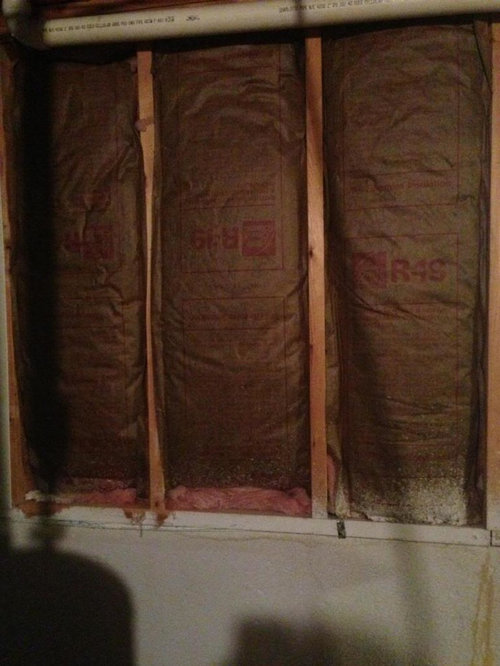
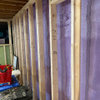
Hi, I am planning to finish my walkout basement. As you can see in the first photo below, the basement wall is 1/2 poured concrete with some type of sprayed on coating (I am the second owner so I am not sure what that is) and then upper half is a normal framed wall with bat insulation. The second photo is showing a close up of where the bottom of the framed wall meets the concrete. As you can see there is a bit of a lip there (it is not uniform around the house, in some areas it is set back 1/2" rather than overhanging). My original plan was to put up 2" XPS and then a 1x3 grid and then drywall. However I haven't seen a lot of examples of covering a framed wall with bat with XPS here, coupled with the fact that there would be gaps between the XPS and either the framed portion of the wall or the concrete due to the overhang in the second photo, I thought I would ask for some opinions on how best to insulate.

Thank you in advance for any replies.

Photobucket

Photobucket

Matt


Follow-Up Postings:

 o
RE: XPS in walkout basement

I'd pull out the existing batts and put XPS or EPS between the studs and add new fiberglass, or reuse the batts if they're not full of mould. Leave no space between insulating batas as convective air currents will degrade their R value. No vapour barrier. I'm assuming mixed or cold climate.

Here is a link that might be useful: Building Science Corp. on basement insulation systems


 o
RE: XPS in walkout basement

It is a cold climate (Michigan). So after putting XPS between the studs and putting the batts back (no mold), would you then put a floor to ceiling sheet of XPS up? I would think I still need something over the poured concrete.

Also, not sure why i have a third picture turned on its side. I guess I posted something incorrectly.


 o
RE: XPS in walkout basement

I would run the XPS from the floor to the top of the concrete wall, then fill the rest--bottom and top--with fg. I wouldn't sandwich the fg with XPS because the lower permeability of the XPS might impede the drying process.


 o
RE: XPS in walkout basement

Thank you for the reply. I drew up what I think you are saying to make sure I understand. Please take look and tell me if option 2 is what you are saying.

Thanks


 o
RE: XPS in walkout basement

Yes, option #2.

A couple of further suggestions:

* put strips of 1" XPS under the wood baseplate to create a thermal break with the concrete floor. This also protects the wood from moisture drive and raises it above any minor flooding that might occur.

* use caulk or single-component polyurethane foam at the existing baseplate.

Air sealing your home is at least as important as insulation in improving the building envelope.


 o
RE: XPS in walkout basement

Worthy, Thank you for your help! I have redrawn option 2 with your suggestions. I have also added a few other things that I was planning to do based on the other reading I have read on the site. Please take a look and tell me what you think. I have a few concerns about mounting the XPS to the existing poured concrete wall as it certainly isn't flat (see the textured coating in the pic) and isn't exactly straight. The other thing that I am bit worried about after reading some other pages is a fire break on the XPS. Do I need to do something at the top of the XPS sheet? I can't really visualize it because of the way my walls are (half and half). Usually I see the firebreak at the rim.


 o
RE: XPS in walkout basement

XPS definitely goes up easier on a smooth block wall than on an irregular poured wall. The concrete that comes through the form edges is the biggest headache. And the older the forms, the more irregularities you have to deal with. One-inch thick XPS conforms better to irregularities than the two-inch thick boards you're planning to use. (If you're in the Very Cold climate zone of the Upper Pennisula, I'd lean towards the thicker board.)

The most important thing is to keep the boards as tight to the wall as you can. Use an extra concrete screw where necessary and/or fill in any cavities with Great Gap etc. handheld single component foam. When you frame against the boards, use shims--cedar shakes work well--to keep the board tight to the wall.

Sometimes this can be a bit finicky and time consuming. That's why I have used spray ccspf on some jobs.

Yes, you have to provide a firebreak. That's necessary no matter insulation you use. Strips of 1/2"drywall are the cheapest material to use.

See the diagram below.


 o
RE: XPS in walkout basement

I think I will switch and go down to 1" XPS then. My walls are not perfect, with the corners being the worst (due to the forms). I may need to fill some of the corners with spray foam. I am just outside of Detroit so not near the next climate zone (I am in zone 5). I updated the diagram to reflect that and include the firebreak as I understand it (on top of the XPS vs on top of the wall). I don't really understand how it will help at that point but put it in there anyway.

I apologize for all of the back and forth. Your assistance has been very valuable. And hopefully the diagram will help others when it is finalized.


 o
RE: XPS in walkout basement

The firebreak should be at the top of the wall. The purpose is to separate the basement wall space from the ceiling space. In a typical stud wall the top plate would serve as the firebreak; an offset wall needs an extra piece to cover the gap.

BTW, the R value of the basement wall is optimally R-19-20, according to the International Energy Conservation Code.

I apologize for all of the back and forth.

No need! That's what these forums are for.

Speaking of which, what illustration software are you using?


 o
RE: XPS in walkout basement

Thanks Worthy, I misunderstood the purpose of the firebreak. I thought it was to contain the XPS, not the entire wall. I have attempted another version that shows where the current top plate is and where the floor joists connect.

I use the website http://www.diagrams.ly to create the drawings. When you create something there, you can save it to your pc (or google drive) as a .xml. You can export it to a .png (which is what I have been doing) or embed the diagram in a web page (that usualy works for me, but didn't on this site). It isn't nearly as robust as something like visio, however it has many stencils and is pretty good once you get used to it.


 o Post a Follow-Up

Please Note: Only registered members are able to post messages to this forum.

    If you are a member, please log in.

    If you aren't yet a member, join now!


Return to the Basements Forum

Instructions

  • You must be a registered member and logged in to post messages on our forums.
  • Posting is a two-step process. Once you have composed your message, you will be taken to the preview page. You will then have a chance to review the contents and make changes.
  • After posting your message, you may need to refresh the forum page in order to see it.
  • It is illegal to post copyrighted material without the owner's consent.
  • HTML codes are allowed in the message field only.
  • No advertising is allowed in any of the forums.
  • If you would like to practice posting or uploading photos, please visit our Test forum.
  • If you need assistance, please Contact Us and we will be happy to help.


Click here to learn more about in-text links on this page.