


|
![]() |
Follow-Up Postings:
|
| It's as word (duh!) probably ceremonial, with a lion's head on a bone hilt top, made in somewhere that I can't read, in Maine. Is it in a scabbard? Where did you get it? Does it have a "real" blade? that is sharpened? Or is it strictly for show. My top of the head guess is that it's part of some Lodge's ceremonial gear....but I am sure someone will know more. Linda C |
|
- Posted by faeryxdecay (My Page) on Sat, Mar 14, 09 at 19:14
| The only thing I know is that Mainz is in Germany My bf got it from his dad. Heres a picture of the blade: ![]() |
|
| Well....Yes! That's a sword!!!! Here's a link... http://www.tritonworks.com/reviews?content=reviews&review=busse_ak47 Since all I can find is that Busse is an American knife maker of some fame....but I can't find that they ever made swords....nor that the operated in Germany. I suggest that 'Maintz" is the name of the blade, not where it was made, and that it's a collector's sword. Perhaps if you find knife and sword collectors sites they will be able to tell you more. Linda C |
|
- Posted by moonshadow (My Page) on Sun, Mar 15, 09 at 12:41
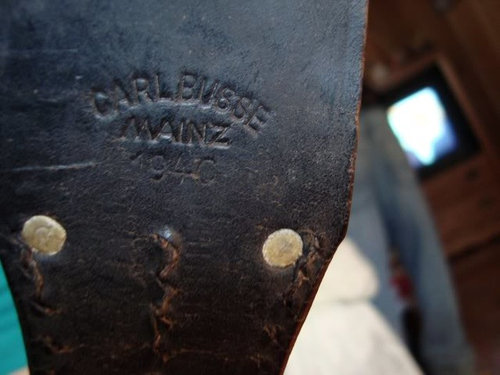
| Interesting. My dad served in Korea but was a huge WWII buff. So this made me curious. Follow me... ;-) This site has a long log posted by someone and indicates the mark "Carl Busse, Mainz" is found on WWII Nazi German Hi-Power (rifle) holsters. This collector claims ownership of a "German M38 (one piece) Gladiator helmet", same makers mark, states is bore a swastika but was rubbed off. This site sold a gun, German Luger BYF, 1942 with Holster, and states the following about the holster: "Included is a P08 marked holster showing a Waffenamt 927 mark coded JKH 42. JKH was the code for Carl Busse Fabrik Fur Heeresausrustungen Aus Stoff und Leder, Mainz, Kurfurstenstrasse. Waffenamt Inspection numbers 286,927 and 179 were assigned to Carl Busse. Originally a brown holster dyed black and now much scuffed. A WWII vet bring back piece. " A site selling a knife with same manufacturer stamp on the sheath as your piece carries. This one also has a swastika on it. A UK militaria shop, listing at bottom of page, "Pony Fur Backpack Good strong hairs to cover.Patina to hard ware.Traces of wartime grey paint remaining.Type with d-rings for attaching directly to the y-straps.Mice have been happily grazing to cloth interior.Maker marked and dated JKH 41-Carl Busse Mainz.Still good for display.In Good condition." $27.20 US Dollars. What wikipedia says about Mainz, Germany. "During World War II the citadel at Mainz hosted the Oflag XII-B prisoner of war camp...During World War II, more than 30 air raids destroyed about 80 percent of Mainz city centre, including most of the historic buildings. Mainz fell to XII Corps, 90th Division, of the Third Army under the command of General George S. Patton, Jr. on 22 March 1945...From 1945 to 1949, the city was part of the French zone of occupation. Probably most informative so far, this PDF article talks about how German WWII military artifacts, especially weapons, were inspected and the die stamps put on by inspectors. "Collectors and other observers of WWII German military artifacts, especially weapons, often see small die stamps on them with a stick figure representation of the German Reich eagle and a number. Commonly referred to as "Waffenamts", they were inspection stamps which identified the item as being inspected and passed, at some stage of its manufacturing Based on codes and abbreviations listed, here's what I came up with on items bearing the mark Carl Busse, Mainz: So, what that would indicate is the scabbard (sheath for swords or other large blades) shown in your photo was made at the Carl Busse Factory, Mainz, Rheinland-Pfalz, German, 1940. Since most items found so far are of a leather nature perhaps those type items were most frequently manufactured at the Busse factory? As far as the sword, sometimes what is doesn't look like helps rule out possibilities. Here's a diagram identifying sword parts and terminology. this site shows the lion head was used on German swords in WW1 & II, but the head is different than yours (and many eyes are rubies). Another site,auction of a WWII German Officer's dress sword, lion head, ruby eyes (again different than yours), asking price $1295.00 What I'm finding puzzling is the grip appears to be bone, where most WWII German military swords I've hit upon so far have metal handles. (Bone was/is commonly used in hunting knives, but that's a whoppin' long blade to have been used for hunting! Unless it was really large game.) Ooohh, wait a minute! I just found a much older German hunting dagger, circa 1860-1880, lion's head similar to yours, hooves on the cross guard, bone (stag) grip. Even has the clamshell guard. Another similar one! Called a "Forestry Dagger" here (3/4 of the way down the page). Grip is different, but many other similarities. "This is the lion-head hunting sidearm as used by forest masters in the service of the Kaisers and kings. The lion-head version was the type used by the Bavarian service. The length is 21 inches overall and the blade is 15 inches." That's as close as I got, now hitting dead ends. I'm going to take a stab (no pun intended) that it's a long hunting/forest type dagger, perhaps not specifically meant for warfare but possibly used in that regard? Does the leather scabbard fit perfectly, as if designed for the blade? If so, that would be a good indicator that the scabbard is the intended mate to the sword/dagger, so it's also German, circa WWII. If it's not quite a perfect fit, perhaps it was an older German hunting dagger that was paired with the WWII scabbard. Perhaps brought back home by a soldier, as was often done? |
|
- Posted by maryland_irisman (pat969@aol.com) on Sun, Mar 15, 09 at 14:17
| I'm more inclined to agree that it is a hunting daggar. The hilt of a battle sword would be constructed in a way to entrap the opponents blade and snap it in two with a twist of the wrist. The scabbard I see in the picture appears to be similar to that for a bayonet which is about the same size as that daggar giving more probability to what MOONSHADOW has suggested. |
|
| So the words Mainz and Carl Busse are on the scabbard not on the sword? That makes a huge difference!! Good sleuthing moonshadow! So what seems likely...it's German Pre 1945, made for "dress" and not necessarily for stabbing the enemy. Likely value....about $1000....or what someone will pay. Linda C |
|
| Moonshadow, thank you for taking the time to research the answer verses answering off the cuff with incorrect information. I enjoy reading this forum, but quite often I see the same quick (and often wrong) answers given out and find it quite frustrating as well as a disservice to those asking. So again, thank you for an interesting read :) |
|
| It's an impressive knife. A German friend of ours gave us a set of fine German cutlery for a wedding gift, and it had bone handles. Most of my better cooking cutlery is also German and they are and always have been noted for their blades/swords and cutlery. I would not assume that the blade is anything but German without some sort of specific indicator it isn't. I am just a little surprised if there is no mark on the blade, regardless of its age. Is there any type of inscription at all on the knife itself? |
|
- Posted by moonshadow (My Page) on Mon, Mar 16, 09 at 17:00
| You're welcome igloo ;-) Due to the length, appreciate anyone taking time to read my little web travels. It was an interesting undertaking, I enjoyed it. Now if I could just unearth that same kind of info on the half dozen or so mystery pieces in my possession I'd be a pretty happy camper! ;D calliope brings up something I noticed in my searching. Many blades mentioned did have markings, but many also were partially or nearly completely worn off (age?use?). But I'm hoping the OP sees this again and can inspect that blade very closely to see if there is evidence of some kind of marking on it. |
|
- Posted by faeryxdecay (My Page) on Tue, Mar 17, 09 at 4:31
| Thank you so much moonshadow, that helped alot I noticed something when I was looking at pictures of it. The eyes appear to be different:
I'm not sure if that means anything. I'm going to look at the blade tomorrow and see if there are any markings on it. |
|
- Posted by moonshadow (My Page) on Tue, Mar 17, 09 at 6:06
| You're welcome, faeryxdecay ;-) More intriguing. I zoomed in really close and is it just me or does it look like there are recesses where a stone once sat for each eye? (most pronounced in the second photo, face facing left) Rubies like some of the other swords linked to above? Fascinating detail in the carving all around! |
|
- Posted by faeryxdecay (My Page) on Tue, Mar 17, 09 at 6:14
| That's what I thought. When I saw your post and you mentioned how the other swords had rubies in their eyes I remembered seeing a spot in one of the eyes where it looked like there may have been a spot for a ruby or something like that. |
|
- Posted by moonshadow (My Page) on Tue, Mar 17, 09 at 7:59
| I keep skipping around photos, so I'm going to put them together here in one post, easier on my income tax-strained eyes! ;D The one from "much older German hunting dagger" link above is closest in appearance so far. Here's what the seller says about it: "German Hunting dagger with lions head pommel. Circa 1860-1880. 14" blade and 20" overall. Stag handle scabbard is very good with some surface age cracking but very solid. This one looks like it was actually used as most were for appearance. $995.00" If the above description is correct, and based on appearances of other WWII daggers & swords seen, I'm wondering if the one you have is not older than WWII era, or at very least not married to the scabbard it's in. Because a little detail that's been bugging me is the way yours sits in the scabbard compared to the one found so far closest in appearance. If you look at the old German Hunting dagger, the sheath only goes up to the clamshell guard. But yours, when in the scabbard, the lion's head rises above what appears to be a belt loop? Just a tad, but it's still above it. If it is indeed a hunting dagger, as the handle would lead one to think, picture someone wearing it out in the woods, attached to their belt. Thinking of all my hikes and hunts in the woods back home on the farm, climbing around rocky stream beds, up almost vertical terrain, wooded hills, maneuvering around thick brush and trees branches, it doesn't take much for something worn on the body to get caught on something or bumped and poke into the wearer. So the closer and snugger to the body the better. So if someone were carrying your dagger on a belt, hiking, mounting or dismounting a horse, would that not be slightly awkward, making the lion's head a bit...floppy? Just enough to be inefficient and annoying to the wearer? Almost (but not quite) poke into the wearer's body, especially when bent at the waist? Or that little bit of lion head sticking above could be just enough to catch a branch, or tangle in a thicket of briars. As is, would it force the wearer to stop every few yards due to a tangle? Or place a hand on the lion's head to hold it snug to the body when bending or walking in dense woods? Would it not be more functional/comfortable for the wearer to have the lion's head sit lower and therefore more snugly in the scabbard, versus protruding that little bit beyond the top of the leather scabbard loop? I could be going way too far into left field on that one, but it just makes me pause just a bit and wonder if your dagger and scabbard are actually not a married pair. Here are comparison photos: Yours: Older hunting dagger Yours has a collar at the base of the lion's head, where the other has nothing. I can't tell from your photos, looks like something is engraved on the band between the hooves, above the clamshell? Is it oak leaves and acorns like the comparable one? |
|
| I don't think anyone mentioned this yet, or maybe it is so obvious to everyone they didn't bother, but it just hit me that the crossguard to the hilt are deer legs, in a running position. You can see the hooves. That is just such a typical hunting motif. I had a deer leg gun rack, and have seen deer leg lamp bases. |
|
- Posted by moonshadow (My Page) on Tue, Mar 17, 09 at 9:44
| Yes, noticed the deer hooves calliope (more evidence it's probably hunting related). I'm getting engrossed in this thing ;p Wonder what the significance of the lion head is? A nod toward a ruler or royalty or something? Just found a tidbit about a long ago German ruler, Henry the Lion. Perhaps it's significance goes back to him? Or refers to a specific region's coat of arms? (per wikipedia, Germany in general had no lion, Munich did but upon Third Reich it was the Eagle. Bavaria had a lion. OK, daydreaming now! |
|
- Posted by faeryxdecay (My Page) on Tue, Mar 17, 09 at 12:10
| This seems to be different also:
|
|
- Posted by faeryxdecay (My Page) on Tue, Mar 17, 09 at 12:14
| Actually the acorn must be part of the scabbard. Here's what it actually looks like up close: |
|
- Posted by faeryxdecay (My Page) on Wed, Mar 18, 09 at 13:57
| I looked at the blade, there are no markings on it anywhere |
|
| It appears the blade is rusting (yes, even carbon steel rusts) and you should prolly wipe it down to prevent further oxidation or pitting. |
|
- Posted by HERSHFAUNGER(lauralhilltwo@hotmail.com) onWed, Apr 6, 11 at 15:01
| THIS FORESTRY DAGGER WAS USED PRIOR TO WW2 AND DURING WW2 THE GROUPING WAS HEADED BY HERMAN GORRING THERE WERE MANY DIFFERENT STYLES AND SIZES OF THESE MOSTLY PRIVATE PURCHASE BY THE MEMBERS OF THE FORESTRY.THE BEST WAY TO TELL WHAT YOU HAVE IS BY THE MAKERS NAME THAT SHOULD BE STAMPED ON THE BLADE THERE ARE MORE THAN 30 OR SO MAKERS FROM GERMANY THAT PROVIDED FORESTERS WITH STYLES TO BUY YOUR DAGGER APPEARS TO BE FROM THE EARLY 1900 PRIOR WW1 SALE VALUE IN YOUR CONDITION SHOULD BE AROUND $1000.TO $1350.IF YOU ARE INTERESTED IN SELLING PLEASE CONTACT ME |
|
- Posted by lazygardens (My Page) on Fri, Apr 8, 11 at 18:17
| It's a "hirschfanger" (hunting sword or dagger) http://www.lakesidetrader.com/Hunting and Forestry.html http://germandressdaggers.com/hunting association.htm These "daggers" were sometimes semi-ceremonial, and often fancy presentation pieces (gilt, engraved, ivory handled, etc.). You need to research the "German National Hunting Association" (Reichsforstdienst) It was established well before the Nazi party. Maybe there was a set of rules for what rank of forester got what materials: carriers of wood and antler swords ranking below ivory and sterling swords? The wood and antler would be more practical if it was meant to be used. Don't give the scabbard too much importance in dating the knife - they wear out or get damaged, and a good knife may have been in several sheaths. Closest match: |
Please Note: Only registered members are able to post messages to this forum. If you are a member, please log in. If you aren't yet a member, join now!
Return to the Antiques & Collectibles Forum
Instructions
- You must be a registered member and logged in to post messages on our forums.
- Posting is a two-step process. Once you have composed your message, you will be taken to the preview page. You will then have a chance to review the contents and make changes.
- After posting your message, you may need to refresh the forum page in order to see it.
- It is illegal to post copyrighted material without the owner's consent.
- HTML codes are allowed in the message field only.
- No advertising is allowed in any of the forums.
- If you would like to practice posting or uploading photos, please visit our Test forum.
- If you need assistance, please Contact Us and we will be happy to help.