

Cast iron question
petaloid
I have been using Crisco to season our vintage cast iron cookware, which seems to work well.
My hubby wants to re-season the pans with mineral oil instead, because he heard this is better.
Any advice would be appreciated.
Browse Gardening and Landscaping Stories on Houzz See all Stories
Kitchen Design
Kitchen Sinks: Enameled Cast Iron for Attractive Durability
By Rachel Grace
Strong, shiny and sustainable, an enameled cast iron sink can bring character to your kitchen
Full Story
Shop Houzz
Shop Houzz: The Cast Iron Kitchen
By Houzz
Celebrate cast iron with cooking accessories and home accents
See Products
Doors
5 Questions to Ask Before Installing a Barn Door
Find out whether that barn door you love is the right solution for your space
Full Story

Inspiration for some backyard chats

Inspiration for a warm welcome

Inspiration for dinner time under the stars
Inspiration for a little quality time
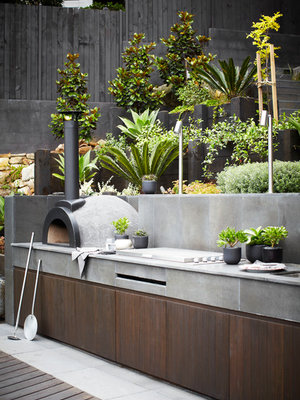
Inspiration for making that best pizza ever








Buckeye Basements, Inc. is a multi-award winning company that provides complete basement remodeling and finishing... Read More
I did this with a Dutch oven. Even though it was food grade mineral oil I used to season the cast iron, the meal I cooked in it tasted like a petroleum product. Vaseline-like.
I wonder where hubby got that idea. To form a durable, non-stick coating on cast iron a drying, or semi-drying oil must be used. Drying oils are ones which will polymerize when heated. Polymerization creates the varnish-like coating we don't like on other kinds of cookware. To the best of my knowledge mineral oil will not do that. Mineral oil will burn, rub off or evaporate but not polymerize. At least not well.
Various oils and fats can be used. Some are better than others. The link below goes into some detail about that and gives a method for creating a very good coating. Many people get a satisfactory coating with a less involved process. But, so far as choice of oil is concerned, I think you wood do well to be guided be this article.
Jim
Here is a link that might be useful: Chemistry of Cast Iron Seasoning
Nope....mineral oil is a non organic oil and doesn't harden like organic oils and fats do. Besides it's not recommended for use on cooking utensils.
Tell your hubby to do the research.
I would never use mineral oil.
Here is a link that might be useful: mineral oil carcinogen
Jimster:
I have been telling them this for a few years.
When I first Posted using oil, they said it would turn Rancid. ?????
I do the Pizza Pans with oil, also and bake them for a few hours.
Sometimes I forget the Cast Iron Skillet on the Range.
I will smell something burning and remember the Skillet,
which is now very clean on the bottom.
So I put some oil on the bottom and throw it in the oven for a couple of hours. (The Skillet Bottom)!!!!!
LOU
Don't think I'd consider mineral oil?!? For me... bacon grease! That's what my Grandmother used. Remember a small CI skillet (maybe 2 eggs max) growing up. It was sorta "washed"... scrubbed with salt and HOT water. Then we'd set it over pilot light in center of stove top till hot and dry. Then a dab of bacon grease smooshed around with a paper towel and it was ready for next time.
OH NO, mineral oil is a petroleum product!
You can use bacon grease or vegetable oil or crisco shortening etc.
Well, I'm off to get some organic flaxseed oil.
Maybe when I make my big trip to Trader Joes.
That was a very interesting article, Jim! Thanks !!
I've got my grandmother's decades old fry pan plus several other pieces of cast iron and I season them all with Crisco vegetable shortening - never anything else. I'm pretty sure my grandmother used lard or Crisco to season her pans. I've successfully removed the old finish and reseasoned old pans with Crisco. Now I'm cooking more and more with my cast iron pans instead of nonstick.
Teresa
Thanks, everyone, for your extremely helpful advice.
I have shared the information with hubby, and he was convinced not to use mineral oil.
We have big flaxseed oil capsules, so we may experiment with oil from those on one of the smaller pans.
I suspect hubby was thinking of another kitchen use of mineral oil. Food grade mineral oil is recommended for use on cutting boards and butcher blocks because it won't turn rancid as vegetable oils might. It's OK for that because it won't be heated.
I find it interesting that the iron itself participates in the chemistry of c.i. seasoning by enhancing the drying process. Artists oils pigmented with metallic oxides such as iron oxide dry faster than those containing other kinds of pigments. The "boiled linseed oil" you get at the paint store is usually not boiled these days. Instead, it contains metallic compounds to speed the drying.
Jim
Jim beat me to it, I was going to say that maybe your DH was thinking about use on cutting boards. In that case food grade mineral oil is the way to go.
Why go to all the trouble and expense of puncturing flax seed capsules? Crisco works fine, as does bacon grease or lard. It gets hard and that's what makes the surface so smooth. There is nothing to be gained by using a "healthy oil" to season a frying pan.
Linda C
Linda,
The reason for using flax seed oil is explained in depth in the linked article. Not all oils are created equal. The author was trying to understand the chemistry of c.i. seasoning and achieve the best possible coating. I think it's interesting and worth knowing about.
However, as I said before, it's not necessary to use the method described in the article to get a usable, if suboptimal, result. Most of us will continue to use any suitable oil or fat we have on hand.
Jim
Jim:
I use Veg. Oil instead of Crisco or Fat, because of the Higher Carbonizing temps.
It makes for a harder surface.
But nothing can take the heat of a Skillet left on a hot
electric burner.
I haven't read the article yet and not tried Flax Oil.
Would that help if I forget a pan on the burner !!! LOL!
Lou
It gets hard and that's what makes the surface so smooth.
um.....
Thanks for the reminder, we need to return Iron Man II.
That was a great article, Jim. Thank you for posting it.
"Would that help if I forget a pan on the burner !!! LOL!"
Nothing you do to the pan can help that. It's the mind which needs help. LOL
"That was a great article, Jim. Thank you for posting it."
I was fortunate to find a site which addressed the issues I wanted help with. It meshed nicely with some things I already knew (drying oils in paint technology) and provided answers to questions I had. Even if I don't change my methods, it gives me a better understanding of the process and helps me fine tune it.
Jim
Posted by jimster "----- It meshed nicely with some things I already knew (drying oils in paint technology) and provided answers to questions I had. Even if I don't change my methods, it gives me a better understanding of the process and helps me fine tune it.
Jim"
I always feel that you are a very seasoned member of this forum.
dcarch
Take a look at this page
Here is a link that might be useful: How to season a cast Iron Skillet
Jim, that article refers to some of my postings on the Chemistry of seasoning a cast iron or high carbon steel pan. The author of that article was in touch with me after she wrote her article and found out Paul Wheaton got his Chemistry of seasoning and maintenance procedures from me. See link below.
-----------------------------------------
It is IMPOSSIBLE to season a cast iron pan with Mineral Oil. Mineral oil is only used on a pan to prevent the pan from going rancid or rusting when stored for a LONG TIME period. Mineral Oil should never be used on a pan unless the intent is to protect it over a long time period. Food Grade Mineral oil IS NOT carcinogenic and is perfectly safe to use on any food item (ex. cast iron or cutting boards). You can purchase Food Grade or Pharmaceutical grade Mineral Oil at any drug store.
If you coat an iron pan with cooking oil......IT CAN DEFINITELY go rancid if you don't regularly use the pan. Some pans (stainless steel) can go rancid in weeks. Cast iron can go rancid in a month.....just depends on the condition of the pan and the actual chemical composition of the cooking oil used to coat the pan. Cooking oils and the different brands can vary significantly in chemical composition.
If you coat an iron pan with Crisco or hydrogenated Lard (the store bought kind), IT WILL NOT go rancid or get sticky for at least a year without using the pan.
Remember oil has two purposes....one for seasoning and one for storage between usage. For optimized care, you need to choose the right oil for the right purpose.
When "seasoning" cast iron, you want to use an oil that is high in UNSATURATED fat. Grapeseed oil is one of the best seasoning oils.
When "storing" cast iron for a long time (years), you want to use Mineral Oil because the molecules are completely saturated and has zero unsaturated molecules in it. Because mineral oil is composed of 100% saturated oil, it CANNOT undergo "low temperature" polymerization reactions. Those low temperature reactions are the kind of chemical reactions that causes a pan to get "sticky" or "go rancid".
When "storing" cast iron for several months, NEVER EVER use regular old cooking oil......IT WILL GET RANCID. How fast it gets rancid is dependant upon several variables.
When "storing" cast iron pans for several months, use Crisco or purchased Lard. It WILL NOT go rancid for at least a year.
When "storing" cast iron for many years....use Mineral Oil.
-----------------------------------------------------------
Bottom line........take this simple advise from someone who really knows his cast iron. Use Grape-seed oil (or lard, or Crisco) for seasoning and use a HIGH TEMPERATURE seasoning method as I've outline in the link below. After your pan is "cured"..... use Crisco or purchased Lard for in between usage. Should you decide to store one of your cast iron pans in the attic for an heirloom gift to one of your grandchildren.......then coat it with Mineral Oil for years of care free storage without rust, stickiness, or it ever going rancid.
Dan
Here is a link that might be useful: Dan on The Chemistry of Seasoning Cast Iron
Dan knows whereof he speaks. I've been seasoning all my cast iron for a long time with grapeseed oil--works very well. A small container of it lasts a long time if all you're using it for is seasoning cast iron.
Another oil good for 'in between' usage is coconut oil. It's a medium-chain (mostly saturated) fat which doesn't seem to go rancid very quickly.
Dan - It's obvious to me that you're a respected authority on cast iron seasoning as I can't tell you how many times I've been directed to the thread you linked over the past couple years. But unfortunately - perhaps due to ADD - I have yet to get through the 70-some posts spanning 1.5 years of dialogue and find your step by step approach to seasoning.
Is there any chance you could do the world a favor and start a NEW thread in the cookware forum to give us a tutorial? Preferably starting with an old, gunky pan that needs to be stripped? Keeping it in simple terms but linking to other threads for in depth knowledge would seem to me a helpful format.
I'd be most appreciative, and I'm sure others would be as well.
I still get lots of emails from others who have read that particular Cast Iron thread. Most have found it helpful and some find it confusing. That long thread referenced definitely needs clarifying given the questions that I still receive. When I get a chance, I will start a new tread on the Cookware forum which will give an exact step by step simple procedure for 1) seasoning both old and new cast iron and 2) how to clean & maintain it properly. I will leave out all of that confusing (to some people) chemistry related stuff.
Dan
Dan,
I'm glad you checked in on this. It's easy to find a set of rote instructions on seasoning c.i. but not so easy to find in-depth information like you provide. Personally, I am always uneasy about following instructions without knowing the underlying principles.
FOAS has a good point. A well edited, well organized presentation of your information on seasoning c.i. would be a valuable resource.
Jim
I have my grandmother's cast iron fry pan....the inside is like satin and for sure she never knew the word poly unsaturated. She smeared it with Crisco and put it in the oven for a while and did it again, fried up some bacon, rather like Joann's directions.
I'll venture to say that from the back of a galloping horse or the handle of a spatula, you would never know if a skillet had been seasoned with flax seed oil, grape seed oil, Crisco or lard.
Linda C
I certainly would know if Granny's pan was seasoned "properly" (i.e. using a high temperature method). Many of the Granny pans that I purchase are simply covered with crud that some would call seasoning....not me. There is a big difference between a hard and durable seasoning layer and plain old crud. There are ways to optimize and speed up the seasoning of cast iron that granny never had available to her. Many simply used to burn pans in outside fires and hope for the best.
That satin finish inside of granny's pan is due to the quality of the casting and the machine finish those old pans received during the manufacturing process. Modern day cast iron pans are inferior to those old pans in both overall quality of the casting and its overall cooking performance. Give me an old Wagner Sidney-O or a Griswold piece of cast iron any day over ANY modern day manufactured pan. There is a big difference in the overall cooking performance of those cast iron pans. Serious cooks like me know the difference.
Dan
Dan,
I'll bet you can answer a question that's been bugging me for a long time.
In discussions of seasoning c.i. pans I often see references to pores of the metal opening as it is heated and oil soaking into the pores. Does cast iron really have pores? Pores large enough to be of any importance? Or is this a myth?
Jim
Dan. I agree with you....but do you know what manufacturing process made the vintage pans so much smoother and even thinner than the rather rough, thicker, heavier modern counterparts?
Teresa
I didn't see much science in the linked article. I would be my guess that heating the iron allows oil to penetrate into the crystaline structure of the metal. Because of the way iron molecules arrange themselve other molecules can pass between them. For example to harden steel it is heated glowing hot which allows carbon to migrate to the surface. Quenching it at that point freezes the carbon at the surface resulting in a chunk of steel that is hard on the outside but still soft and flexible on the inside. Non-hardened steel has hardness that compares to cold butter! An ancient steel hardening process involves laying the steel in burning charcoal which allows it to absorb carbon from the charcoal. Cast iron starts with more carbon then steel... steel by definintion having only 2-3% carbon. Both are blends of iron and carbon. Stainless is alloyed with other metals which help it to resist the penetration of oxygen. We have a metalurgist at work that I may be able to corner sometime and get his opinion.
Bacteria can also hide inside iron. That is why you get a tetnus shot after stepping on a nail. Don't worry cooking with your iron cookware as cooking heats it hot enough to kill them off. Hospitals make surgical tools safe by heating them up hot enough to kill the germs.
The world is not as solid as you may think.
Just my non-science guess that heating it allows the oil to soak in. That would block out oxygen which causes rust... or its scientific name iron oxide.
Other science problems I had with the article was the issue of nitrates. Yes they are bad but they are used to preserve your hotdogs. Small amounts are not apt to hurt you. If nitrates concern you never ever cook with mesquite wood! At work I've taken people to the hospital for nitrate intoxication... it makes them dizzy. Our steel hardening process releases high levels of nitrates from the chemicals that have to be properly ventilated or people get sick.
A seasoned pan will hold the seasoning for a long time. It should not require being reseasoned with each use. The article author stripped the pan with an acid... which made me cringe. Must enjoy the fine taste of oven cleaner. I clean mine with nothing but warm running water and a scrub pad. A thin film of bacon grease that would be unacceptable on my dinner plates I ignore on the cast iron pans... it is the nature of that cooking pan. In the past we have had some debate about tomato sauces and iron pans as the tomato acid will take the seasoning out. While it unseasons the pan the release of some iron into the food provides that nutrient in your diet.
Directions cast right into the bottom of my frying pan call for coating it with cooking oil, baking it at 300 for an hour, then wiping any excess oil off. I've never seen it as a coating. I cook my pancakes on a dry iron frying pan... cleaning it with no more then a hard wipe with a paper towel.... no oil, nothing sticks, and it is clean ready for tomorrows pancake. Of which I'm going to have a couple right now.
: )
lyra
Lyra, I'm the only who always made tomato based sauces in cast iron, my old doc told me that's why I never had problems with my iron level. When my stomach started rebelling at the combination of tomato and onion, I quit doing that so much and sure enough, started having problems keeping my iron level up. At any rate, whenever I made chili in my cast iron dutch oven, I'd clean it well and then use it for a couple of batches of french fries and that kept it nicely seasoned!
My old cast iron skillets, like Lyra's, are slick as silk, nearly as slick as teflon, even eggs don't stick. And if someone puts oven cleaner on them, they can figure on an early death, LOL.
I've always used crisco/lard to season my cast iron pans but I don't think I've ever let one sit unused for a couple of months, let alone a year.
Annie
Cast iron cookware discussions can get very heated. :-)
With the exception of non-stick-ness and some possible health benefits to some people, for me the merits of cast iron are somewhat limited.
Just MHO:
Cast iron non-stick is good, but not as good as a few other kinds.
Cast iron is not a very good heat conductor. No energy savings.
Cast iron “retains” heat because it is so heavy and a poor heat conductor. A ceramic pot retains heat much better.
Cast iron gives you even heat because it is so thick. It takes forever to get hot. A good aluminum cookware will give you very even heat much faster, and it is much lighter.
Cast iron Dutch oven does not cook better than other metals. If you are stewing, once you put a cover on and the food starts to boil, the inside environment is no different, 100 degrees C, Dutch oven or stainless steel or Corning ware. Do you remember Physics 101? You can boil water in a paper container?
I don’t understand enamel coated cast iron cookware. It’s very expensive, difficult to use, difficult to clean, way too heavy, gets damaged easily.
I do not understand why the problems with seasoning cast iron. If you cook with cast iron regularly, it is impossible to keep it from being seasoned.
If you do not have a hot enough fire, a very heavy cast iron pan can help searing meat, but not a lot of meat, and it will take awhile.
Cast iron was popular not because it was better; it was because it was a low-technology item to manufacture. It is expensive today not because it is better, it is because it is difficult to mass-produce.
But, as the Platters song goes, “To Each His Own”.
If you use cast iron cookware on a glass cook top, it may be a good idea to use fine grit Carborundum sandpaper, or a fine grit diamond sharpening block to smooth out the bottom. Cast iron has lots of carbide crystals which are almost as hard as diamond, and can scratch tempered or heat treated glass easily.
dcarch
dcarch, cast iron's massiveness and slow response to heat can be used to our advantage; brown some meat, add some stock or other liquid, cover and place in a slow oven for long, slow cooking--there will be little fluctuation in temperature. Cast iron is a tool which has a couple of good applications, but as you note it falls flat in several others. You wouldn't use it to make a temperature sensitive sauce, but then again to use a fancy copper saucepan to braise a pot roast would be overkill.
The link has a great article about the advantages and disadvantages of most cookware materials; it contains more info about such topics than any sane person needs. But who ever said that denizens of this forum were sane?
Here is a link that might be useful: stovetop cookware
Cast iron retains hear and heats evenly. It doesn't get hot spots.
Enamel coated cast iron, while visually pleasing, also works very well for braising, when you don';t want the seasoning to cook off your cast iron. It works lots better than aluminum and lots and lots better than stainless steel....even clad steel.
I have cooked in it all and if I had to choose one "thing" to cook in for months on end it would be a porcelain coated cast iron Dutch oven.
Linda C
Re enameled cast iron - I won't pretend to have had enough experience with it to discuss its virtues with cooking, but my extremely limited experience has me whole-heartedly agreeing with dcarch about its fragility. Two Le Creusets, one Staub, one Mario Batali - all chipped, nicked or scratched although not a one of them has been used more than a dozen times or handled roughly. Honestly the only times I use them is when I want them for presentation. Otherwise I'm a bit scared.
I am not a fan of enameled cast iron either although I have plenty. Because of the list mentioned by dcarch, I also save mine for presentation , which in my case is when I have company, or feel like the extra effort involved to use it for me.
Otherwise, I much prefer stainless steel on an everyday basis which can go in the dishwasher and never chips or stains- and seems to cook the same. And doesn't need tender lovin' care.
I keep the pieces I have wrapped in dishcloths so they don't chip. None are chipped but I really, really, don't want them to chip either.
Petal:
There is a lot of info on " Seasoning Cast Iron " if you try the Search Box, Below the Posts.
Lou
Everyone is entitled to their own opinion about Le Creuset, YMMV, etc. But I think there are a lot of posters here that use their LC very frequently and buy more of it when they find a sale. My one pot (3.5 French oven, black exterior, and beige enamel interior) has held up very well these past 15-20 years. No chips anywhere, no rust, but the inside is well used and shows it. I know it is clean, if stained somewhat so I will continue to use it and enjoy the use.
Teresa
You're absolutely right, Teresa. We don't have to read through too many threads to see that different people have different tolerences for different stuff. Some think that ceramic cooktops are sensitive and scratch easily; I disagree. Some people think non-serrated steak knives take too much effort to maintain; I disagree. Some people think enameled cast iron is fragile; I happen to agree.
I think cooking style has something to do with liking enameled cast iron too.
I don't cook braised foods much and don't make a lot of soups or stews.
My style tends to be fast seared something (tuna, chicken, salmon, steak) with stir fries most days and enameled cast iron isn't the best for that.
But, I do think some enameled cast iron is beautiful cookware!
The big advantage of a cast iron pan, to me, is that after searing the whumpus out of meat, the pan cleans up very quickly.
Stick it under running water, brush off the biggest crud, dry on the burner, and wipe with a squirt of oil. With stainless, I'd be scrubbing off blackened oil. The cast iron pan is already black!
I use any oil handy, as long as it s not 20w-50.
The other big advantage is that cast iron pans are cheap. Mine was $5 at a flea market. You can get them for $5 at garage sales etc all day long, or brand new for $25. I have yet to find an All-Clad stainless pan for $5.
I was talking about enameled cast iron, not regular, and most of that is on par pricewise with stainless. I put most of my stainless in the dishwasher.
Like Bumblebeez, I don't do a lot of stews or braising any more, I mostly cook for myself. I do have one enameled brasier, it's a big 5 quart, so it gets used seldom but it's pretty. I also have one small Le Crueset skillet that Elery got on eBay, also pretty but seldom used, even he agrees that it's an awkward size. That's why I tend to go to a store, pick things up and handle them before I buy, my hands are small and I'm short so knives and pans and even mugs/cups and glasses are sometimes too big for me to handle deftly.
I love my cast iron, and do a lot of quick searing and stir frying in it, as well as things like eggs. It's served me well and the clean up is easy and the stuff was certainly cheap enough. My favorite Griswold was a couple of bucks at a yard sale. The downside is that it's heavy, but the Griswold has a "helper handle", which certainly is...well...helpful. (grin) I don't like pans that don't have regular handles, like those "every day pans". I can't figure out how to pick them up and dump things out of them without spilling it down myself or burning my arms.
Other people, however, love them. So, as FOAS noted, we all like different things and have different cooking styles. What works for others often as not does not work for me and vice versa.
For instance, Elery bought me a bunch of copper pans, stainless interiors. Very expensive, even on eBay, and pretty, French stuff. They hang on my wall and I never use them because they were so expensive and I don't want to have to polish them and I'm afraid I'll do something destructive to them, somehow.
They're pretty, though...
Annie
A person would have to be nuts to think I'm sane. I doubt sanity is all it is cracked up to be... whatever sanity is anyways.
I've seen aluminum associated with old-timers disease. If I'm going to further damage my memory it will be with beer or a fine scotch whiskey. At work I invented my own disease called "male memory disorder". It causes men to think their wives or gf know where they left their car keys. Very closely associated with testostrone poisoning which causes old bald fat men to drive sports cars and wear speedos.
Coated aluminum may be safer but that brings up the issues of chemicals in the non-stick coating. Copper almost certainly has to be coated as copper oxide (green gunk) is a potent poison. There is reason you don't see lots of pretty copper cookware.
One of my regular warhorse frying pans is glass. Very difficult to clean... green scotch pad and lots of elbow grease. I do like that I can hold it up to the window and see if I've got all the dirt off... a window right behind my kitchen sink. I used to have a dishwasher but ain't seen her in years... I think she moved out.
Before anyone feels overly insulted I did claim insanity at the start of this post... the insanity defense!
: )
lyra
Lyra, LOLOLOL ! You are insane!! (But I don't remember why I think you are insane).
. The more aluminum and non-stick coating people use, the longer people seem to live. After trillions of cookwares have been in use, life span has increased by at least 20 years.
. glass is technically not a solid. It is actually a liquid. It desolves in water (very slowly) and it drips after a long time. Old galss panes are thicker in the bottom.
dcarch
Lyra, is male memory disorder or testosterone poisoning related in any way to hearing? Elery tells me he doesn't have a hearing problem, he has a listening problem. I think I might have one too, but I don't really remember why I think that...
For the record, I love you insane. Hey, maybe it's just "Michigan Madness", although I thought that was more prevalent in February.
Annie
Bunnyman,
If you want to read a bit about the chemistry involved in seasoning a pan you will find that information buried somewhere in the post that I referenced above. It is a rather long post with lots of useful information. I am a retired chemist and know what I am talking about. I am an excellent cook and know how to apply science to my cooking. One day I intend to publish a cookbook and it will contain a chapter on the care and seasoning of cast iron.
My love of cast iron began many years ago when I purchased a large cast iron Gypsy pot for cooking Jambalaya outdoors. This first pot was a 12 gallon size. Now I own many other cast iron pots ranging in size from 1 gallon up to 25 gallons. That’s not counting all of my skillets, Dutch ovens, griddles, etc. And yes I do own and use lots of high carbon steel, stainless steel, glass, aluminum, and cast aluminum cookware. The only pot I can find that will hold the huge quantities of rice and meat that goes into cooking a batch of jambalaya is one that is made of cast iron. FYI, that 25 gallon pot will hold 40 pounds of rice along with 40 pounds of onions and 100 pounds of chicken, pork, and sausage. This will provide enough jambalaya for 320 servings.
Yes, glass most certainly is a liquid which is contrary to what many people believe. To clean your warhorse glass frying pan use a product called DAWN POWER DISSOLVER and your scrubbing days will be over.
You are correct in stating that copper oxide is poisonous. However, aluminum is completely harmless and not at all related to any old timer’s disease. If aluminum caused any health risk whatsoever, we would not be worldwide drinking trillions of beers and sodas from aluminum cans.
Theresa,
Cast iron pans manufactured prior to 1890 used a completely different casting process than what is used today. These old pans will have what is called a “gate mark” on the underside of the vessel……the gate mark will look like a line. These gate marks were formed as the molten metal was "poured" into the pan mold. These old pans are much tougher and the surface is naturally a lot smoother than pans you see today. After 1890, they began a using a process known as "injection" (i.e. no longer pouring) sand casting to manufacture iron pans. The smoothest of the pan was a function of the quality (fineness) of the sand used in the manufacturing process. Companies like Griswold and Wagner Sidney-O had very good quality control both in the composition of their pig iron and in their casting process. This allowed them to make their pans THINNER and lighter while still retaining its overall strength. These old companies then used labor intensive machines to polish the interior of the pans. Most of today’s’ cast iron pans are inferior in quality to these old pans. The Le Creuset pans are an exception. The quality of their castings is outstanding.
Jim,
If you look at cast iron under high magnification, you will see that it does contain some tiny pores. Those pores will indeed absorb oil. Those tiny pores become perfectly sealed when you season your pan properly (i.e. the HIGH TEMPERATURE procedure). Low temperature seasoning methods do not give the same excellent results of high temperature seasoning……you will get much different results at different seasoning temperatures. This is because the extent of polymerization (seasoning) if a function of temperature.
What many cast iron users simply do not understand…. that if ANY trace of water is left in a poorly seasoned pan, that water will initiate rust. When iron combines with oxygen to from that rust…….its volume expands tremendously. Ever notice how rust lifts the paint off of metal??? Rust will likewise literally lift the seasoning off of the pan. Since this occurs on a "micro" scale, you will know this is occurring on your pan when you observe some of the seasoning actually lifting and falling off. To prevent this from happening......ALWAYS dry your pan using burner heat after cleaning a cast iron pan……..towel drying is not dry enough!! This is especially true with rough surfaced cast iron pans like Lodge.
The surface of most cast modern day cast iron products, such as Lodge, is rather rough and will hold/trap water easily. A smooth surface is much superior to a rough surface when searing meat. Those pores will collect meat juices that will steam the meat and will keep the temperature at 212 degrees F until that steam has dissipated. Smooth surfaces do not allow any water to collect between the meat and the pan surface; therefore, the temperature that the meat sees is always way above 212. Different cooking temperatures allow different chemical reactions to occur. Most cooks are familiar with what happens when you put too much meat in the pan and try to sear it. The silky smooth surfaces of those old cast iron pans do not allow meat juices to accumulate under the meat that is being seared…….the result is the buildup of a much better fond. Better fond equals superior flavor in ANY dish.....especially in a Cajun brown jambalaya. Good cooks know that fond can separate a good tasting dish from an truly outstanding dish.
Dan
Dan,
Thanks. Definitive infromation regarding cast iron.
Off-topic.
Interestingly, pure water is very good insulator and molten glass is a very good electrical conductor.
My question is, what if you leave a pot by accident on an induction cooktop and the heat melts (1500 C) the glass? since induction can generator eddy electrical current in a conductor, what could happen? Assuming the safety cut-off switch is not working.
dcarch
Pure water has no chemical ions it it......so it cannot pass an electric current. Put a dab of table salt in it (adds sodium and chloride ions) and it will become conductive. Room temperature (ultra slow moving) liquid glass (a solid to most people's way of thinking) has lost of potential ions within it.....however, those ions cannot MOVE so glass cannot pass an electrical current. It actually takes the movement of ions for a non-metal like water or glass to carry an electrical current.
When glass attains the molten (flowing) state, ions can move through it and hence can carry an electrical current. Pure glass cannot be heated by induction currents since it is not magnetic. Only magnetic pots and pans can be heated by induction currents. So leaving a glass pot on an induction burner will not cause a melt down to occur should someone accidently turn on that induction burner. It is perfectly safe to put a glass item on an induction burner.
Dan
I have a set of cast iron I received after my mother died. The one fry pan has what I can only describe as gunk on the outside and bottom of the pan. I'm not sure if I should clean it off or not. I noticed in the article on how to season the pan the author coated the outside of the pan with the exception of the bottom.
Any help is appreciated.
If the ''gunk'' bothers you, remove it - fast way would be a wire brush wheel in a drill, but you could also manually scrape/soak/scrub.
I wonder if you left the pan in the oven during a self-clean cycle, if the gunk would be burned off? Obviously you'd have to re-season.
I have been using food grade mineral oil for 50 years. My grand mother used it on all her castiron we would do this out side using an out side burner.after cleaning we would get it to around 500 degrees and use a small mop to oil it. We would hear it rub on the mineral oil. And it SMOKES UP. After the smoking stopped we would reseason it again. If it fooled town too much we would reheat it again. Oil it and after it stopped smoking we did it a third time. What we liked about it is the carbonization will NOT rub off on you, sevondltpy it was a very tough seasoning and thirdly if you don't use it for months it will NOT get that rancid smell , no matter how long it sets up! But it has to be 450 yo 500 degrees and has firm a dry carbonized finish. If you don't get it hot it can leave a slight Vaseline like taste. But properly done it won't runabout if on you or your cloths!
"I have a set of cast iron I received after my mother died. The one fry pan has what I can only describe as gunk on the outside and bottom of the pan. I'm not sure if I should clean it off or not. I noticed in the article on how to season the pan the author coated the outside of the pan with the exception of the bottom.
Any help is appreciated."
The self-cleaning cycle works very well. I picked up an old cast iron (smooth surfaced) frying pan at a tag sale. It was encrusted with mystery materials from being in the cellar storage. I think it had its last meal still in it.
Self cleaning brought it back to store bought quality and I season it with crisco only.